Garfield Heights, Ohio — Dog Bite Law
Garfield Heights maintains one of the most comprehensive dog control ordinances in Cuyahoga County. Its Chapter 506 — separate from the general animal code — establishes a detailed three-tier classification system for nuisance, dangerous, and vicious dogs with requirements that exceed most neighboring municipalities: neon yellow visual identification even for nuisance-level dogs, $100,000 liability insurance for both dangerous and vicious classifications, mandatory professional obedience training, and a local strict liability provision under Section 506.98 that reinforces Ohio's state strict liability statute.
If you have been bitten by a dog in Garfield Heights, Ohio law under R.C. § 955.28 entitles you to compensation from the dog's owner, keeper, or harborer regardless of whether the animal has ever bitten anyone before. Garfield Heights' layered ordinance framework creates multiple independent negligence per se claims on top of that strict liability foundation.
Garfield Heights at a Glance
No fee unless we recover — call (216) 363-6040
Garfield Heights at a Glance
Garfield Heights Animal Control & Local Ordinances
Garfield Heights regulates animals under two separate chapters of its Codified Ordinances: Chapter 505 (Animals and Fowl) covers basic leash and at-large requirements, while Chapter 506 (Nuisance, Dangerous and Vicious Animals) establishes one of the most detailed behavioral classification systems in the county — comparable in scope to Lakewood's dual-chapter framework and Euclid's comprehensive dangerous dog ordinance.
Chapter 505 — At-Large and Basic Leash Requirements
Chapter 505 establishes the baseline obligation that no owner, keeper, or harborer shall permit a dog to run at large within the city. This at-large prohibition applies to all dogs regardless of classification and provides the simplest negligence per se pathway in any bite case — if the dog was not securely leashed or under reasonable control at the time of a bite, the owner has violated Chapter 505.
Chapter 506 — Three-Tier Classification System
Chapter 506 is the core of Garfield Heights' dog control framework. It establishes three behavioral classifications — nuisance, dangerous, and vicious — each carrying escalating requirements. Unlike cities with breed-specific legislation such as Fairview Park, Brooklyn, or Parma, Garfield Heights uses a purely behavior-based system. Classification is determined by the Police Chief after investigation under Section 506.02, with objection hearings available under Section 506.06.
Section 506.03 — Nuisance Dog Requirements
Even at the lowest tier — nuisance — Garfield Heights imposes obligations that many cities reserve for dangerous or vicious dogs. A nuisance dog must be kept on a non-retractable leash or tether no longer than six feet, controlled by a person of sufficient size and strength. The owner must identify the dog with a neon yellow leash, collar, harness, vest, or other garment — without patterns or adornments except designs to increase nighttime visibility — that is visible and identifiable to an ordinary person from at least 15 feet away. The owner must post an 8-by-10-inch sign reading "NUISANCE DOG" in lettering at least two inches high, visible from all areas of customary public access, including a visual symbol for children or people who cannot read. This neon yellow requirement at the nuisance level is unique — in Lakewood, neon yellow is only required for dangerous and vicious dogs.
Section 506.03 — Dangerous and Vicious Dog Requirements
Section 506.03 imposes extensive requirements on owners of dangerous and vicious dogs, creating a cascade of independent negligence per se grounds when any single requirement is unmet:
On-Premises Confinement: The dog must be confined in one of three configurations: a locked pen with a secured top; a locked fenced yard in the rear yard with self-closing and self-latching gates at least six feet tall, with the dog restrained by a leash or tether no longer than ten feet controlled by a person at least 18 years of age and of sufficient size and strength; or any other locked enclosure with a secured top including a house — but if confined outdoors, the dog must be under direct supervision of a person who is at least 18 and of sufficient size and strength to control the dog.
Off-Premises Control: The dog must be restrained by a non-retractable leash or tether no longer than six feet, controlled by a person at least 18 years of age and of sufficient size and strength, and muzzled. The explicit non-retractable requirement means any retractable leash — even one locked at six feet — violates the ordinance.
Neon Yellow Visual Identification: The dog must wear a neon yellow leash, collar, harness, vest, or other garment visible from 15 feet away. The garment must be without patterns or other adornments except designs intended to increase nighttime visibility. This requirement applies in common areas of multiple-unit properties as well as public spaces.
Signage: The owner must post 8-by-10-inch signs reading "DANGEROUS DOG" or "VICIOUS DOG" in lettering at least two inches high, visible from all areas of customary public access. The sign must include a visual symbol for children or people who cannot read. In residential areas, signs must be set back at least five feet from the front property line. All signs must be purchased from the City — standardizing their appearance and ensuring the City has a record of who is purchasing them.
Color Photo to Police: Within ten calendar days of classification, the owner must provide the Division of Police with an identifying color photograph of the dog.
Professional Notification: The owner must notify veterinarians, veterinary staff, groomers, and other members of the public who come into direct contact with the designated dog of its classification prior to such contact. This requirement extends the warning obligation beyond neighbors and passersby to anyone who might handle the animal.
Mandatory Obedience Training: The owner must successfully complete a dog obedience or behavior modification course that includes a minimum of six hours of in-person professional training within 90 calendar days of classification. This is more prescriptive than most cities, which either do not require training or leave it to the court's discretion.
$100,000 Liability Insurance: Owners of both dangerous and vicious dogs must maintain a policy of liability insurance providing not less than $100,000 per occurrence for damage, bodily injury, or death of a person or animal caused by the dog. The insurance must be obtained within 14 calendar days of classification, and the owner must provide a copy to the Police Chief on a yearly basis and upon request to any law enforcement officer, county dog warden, or public health official. This $100,000 threshold for dangerous dogs — not just vicious — is higher than most cities in the service area, which typically require insurance only for vicious dogs.
Section 506.04 — Declassification
Section 506.04 provides a pathway for declassification after a period of compliance. The specific requirements for declassification reinforce the seriousness of the initial classification and the ongoing nature of the owner's obligations.
Section 506.05 — Cross-Jurisdictional Classification
Section 506.05 addresses dogs that have been classified by another jurisdiction. This portability provision means a dog classified as dangerous or vicious in another city and then brought into Garfield Heights carries its classification with it — the owner cannot escape the requirements of Chapter 506 by relocating.
Section 509.07 — Ownership Restrictions
Section 509.07 imposes restrictions on who may own dangerous and vicious dogs, potentially barring certain individuals from ownership based on prior convictions or violations.
Section 506.98 — Local Strict Liability
Section 506.98 establishes a local strict liability provision. This is significant because it provides an independent municipal strict liability basis alongside R.C. § 955.28. While the practical effect may be largely duplicative of the state statute, the existence of a local strict liability provision reinforces the city's intent that dog owners bear responsibility for injuries caused by their animals and may provide an additional cause of action under certain circumstances.
Penalty Escalation
Garfield Heights' penalty structure features aggressive escalation tied to bite outcomes. A nuisance dog violation that results in an aggressive bite becomes a misdemeanor of the first degree — a jump from M4 to M1 in a single incident. Dangerous and vicious dog violations escalate from M3 first offense to M1 if the dog bites, and to M1 with possible court-ordered euthanasia if the dog kills or causes serious injury to a human. The mandatory obedience training requirement after a violation adds another layer — the court must order the offender to complete training and provide written proof to the Police Chief.
Ohio Strict Liability — R.C. § 955.28
Ohio's strict liability statute — R.C. § 955.28 — is the foundation of every dog bite claim in Garfield Heights. The owner, keeper, or harborer of a dog is liable for any injury the dog causes, regardless of prior incidents or knowledge of dangerous tendencies. For a full explanation of the statute, defenses, and damages, see our complete guide to Ohio dog bite law.
Garfield Heights' Chapter 506 framework creates unusually strong interactions with state law because the ordinance imposes substantial requirements at every classification tier — including the lowest.
Neon Yellow at Nuisance Level — Concealment Begins Early
The most distinctive feature of Garfield Heights' ordinance is the neon yellow identification requirement for nuisance dogs — the lowest tier. In Lakewood, neon yellow is reserved for dangerous and vicious dogs. In Garfield Heights, even a dog that has merely chased or menaced someone without causing injury must be visually identified. This means the absence of neon yellow identification on a classified nuisance dog is an ordinance violation from the moment of classification. If that nuisance dog subsequently bites someone, the owner's failure to display the neon yellow garment is negligence per se — and supports the argument that the owner concealed the dog's classification from the public, which may be relevant to punitive damages.
$100,000 Insurance for Dangerous Dogs — Not Just Vicious
Most cities in the service area require liability insurance only for vicious dogs or set the threshold at $50,000. Garfield Heights requires $100,000 in coverage for both dangerous and vicious dogs — matching the highest threshold in the area (Cleveland Heights, Euclid) and applying it one tier lower than most cities. This creates two practical advantages for bite victims: first, there is a $100,000 insurance policy available as a recovery source in cases involving dangerous (not just vicious) dogs; second, the 14-day compliance window means many owners who are classified never obtain the insurance, providing an immediate negligence per se claim.
Mandatory Professional Training — Evidence of Behavioral Awareness
The mandatory six-hour in-person obedience training within 90 days of classification is both a control measure and an evidentiary tool. If the owner completed the training, the trainer's records document that the owner received professional instruction on managing a classified dog — and any subsequent failure to follow that training is evidence of knowing disregard. If the owner failed to complete the training, that failure is itself a violation supporting negligence per se and demonstrating unwillingness to manage the dog's known behavioral issues.
Professional Notification Requirement — Expanded Circle of Awareness
The requirement to notify veterinarians, groomers, and others who come into direct contact with the dog extends the owner's duty of disclosure beyond the immediate neighborhood. If a groomer or veterinary technician is bitten by a classified dog whose owner failed to provide the required notification, the professional notification violation is a standalone negligence per se claim. This provision also generates records — veterinary files and grooming intake forms may document whether the owner complied with or ignored the notification obligation.
Harborer Liability in a High-Rental City
Garfield Heights has a substantial rental housing stock. Under R.C. § 955.28, a "harborer" is anyone with possession and control of the premises where the dog lives who acquiesces to its presence. When a tenant's dog has been classified under Chapter 506, the landlord receives constructive notice of the classification through multiple channels: the signage requirement means a "DANGEROUS DOG" or "VICIOUS DOG" sign — with a visual symbol readable by children — must be posted on the premises. A landlord who sees this sign (or should see it during routine property management) and takes no action may face harborer liability. The City-purchased sign requirement makes it harder for owners to claim they were unaware of the classification, and the sign's visibility from public access areas means neighbors and visitors are likely to notice and potentially report non-compliance.
Cross-Jurisdictional Portability
Section 506.05's portability provision has practical importance given Garfield Heights' borders. The city is surrounded by Maple Heights (shares the same court), Cleveland (to the north), and Independence. A dog classified as dangerous in any of these jurisdictions retains its classification when it enters Garfield Heights — and becomes subject to Chapter 506's full requirements, including the neon yellow identification, $100,000 insurance, and obedience training. An owner who relocates a classified dog to Garfield Heights without complying with Chapter 506 is immediately in violation of multiple provisions.
“The owner, keeper, or harborer of a dog is liable in damages for any injury, death, or loss to person or property that is caused by the dog, unless the person was trespassing or committing a criminal offense on the property of the owner, keeper, or harborer, or was teasing, tormenting, or abusing the dog.”— Ohio Revised Code § 955.28(B)
Venue & Court Information
Garfield Heights Municipal Court
Dog bite cases arising in Garfield Heights are heard at the Garfield Heights Municipal Court, located at 5555 Turney Road, Garfield Heights, OH 44125. Judge Deborah J. Nicastro and Judge Sergio DiGeronimo share the bench. Clerk of Court Alexander F. Grgat administers case filing and records.
The Garfield Heights Municipal Court has one of the broader geographic jurisdictions among Cuyahoga County municipal courts, serving nine communities: Garfield Heights, Independence, Maple Heights, Brecksville, Cuyahoga Heights, Newburgh Heights, Valley View, Walton Hills, and portions of the Cleveland Metroparks. This multi-community jurisdiction — with a combined population exceeding 80,000 — means the court regularly handles cases arising under different municipal ordinance frameworks from a single bench.
The court hears civil claims up to $15,000 and operates a small claims division for claims up to $6,000. Most court business is conducted virtually through Zoom, with the Clerk's office operating online around the clock for document filing and case management.
For dog bite cases involving serious injuries — emergency surgery, hospitalization, permanent scarring, significant lost wages, or ongoing rehabilitation — damages will typically exceed the $15,000 municipal court limit. These cases should be filed in the Cuyahoga County Court of Common Pleas at 1 Lakeside Avenue, Cleveland, OH 44113, which has no jurisdictional cap. An attorney can evaluate the likely value of your claim and file in the appropriate court.
Statute of Limitations
Strict liability claims under R.C. § 955.28 must be filed within six years. Negligence claims must be filed within two years. If the victim was a minor at the time of the bite, the statute of limitations does not begin to run until the child turns 18. For complete details on filing deadlines and recoverable damages, see our Ohio dog bite law guide.
Local Risk Factors in Garfield Heights
Population and Urban Density
Garfield Heights is a city of approximately 29,800 residents (2020 census) in 7.23 square miles, yielding a population density of about 4,000 people per square mile. Located approximately seven miles southeast of downtown Cleveland, Garfield Heights is an inner-ring suburb with a fully urban character — grid-pattern streets, sidewalks, and residential lots that place homes close together and close to the public right-of-way. This density creates constant proximity between dogs and pedestrians, delivery workers, mail carriers, and children walking to and from school.
Rental Housing and Multi-Unit Properties
Garfield Heights has a significant rental housing component, with approximately 43% of occupied housing units renter-occupied. Multi-unit apartment buildings and duplexes are common throughout the city, particularly along major corridors. Chapter 506 specifically addresses common areas of multiple-unit properties — the neon yellow identification and off-premises control requirements apply within these shared spaces, not just on public sidewalks. Dog bites in apartment hallways, shared laundry rooms, parking lots, and common outdoor areas all fall within the ordinance's scope. The high rental population also increases the frequency of harborer liability scenarios: landlords who know or should know about a tenant's classified dog face liability under R.C. § 955.28.
Garfield Park Reservation and Metroparks
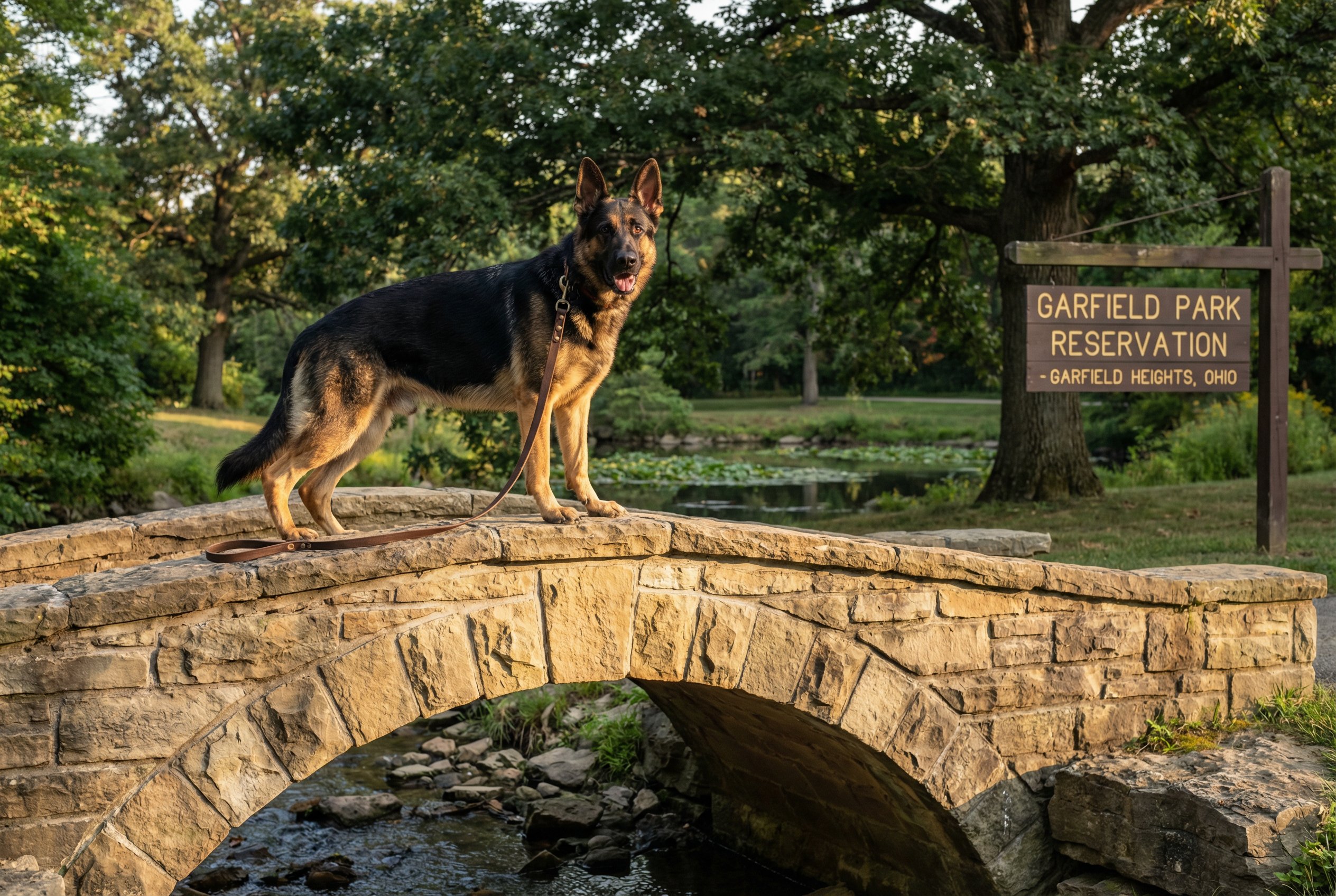
Garfield Park Reservation — part of the Cleveland Metroparks system — occupies a significant area in the city's northeast corner at the border with Cleveland. Walking trails, picnic areas, and open green space attract dog walkers from Garfield Heights and surrounding communities. The Metroparks fall within the Garfield Heights Municipal Court's jurisdiction, meaning dog bite incidents on Metroparks property in this area are subject to both Metroparks regulations and Chapter 506 requirements for any classified dogs. The overlap between a natural park setting and dense urban residential neighborhoods creates areas where leashed dogs encounter joggers, cyclists, and families at close quarters on narrow trails.
Socioeconomic Factors and Compliance
Garfield Heights' median household income is approximately $54,000, with a poverty rate near 22%. The $100,000 liability insurance requirement and mandatory six-hour professional obedience training represent meaningful financial burdens for classified dog owners. While these requirements exist to protect public safety, the practical reality is that compliance rates among lower-income owners may be lower — meaning dog bite victims are more likely to encounter owners who lack the required insurance and have not completed training. The absence of insurance does not eliminate recovery options — homeowner's and renter's insurance policies often cover dog bite liability — but it does mean the specific $100,000 municipal policy may not exist as a dedicated recovery source, making it more important to identify all potential coverage including landlord policies.
Penalty Escalation as Deterrent and Evidence
Garfield Heights' aggressive penalty escalation — where any classified dog violation jumps to a misdemeanor of the first degree if the dog bites — creates a meaningful deterrent. But for bite victims, the penalty structure also provides evidence: if the owner has been charged with or convicted of an M1 violation following a bite, that criminal proceeding establishes the factual predicate for civil claims. Criminal conviction records, police investigation reports, and Chapter 506 classification documents generated through the enforcement process become evidence in the civil case.
Reporting a Dog Bite in Garfield Heights
Dog bite victims in Garfield Heights should call the Garfield Heights Police Department at 216-475-1234 (non-emergency) or the Animal Warden directly. The Police Chief is responsible for investigating and classifying dogs under Section 506.02 — request that the responding officer document the dog's current classification status, whether the owner displays the required neon yellow identification and signage, whether the dog was muzzled and on a non-retractable leash if off the owner's property, and whether the owner can produce proof of $100,000 liability insurance. Victims should also report the bite to the Cuyahoga County Board of Health at 216-201-2001 for quarantine follow-up. Preserve copies of all incident reports, classification records, and photographs of the scene.
Frequently Asked Questions — Garfield Heights
Related Articles & News
Avery's Law in Garfield Heights Ohio: New Dog Bite Rules for 2026
Ohio's new Avery's Law took effect March 18, 2026, bringing felony charges and mandatory insurance for dangerous dog owners. Here is what Garfield Heights residents need to know.
Read article →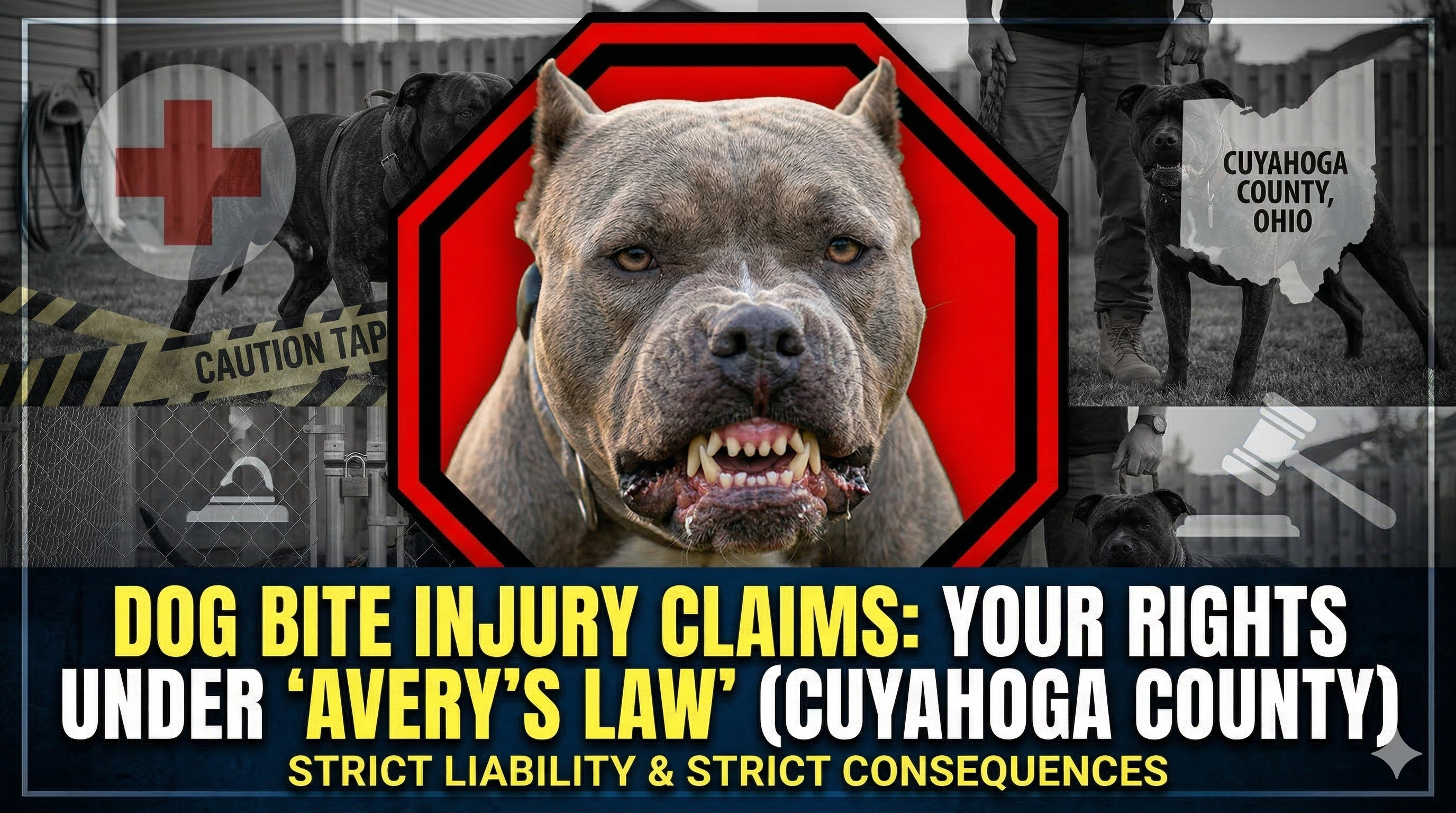
Avery's Law Is Now in Effect: What Ohio's New Dog Attack Law Means for Cuyahoga County Victims
Ohio's most significant overhaul of dangerous dog law in decades takes effect March 18, 2026. Here is what Avery's Law changes, what it does not change, and what it means if you or someone you love is attacked by a dog in Cuyahoga County.
Read article →About This Resource
This site provides educational analysis of Ohio dog bite law under R.C. § 955.28 for residents of Garfield Heights and Cuyahoga County. It is not a law firm and does not provide legal advice.
For legal representation, this resource is operated in association with Ryan Injury Attorneys, a personal injury law firm licensed in Ohio.