Cleveland Heights, Ohio — Dog Bite Law
Cleveland Heights classifies pit bull terriers as vicious dogs by default and imposes some of the most demanding vicious dog requirements in Cuyahoga County — including mandatory $100,000 liability insurance, registration with photo identification, conspicuous property signage, and a three-foot chain with 300 pounds of tensile strength when off premises. If you have been bitten by a dog in Cleveland Heights, Ohio's strict liability law under R.C. § 955.28 entitles you to compensation from the dog's owner, keeper, or harborer regardless of whether the animal has ever shown aggression before.
Cleveland Heights' ordinances also provide powerful additional grounds for recovery. A violation of the city's vicious dog registration, insurance, confinement, leash, or signage requirements supports a negligence per se claim — opening the door to punitive damages that are not available under strict liability alone. The city explicitly contemplates strict criminal liability for violations of these provisions.
Cleveland Heights at a Glance
No fee unless we recover — call (216) 363-6040
Cleveland Heights at a Glance
Cleveland Heights Animal Control & Local Ordinances
Cleveland Heights regulates animals under Chapter 505 (Animals and Fowl) of its Codified Ordinances. The primary dog bite provision is Section 505.092 (Dangerous and Vicious Dogs), which establishes both behavioral and breed-specific classifications with extensive registration and control requirements.
Three-Part Vicious Dog Definition
Cleveland Heights defines a "vicious dog" under three independent criteria — any one of which is sufficient. First, a dog with a propensity, tendency, or disposition to attack, cause injury, or endanger the safety of people or domestic animals. Second, any dog that without provocation attacks a person or domestic animal with severity sufficient that a reasonable person would conclude the dog presents a substantial risk, or has killed another domestic animal. Third, a dog that belongs to a breed commonly known as a pit bull — including any dog that is part pit bull. Ownership, keeping, or harboring of such a dog is prima facie evidence of owning a vicious dog.
Vicious Dog Registration and Insurance
Section 505.092 requires owners of vicious dogs to register the animal with the Cleveland Heights Animal Warden within ten days of bringing the dog into the city, and annually by January 31 with a $20 permit fee. The registration requirements go significantly beyond what most municipalities demand. The owner must show proof of $100,000 liability insurance covering claims for injury to persons, domestic animals, or property resulting from the dog's acts — and must maintain that insurance continuously. The owner must provide a photo of the animal. The owner must also post a conspicuous sign on the property, visible to anyone approaching from the street, stating that a vicious dog is present.
For bite victims, these layered requirements create multiple independent bases for negligence per se. If the dog was unregistered, uninsured, or the property lacked the required signage at the time of the bite, each missing requirement is a separate ordinance violation that establishes breach of duty without the victim needing to prove what a "reasonable person" would have done.
Confinement and Control Requirements
The confinement standards for vicious dogs in Cleveland Heights are among the strictest in Cuyahoga County. On the owner's premises, the dog must be securely confined indoors or in an enclosed, locked pen or dog run with secure sides and a secure top. The ordinance goes further than most by specifying that a dangerous or vicious dog may not be kept near open windows or screen doors if those are the only barrier preventing escape, and may not be kept on a patio, porch, or any part of a structure that would allow the dog to exit on its own — even if chained or leashed.
Off premises, the dog must be muzzled and on a chain no more than three feet long with at least 300 pounds of tensile strength. This three-foot chain requirement is notably shorter than the six-foot leash allowed in most other Cuyahoga County cities with BSL — including Brooklyn, Brook Park, and Broadview Heights. The shorter chain provides less room for a dog to lunge at passersby, but its violation is also easier to establish: any leash longer than three feet is automatically non-compliant.
Additional Restrictions
Cleveland Heights limits vicious dog ownership to one per dwelling unit and requires the owner to either own the premises or have written permission from the property owner. Testimony that a vicious dog was unconfined on the premises or beyond the premises without being muzzled and chained constitutes prima facie evidence of a violation. Violations are a second-degree misdemeanor on first offense — up to 90 days in jail and $750 in fines — and a first-degree misdemeanor on subsequent offenses, with up to six months in jail and $1,000 in fines. The court can order the dog destroyed if it attacks a person or domestic animal and presents a continuing threat.
Animals Running at Large
Section 505.07 requires all animals to be kept under control and not permitted to run at large. Dogs must be on a leash at all times when off the owner's property. Additionally, Section 505.06 prohibits animals in public parks, and Section 505.05 prohibits animals (except guide dogs) in stores and malls. A dog bite occurring in any of these restricted locations creates additional negligence per se arguments because the dog should not have been present at all.
Comparison with Neighboring Cities
Cleveland Heights' vicious dog framework is among the most comprehensive in Cuyahoga County. While Parma bans pit bulls outright and Brooklyn classifies them as vicious with standard confinement rules, Cleveland Heights layers its vicious classification with the $100,000 insurance mandate, three-foot chain with 300-pound tensile strength, property signage, photo registration, dwelling-unit limits, and landlord permission requirements. No other city in the county imposes all of these simultaneously. Cities like Cleveland, which borders Cleveland Heights to the west, have no breed-specific restrictions at all — creating the same cross-jurisdiction dynamic seen with Brooklyn.
Ohio Strict Liability — R.C. § 955.28
Ohio's strict liability statute — R.C. § 955.28 — is the foundation of every dog bite claim in Cleveland Heights. The owner, keeper, or harborer of a dog is liable for any injury the dog causes, regardless of whether the dog has ever bitten anyone before or shown aggressive tendencies. For a full explanation of the statute, defenses, and damages, see our complete guide to Ohio dog bite law.
Cleveland Heights' layered vicious dog ordinance creates especially powerful interactions with state law for bite victims.
The $100,000 Insurance Requirement as a Litigation Advantage
Cleveland Heights' mandatory $100,000 liability insurance requirement for vicious dog owners is significant for two independent reasons. First, if the owner maintained the required insurance, there is a guaranteed minimum source of recovery for the victim — a $100,000 policy specifically covering claims arising from the dog's acts. Second, if the owner failed to obtain or maintain the insurance, that failure is itself an ordinance violation that supports a negligence per se claim and an argument for punitive damages. In practice, many pit bull owners in Cleveland Heights do not carry the required insurance because standard homeowner's policies frequently exclude pit bulls. This insurance gap strengthens the negligence per se argument while potentially complicating the collection of damages — making early investigation of insurance status critical.
Multiple Simultaneous Ordinance Violations
Cleveland Heights' ordinance creates so many independent compliance requirements that a pit bull bite case almost inevitably involves multiple simultaneous violations. Consider a typical scenario: an unregistered, uninsured pit bull escapes from a yard without the required "vicious dog" signage and bites a pedestrian. That single incident involves violations of the registration requirement, the insurance requirement, the signage requirement, the confinement requirement, and the leash law — five separate ordinance violations, each independently supporting a negligence per se claim. This multiplicity of violations significantly strengthens the argument that the owner's conduct was reckless or willful, supporting a claim for punitive damages.
Harborer Liability in a Walkable Inner-Ring Suburb
Cleveland Heights has one of the highest renter populations in Cuyahoga County, with significant multi-family housing stock along its major corridors. The "harborer" definition under R.C. § 955.28 reaches landlords and property managers who have control of the premises and acquiesce to a dog's presence. Cleveland Heights' ordinance adds a unique dimension: a vicious dog may not be kept on any premises without the written permission of the property owner. If a landlord gave that written permission, the landlord has documented knowledge and consent — making a harborer liability claim straightforward. If the landlord did not give written permission, the tenant has violated the ordinance, and the landlord's failure to enforce their own lease provisions or the city's ordinance may itself constitute acquiescence.
The Three-Foot Chain Standard
The three-foot chain with 300-pound tensile strength requirement is the shortest and most specific leash standard in any Cuyahoga County municipality. For bite victims, this precision is a litigation advantage. In cities with a standard six-foot leash law, there can be ambiguity about whether a retractable or fabric leash satisfies the requirement. In Cleveland Heights, the ordinance specifies a chain — not a leash, not a tether — with a measurable tensile strength. Any deviation from these specifications is a clear-cut violation. If the dog was on a standard nylon leash, a retractable lead, or a chain longer than three feet, the owner violated the ordinance regardless of how "reasonable" the leash appeared.
“The owner, keeper, or harborer of a dog is liable in damages for any injury, death, or loss to person or property that is caused by the dog, unless the person was trespassing or committing a criminal offense on the property of the owner, keeper, or harborer, or was teasing, tormenting, or abusing the dog.”— Ohio Revised Code § 955.28(B)
Venue & Court Information
Cleveland Heights Municipal Court
Dog bite cases in Cleveland Heights are heard at Cleveland Heights Municipal Court, located at 40 Severance Circle, Cleveland Heights, OH 44118. Unlike most smaller suburbs, Cleveland Heights has its own dedicated municipal court with jurisdiction solely within the city's corporate limits. The court handles civil claims up to $15,000 and small claims up to $6,000.
Having a dedicated municipal court means the judges regularly encounter Cleveland Heights' specific ordinance framework — including the pit bull classification, insurance requirements, and three-foot chain standard. Attorneys who practice in this court develop familiarity with how these judges interpret the city's vicious dog provisions, which can influence case strategy.
Cases exceeding $15,000 in claimed damages — which includes most serious dog bite cases involving emergency surgery, hospitalization, permanent scarring, or significant lost wages — are filed in the Cuyahoga County Court of Common Pleas at 1 Lakeside Avenue, Cleveland, OH 44113. Given the severity of injuries that vicious dog attacks typically cause, many Cleveland Heights dog bite cases will exceed the municipal court threshold.
Statute of Limitations
Strict liability claims under R.C. § 955.28 must be filed within six years. Negligence claims must be filed within two years. If the victim was a minor at the time of the bite, the statute of limitations does not begin to run until the child turns 18. For complete details on filing deadlines and recoverable damages, see our Ohio dog bite law guide.
Local Risk Factors in Cleveland Heights
High-Density Walkable Neighborhoods
Cleveland Heights is one of the most walkable inner-ring suburbs in Cuyahoga County, with dense residential neighborhoods, active commercial districts, and extensive pedestrian infrastructure. The Coventry Village, Cedar-Fairmount, and Cedar-Lee neighborhoods feature ground-level retail with apartments above, sidewalk dining, and high foot traffic throughout the day and evening. Dog-pedestrian encounters are frequent in these areas. Bites near commercial establishments raise additional questions about whether business owners or commercial property managers qualify as harborers if they permitted dogs on their premises.
Large Rental Housing Stock
Cleveland Heights has a significant proportion of rental housing — both in large apartment complexes and in the multi-family conversions common in the city's older housing stock. The "harborer" definition under R.C. § 955.28 makes this relevant because landlords who know about and acquiesce to a tenant's dog can face liability. Cleveland Heights' ordinance strengthens this dynamic by requiring written property owner permission for vicious dogs. A landlord who provided that written consent has documented their knowledge and acquiescence. A landlord who didn't provide consent may have failed to enforce the ordinance on their own property. Either way, the landlord's position is more legally exposed than in cities without this permission requirement.
Parks, Schools, and Public Spaces
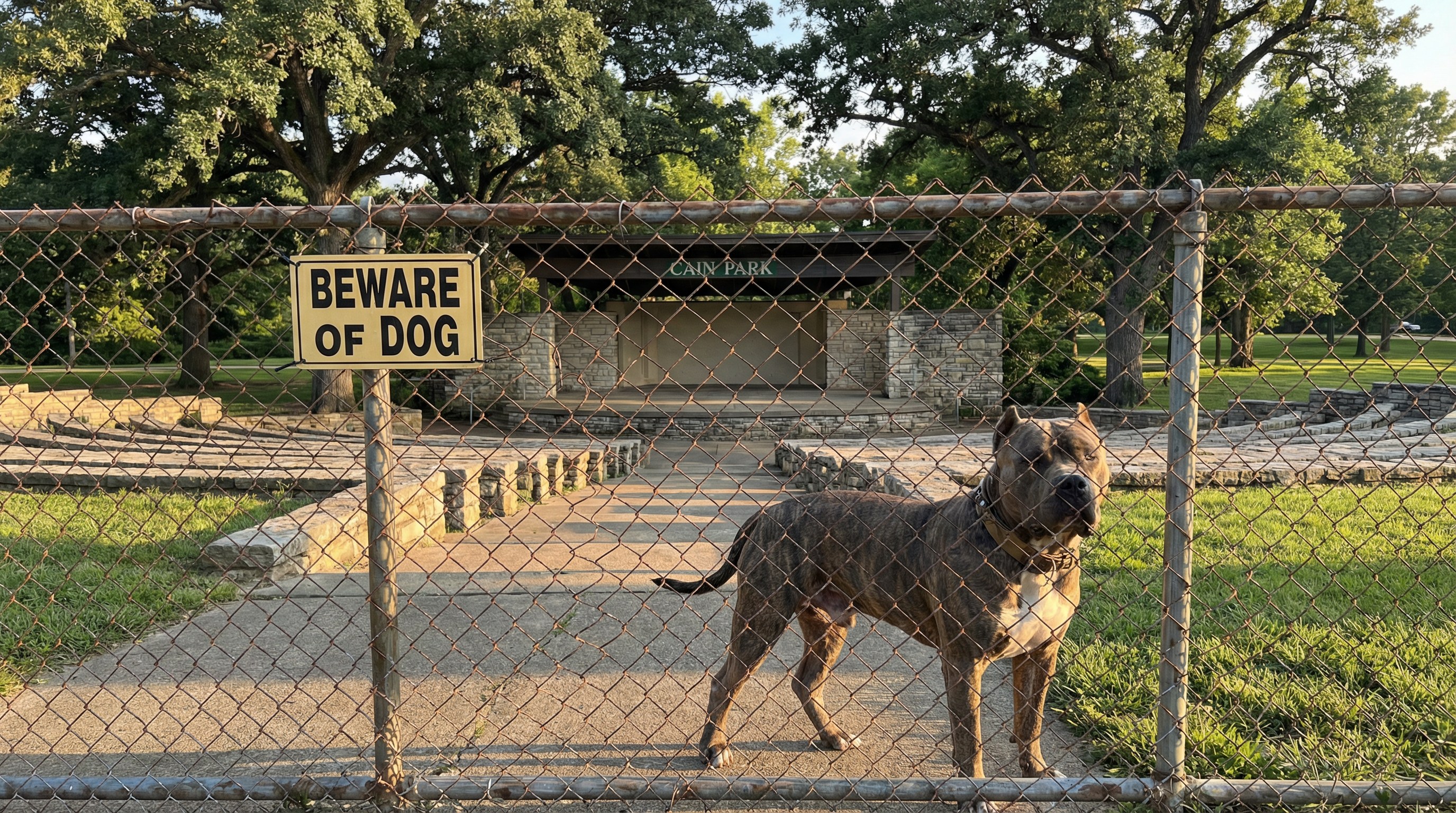
Cleveland Heights is home to Cain Park (a city-owned arts park that hosts outdoor concerts and festivals), Forest Hill Park, Cumberland Park, and numerous smaller neighborhood parks and playgrounds. Section 505.06 prohibits animals in public parks — meaning any dog bite in a Cleveland Heights park involves both a leash law violation and a park-restriction violation. The city's schools and playgrounds are similarly high-risk areas where children are present and where dog owners may walk unleashed or poorly controlled dogs. Bites involving children trigger extended statute of limitations protections and typically result in higher damage awards for scarring and emotional distress.
Cross-Border Dynamics
Cleveland Heights borders Cleveland (no BSL), East Cleveland, University Heights, and South Euclid. A pit bull owner living in Cleveland faces no breed-specific obligations. But if that dog is walked into Cleveland Heights — even briefly — the full vicious dog framework applies: registration, insurance, three-foot chain, muzzle, and signage. Owners who live near the border may be unaware that crossing into Cleveland Heights transforms their legal obligations. A bite by a Cleveland-based pit bull inside Cleveland Heights limits gives the victim access to the city's entire vicious dog ordinance for negligence per se purposes.
Reporting a Dog Bite in Cleveland Heights
Dog bite victims in Cleveland Heights should contact the Animal Protective Unit at 216-291-4987 to report the incident and request animal control documentation. Impounded animals are held at Pepperidge Kennels (7368 Oakhill Rd, Oakwood, OH 44122). Victims should also contact the Cuyahoga County Board of Health at 216-201-2001 for bite reporting and quarantine follow-up. Request copies of all incident reports, animal control records, and — critically — verification of whether the dog was registered as a vicious dog with the city, whether the owner carried the required $100,000 insurance, and whether the property displayed the required signage. Each missing requirement is an independent basis for a negligence per se claim.
Frequently Asked Questions — Cleveland Heights
Related Articles & News
Dog Bite Settlement in Cleveland Heights Ohio: What to Expect
If you were injured by a dog in Cleveland Heights, Ohio, understanding how settlements are calculated can help you maximize your recovery under Ohio strict liability law.
Read article →
Avery's Law Is Now in Effect: What Ohio's New Dog Attack Law Means for Cuyahoga County Victims
Ohio's most significant overhaul of dangerous dog law in decades takes effect March 18, 2026. Here is what Avery's Law changes, what it does not change, and what it means if you or someone you love is attacked by a dog in Cuyahoga County.
Read article →About This Resource
This site provides educational analysis of Ohio dog bite law under R.C. § 955.28 for residents of Cleveland Heights and Cuyahoga County. It is not a law firm and does not provide legal advice.
For legal representation, this resource is operated in association with Ryan Injury Attorneys, a personal injury law firm licensed in Ohio.