Maple Heights, Ohio — Dog Bite Law
Maple Heights is a densely populated southeastern Cuyahoga County suburb of approximately 23,700 residents located roughly eight miles southeast of downtown Cleveland along the Broadway Avenue and Warrensville Center Road corridors. The city's Chapter 618 animal ordinance uses a unique section numbering system and includes provisions for court-ordered destruction of attacking animals, mandatory impoundment of dangerous and vicious dogs, and enhanced criminal penalties for owners of classified dogs who violate confinement requirements.
If you have been bitten by a dog in Maple Heights, Ohio law under R.C. § 955.28 entitles you to compensation from the dog's owner, keeper, or harborer regardless of whether the animal has ever bitten anyone before. Maple Heights' homeownership rate of approximately 63% means the majority of dog bite claims will have access to a homeowner's insurance policy, though the city's significant rental population — over 36% of housing units — introduces harborer liability considerations for landlords and property managers.
Maple Heights at a Glance
No fee unless we recover — call (216) 363-6040
Maple Heights at a Glance
Maple Heights Animal Control & Local Ordinances
Maple Heights regulates animals under Chapter 618 of its Codified Ordinances. Unlike most Cuyahoga County suburbs that use the standard 618.01 state law template, Maple Heights' animal code uses a unique section numbering system with its core provisions spread across Sections 618.02, 618.03, and 618.09. The ordinance framework is moderately enhanced compared to the bare state law minimum, with court-ordered destruction authority, mandatory impoundment, and enhanced penalties for dangerous and vicious dog violations.
Section 618.02 — Certain Animals Prohibited; Wild, Dangerous, Vicious or Undomesticated Animals
Section 618.02 prohibits harboring wild, dangerous, vicious, or undomesticated animals within the city, and separately prohibits keeping livestock including horses, cattle, swine, and poultry. Two provisions are particularly significant for dog bite litigation:
Court-Ordered Seizure (618.02(f)): If a law enforcement agent has probable cause to believe an animal is being harbored in violation of this section, the agent may petition a court to order seizure and impoundment pending trial. This means that a dangerous or vicious dog can be removed from the owner's possession before the criminal case is resolved — creating immediate documentation of the animal's classification and the circumstances that led to seizure.
Court-Ordered Destruction (618.02(g)): Any animal that attacks a human being or other domestic animal may be ordered destroyed when the court determines the animal represents a continuing threat of serious harm. This provision gives the court discretion to order euthanasia based on a threat assessment — a judicial finding that is discoverable in any subsequent civil claim and establishes the severity of the risk the animal posed.
Section 618.03 — Control of Domestic Animals; Animals Running at Large
Section 618.03 is the primary confinement and leash provision. It requires every owner or person in charge of any domestic animal — including dogs and cats — to keep the animal physically confined or restrained upon the premises by a leash, tether, adequate fence, supervision, or secure enclosure to prevent escape, or under reasonable control of some person. No animal may run at large within the city. Female dogs in heat must not go beyond the owner's premises unless properly leashed.
Enhanced Penalties for Dangerous and Vicious Dogs: Violations of Section 618.03 involving dangerous or vicious dogs trigger enhanced penalties under Section 618.09(i) and mandatory impoundment under Section 618.12. This cross-referencing structure means that a dangerous or vicious dog found running at large faces both the standard at-large penalty and the additional dangerous dog penalties — double accountability.
Court-Ordered Training and Destruction: In addition to fines, the court may order the offender to personally supervise the dog, cause the dog to complete dog obedience training, attend a class on responsible pet ownership and dog behavior, or do all three. Alternatively, the court may order the dog to be humanely destroyed. The availability of court-ordered obedience training creates a documented record — if the owner was previously ordered to train the dog and a subsequent bite occurs, the failure of the training program (or the owner's failure to comply) becomes powerful evidence of negligence.
Section 618.09 — Dangerous and Vicious Dogs
Section 618.09 contains the enhanced penalty structure for dangerous and vicious dog violations. While the full text of this section cross-references from Section 618.03, the existence of a dedicated penalty section for classified dogs signals that Maple Heights treats dangerous and vicious dog infractions as a distinct and more serious category of offense — not merely an aggravated version of the general at-large prohibition.
Section 618.05 — Nuisance Conditions
No person shall keep or harbor any animal in the city so as to create excessive noise, offensive odors, or unsanitary conditions that are a menace to the health, comfort, or safety of the public. Animals must be provided access to shelter from wind, rain, snow, or excessive direct sunlight. Nuisance complaints documented by the Animal Control Officer create a record of the owner's pattern of inadequate animal management — relevant to establishing that the owner knew or should have known the dog posed a risk.
Section 618.12 — Impoundment
Maple Heights impounds animals found violating Chapter 618. The impoundment fee structure is notable: canines are charged $15 per day, felines $10 per day, and exotic or vicious animals $20 per day. The higher rate for vicious animals reflects the additional resources required to house them safely. All fees must be paid in cash at the Police Department — no checks or credit cards accepted. Impoundment records are maintained by the Police Department and are available through public records requests.
Ohio Strict Liability — R.C. § 955.28
Ohio's strict liability statute — R.C. § 955.28 — is the primary basis for dog bite claims in Maple Heights. The owner, keeper, or harborer of a dog is liable for any injury the dog causes, regardless of prior incidents or knowledge of dangerous tendencies. For a full explanation of the statute, defenses, and damages, see our complete guide to Ohio dog bite law.
High-Density Population and Encounter Frequency
Maple Heights is one of the most densely populated communities in the service area at approximately 4,500 people per square mile — six times the density of Independence and comparable to inner-ring suburbs like Lakewood and Euclid. The city's postwar housing stock features modest lot sizes, narrow setbacks between homes, and limited buffer space between residential properties and sidewalks. This density means dogs and pedestrians share tight spaces. Encounters between dogs and mail carriers, delivery workers, children walking to school, and neighbors are a daily reality in Maple Heights' residential blocks.
Young Population and Child Victim Considerations
Maple Heights has a younger population profile than many Cuyahoga County suburbs: approximately 24% of residents are under 18, with a median age of 36. Children are disproportionately at risk for dog bite injuries because they are smaller (placing faces and necks at dog-strike height), less able to interpret warning signs of aggression, and more likely to engage in behaviors that provoke dogs — running, screaming, or approaching unfamiliar animals. Dog bite injuries to children frequently involve the face, head, and neck, resulting in scarring, reconstructive surgery, and significant emotional trauma. When the victim is a minor, the statute of limitations does not begin to run until the child turns 18 — meaning the family has an extended window to pursue a claim.
Rental Population and Harborer Liability
With approximately 36.6% of housing units renter-occupied, Maple Heights has one of the higher rental populations in the service area — comparable to Euclid and significantly higher than owner-dominated communities like Independence (95% owner-occupied) or Broadview Heights. The substantial rental population creates recurring harborer liability scenarios. Under R.C. § 955.28, a landlord who permits tenants to keep dogs — and who knows or should know that a tenant's dog has exhibited aggressive behavior or violated Chapter 618 — may be deemed a harborer and face strict liability for resulting injuries. Landlords who receive complaints about a tenant's dog and fail to act are particularly vulnerable to harborer claims.
Insurance Recovery in a Mixed-Income Community
Maple Heights' median household income of approximately $52,800 and poverty rate of roughly 26% present a mixed insurance landscape. The 63% of residents who own their homes typically carry homeowner's insurance with standard personal liability coverage of $100,000 to $300,000 per occurrence — adequate for many dog bite claims. However, the 37% who rent are less likely to carry renter's insurance, and even when they do, renter's policies may have lower liability limits or dog breed exclusions. In cases where the dog owner lacks personal insurance, the analysis shifts to landlord liability: the property owner's commercial or landlord insurance policy may provide coverage if the landlord can be established as a harborer.
Court-Ordered Destruction as Evidence
Maple Heights' court-ordered destruction provision under Section 618.02(g) is significant for civil claims because a judicial finding that a dog represents a continuing threat of serious harm is powerful evidence in a subsequent civil case. If the court has already determined — in a criminal or administrative proceeding — that the dog was dangerous enough to warrant destruction, the owner's liability in a civil claim is substantially strengthened. Even if the court stops short of ordering destruction but considers the question, the record of that proceeding is discoverable.
Garfield Heights Municipal Court — Shared Jurisdiction
Like Independence, Maple Heights falls within the jurisdiction of the Garfield Heights Municipal Court. The same judges who handle dog bite cases under Garfield Heights' comprehensive Chapter 506 — neon yellow identification, mandatory obedience training, $100,000 insurance for both dangerous and vicious dogs, local strict liability under 506.98 — also hear cases arising under Maple Heights' Chapter 618. This shared jurisdiction means judges bring heightened awareness of dog control standards to every case on the docket.
“The owner, keeper, or harborer of a dog is liable in damages for any injury, death, or loss to person or property that is caused by the dog, unless the person was trespassing or committing a criminal offense on the property of the owner, keeper, or harborer, or was teasing, tormenting, or abusing the dog.”— Ohio Revised Code § 955.28(B)
Venue & Court Information
Garfield Heights Municipal Court
Dog bite civil claims arising in Maple Heights are heard at the Garfield Heights Municipal Court, located at 5555 Turney Road, Garfield Heights, OH 44125. Judge Deborah J. Nicastro and Judge Sergio DiGeronimo share the bench. Clerk of Court Alexander F. Grgat administers case filing and records (216-475-1900).
The Garfield Heights Municipal Court serves nine communities: Garfield Heights, Maple Heights, Independence, Brecksville, Cuyahoga Heights, Newburgh Heights, Valley View, Walton Hills, and Metro Parks. The court hears civil claims up to $15,000 and operates a small claims division for claims up to $6,000.
Maple Heights also operates a Mayor's Court at 5353 Lee Road for minor traffic and criminal offenses. The Mayor's Court does not handle civil or small claims matters — those must go to the Garfield Heights Municipal Court.
Dog bite cases involving serious injuries — emergency surgery, hospitalization, permanent scarring, significant lost wages, or ongoing rehabilitation — will frequently exceed the $15,000 municipal court limit. These cases should be filed in the Cuyahoga County Court of Common Pleas at 1 Lakeside Avenue, Cleveland, OH 44113, which has no jurisdictional cap. Cases involving child victims with facial scarring or reconstructive surgery are particularly likely to warrant Common Pleas filing given the higher damages potential.
Statute of Limitations
Strict liability claims under R.C. § 955.28 must be filed within six years. Negligence claims must be filed within two years. If the victim was a minor at the time of the bite, the statute of limitations does not begin to run until the child turns 18. For complete details on filing deadlines and recoverable damages, see our Ohio dog bite law guide.
Local Risk Factors in Maple Heights
Population and Density
Maple Heights is one of the larger and more densely populated cities in the service area, with approximately 23,700 residents in roughly 5.2 square miles — yielding a population density of approximately 4,500 people per square mile. This is among the highest densities in the service area, comparable to Lakewood and far exceeding lower-density suburbs like Independence (784/sq mi) or Broadview Heights. The 1950s-era housing stock features compact lot sizes and minimal setbacks, concentrating dogs and pedestrians in close proximity across virtually every residential block.
Young Population and Child Safety
Approximately 24% of Maple Heights residents are under 18 — one of the higher child populations in the service area. The median age is 36, significantly younger than aging communities like Lyndhurst (median age 48). Children are the most vulnerable demographic for dog bite injuries: they are at face and neck height to many dog breeds, less able to read canine warning signs, and more likely to engage in behaviors that trigger attacks. Dog bite injuries to children frequently involve facial lacerations, eye injuries, and ear damage requiring reconstructive surgery. The emotional and psychological impact on child victims — fear of dogs, nightmares, anxiety — constitutes an independent category of compensable damages.
Broadway Avenue and Southgate Corridors
Broadway Avenue (State Route 14) runs north-south through Maple Heights and serves as a major commercial and transit corridor. The Southgate Transit Center — a GCRTA hub connecting multiple bus lines between downtown Cleveland, Bedford, Shaker Heights, East Cleveland, and the Summit County line — generates substantial pedestrian traffic in the commercial area. The combination of bus stops, retail storefronts, parking lots, and sidewalks creates regular dog-human encounters. Dog bite incidents on or near commercial properties involve analysis of both the dog owner's strict liability under R.C. § 955.28 and the property owner's potential premises liability for failing to maintain safe conditions.
Warrensville Center Road Corridor
Warrensville Center Road forms Maple Heights' western boundary and serves as another major commercial artery shared with neighboring communities. The corridor's mix of residential and commercial properties, combined with high traffic volumes and pedestrian activity at intersections, creates additional encounter zones where dogs and people interact in close proximity.
Rental Housing and Landlord Responsibility
With over 36% of housing units renter-occupied and a significant inventory of multi-family buildings, Maple Heights has a substantial population of tenants whose dogs are kept in properties they do not own. Landlords who permit dogs — through lease provisions or through failure to enforce no-pet policies — bear potential harborer liability when they know or should know of a dog's aggressive behavior. The 618.03 enhanced penalty structure for dangerous and vicious dogs provides landlords with clear notice that classified dogs on their properties trigger additional legal obligations.
Animal Control Officer
Maple Heights maintains an Animal Control Officer assigned to the Police Department who enforces local, county, and state animal laws, investigates complaints of animal abuse and cruelty, and provides nuisance animal trapping services on a seasonal basis (March through October). The Animal Control Officer is available Monday through Friday, 8:00am to 4:00pm, with after-hours animal emergencies handled through the Police Department dispatch. Impoundment of animals found violating Chapter 618 generates formal records maintained by the Police Department.
Reporting a Dog Bite in Maple Heights
Dog bite victims in Maple Heights should call the Maple Heights Police Department at 216-662-1234 (non-emergency) or contact the Animal Control Officer through dispatch at (216) 662-5884 or voicemail at (216) 587-9646. Victims should also report the bite to the Cuyahoga County Board of Health at 216-201-2001. Request documentation of the dog's identity, the owner's information, the circumstances of the bite, and any prior complaints, impoundment records, or classification history for the dog.
Frequently Asked Questions — Maple Heights
Related Articles & News
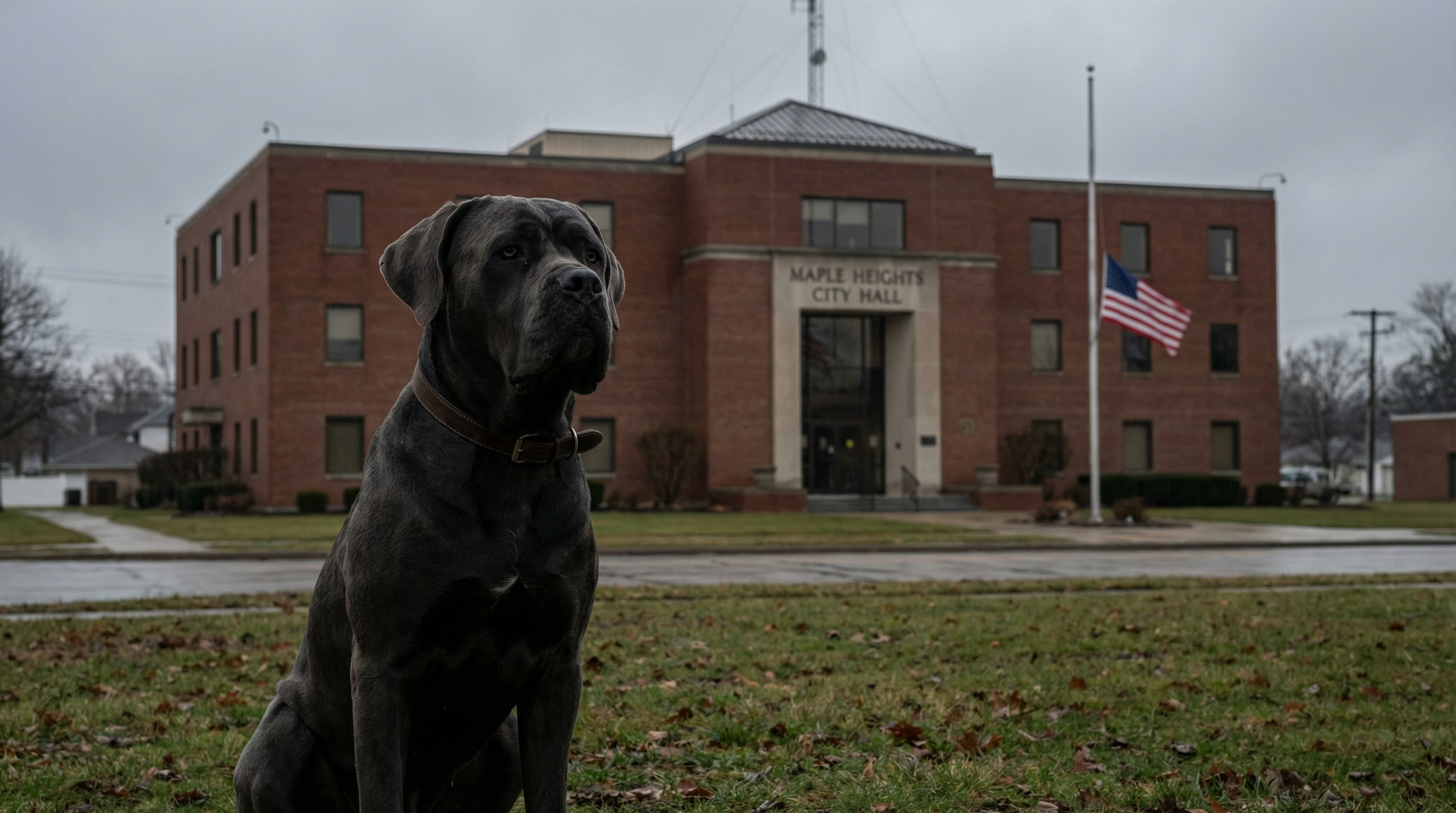
Dog Bite in Maple Heights Ohio: Incident Report and Legal Guide
If you or a loved one has been bitten by a dog in Maple Heights, Ohio, understanding your legal rights is the first step toward recovery. Learn about local ordinances and Ohio strict liability laws.
Read article →
Avery's Law Is Now in Effect: What Ohio's New Dog Attack Law Means for Cuyahoga County Victims
Ohio's most significant overhaul of dangerous dog law in decades takes effect March 18, 2026. Here is what Avery's Law changes, what it does not change, and what it means if you or someone you love is attacked by a dog in Cuyahoga County.
Read article →About This Resource
This site provides educational analysis of Ohio dog bite law under R.C. § 955.28 for residents of Maple Heights and Cuyahoga County. It is not a law firm and does not provide legal advice.
For legal representation, this resource is operated in association with Ryan Injury Attorneys, a personal injury law firm licensed in Ohio.