East Cleveland, Ohio — Dog Bite Law
East Cleveland, Ohio has no breed-specific legislation and no local dangerous or vicious dog ordinance beyond state defaults. That means Ohio's strict liability statute — R.C. § 955.28 — does the heavy lifting in every dog bite case here. The owner, keeper, or harborer of a dog is liable for any injury the dog causes, regardless of whether the animal has ever bitten anyone before or shown any prior aggression.
While East Cleveland's local ordinance framework is minimal compared to neighboring cities, the city's basic leash law and public park prohibition still provide independent grounds for negligence per se claims when violated. And East Cleveland's unique conditions — high population density, significant housing vacancy, and borders shared with both Cleveland and Cleveland Heights — create distinct challenges for bite victims that require an attorney familiar with the local landscape.
East Cleveland at a Glance
No fee unless we recover — call (216) 363-6040
East Cleveland at a Glance
East Cleveland Animal Control & Local Ordinances
East Cleveland regulates animals under Chapter 505 of its Codified Ordinances, but the provisions are substantially more limited than neighboring municipalities. The city has no breed-specific legislation, no local dangerous or vicious dog registration requirement, and no confinement standards beyond those imposed by state law.
Animals Running at Large — Section 505.01
Section 505.01 is East Cleveland's primary animal control provision. It defines "at large" as off the premises of the owner and not under control by leash, cord, or chain. No person owning, keeping, or harboring a dog may permit it to run at large within the city. This basic leash requirement applies to all dogs regardless of breed, size, or history.
When a dog bites someone while running loose in East Cleveland, the leash violation under Section 505.01 establishes a negligence per se claim in addition to strict liability under R.C. § 955.28. This matters because negligence per se — violating a safety ordinance that was designed to protect the public — can open the door to punitive damages for willful or reckless conduct that strict liability alone does not support.
Public Park Prohibition — Section 505.01(d)
Section 505.01(d) prohibits any person from taking, leading, or having in their possession any animal in any public park within the city. This is a complete ban — not a leash-optional rule. Any dog in any East Cleveland park is in violation of the ordinance, period. If a dog bites someone in a city park, this prohibition provides an additional and independent negligence per se basis beyond the general leash requirement.
What East Cleveland Does Not Have
Understanding what East Cleveland lacks is as important as understanding what it has. The city does not have:
A breed-specific ordinance. Unlike Brooklyn, Broadview Heights, Cleveland Heights, or Parma, East Cleveland imposes no additional requirements on pit bulls or any other breed. A pit bull in East Cleveland faces no more regulation than a golden retriever.
A local dangerous or vicious dog registration system. Cities like Cleveland Heights require vicious dogs to be registered with a $20 annual fee, $100,000 liability insurance, photo identification, and conspicuous property signage. East Cleveland has no such system. Dangerous and vicious dog designations in East Cleveland default entirely to the state framework under R.C. § 955.222, administered by the county dog warden rather than local animal control.
Specific confinement standards for dangerous or vicious dogs. Cities with local ordinances often impose locked pen requirements, muzzling rules, specific chain lengths, and tensile strength standards. East Cleveland defaults to the state requirements under R.C. § 955.22, which require confinement but with less specificity than the most detailed municipal codes in the county.
Comparison with Neighboring Cities
East Cleveland's minimal ordinance framework stands in sharp contrast to its immediate neighbors. Cleveland Heights, which directly borders East Cleveland to the east and south, has the most demanding vicious dog ordinance in Cuyahoga County — mandatory $100,000 liability insurance, 3-foot chain with 300-lb tensile strength, conspicuous property signage, annual registration, and pit bulls classified as vicious by default. Cleveland, which borders East Cleveland to the west and north, also has no BSL but has a more developed animal control infrastructure through its Division of Animal Care & Control. East Cleveland relies on patrol officers and the county shelter for animal enforcement, with no dedicated local animal control unit.
Ohio Strict Liability — R.C. § 955.28
Ohio's strict liability statute — R.C. § 955.28 — is the foundation and primary tool for dog bite claims in East Cleveland. Because the city has no breed-specific legislation and minimal local ordinance structure, state law carries more weight here than in municipalities with extensive local codes. For a full explanation of the statute, defenses, and damages, see our complete guide to Ohio dog bite law.
Strict Liability Without Local Enhancement
Under R.C. § 955.28, the owner, keeper, or harborer of a dog is liable for any injury, death, or loss to person or property caused by that dog. The statute imposes liability without fault — the victim does not need to prove the owner was negligent or that the dog had a prior bite history. This is Ohio's one-bite-is-enough principle, and it applies in East Cleveland exactly as it does everywhere else in the state.
In cities with breed-specific or detailed dangerous dog ordinances, victims can layer multiple legal theories — strict liability plus negligence per se for each ordinance violation. In East Cleveland, the layering opportunities are more limited. A victim can pursue strict liability under R.C. § 955.28 and, if the dog was loose, negligence per se under Section 505.01. But the extensive ordinance violation stacking available in Brooklyn (vicious classification + confinement violation + muzzle violation + leash violation + dog park prohibition) or Cleveland Heights (vicious classification + insurance violation + registration violation + signage violation + leash specification violation) is not available here.
Harborer Liability in a High-Vacancy City
East Cleveland has one of the highest housing vacancy rates in Cuyahoga County — over 25% of its housing units were vacant as of the 2020 census. Many residential properties are rental units, and some buildings have uncertain or absentee ownership. The "harborer" definition under R.C. § 955.28 — anyone who has possession and control of the premises where the dog lives and acquiesces to its presence — is particularly relevant here.
Landlords who know a tenant keeps a dog and permit it have acquiesced to the dog's presence and can be held liable as harborers. In East Cleveland's rental-heavy housing stock, this frequently brings property owners and management companies into bite cases alongside the dog's direct owner. Establishing who controls a given property — particularly in buildings with unclear ownership chains, tax-delinquent properties, or informal rental arrangements — can be the critical investigative step in an East Cleveland dog bite case.
The Cleveland Heights Border — Ordinance Jurisdiction Matters
East Cleveland shares a long border with Cleveland Heights along Noble Road, North Taylor Road, and Euclid Avenue. Cleveland Heights classifies pit bulls as vicious by default, requires $100,000 liability insurance, mandatory registration, property signage, muzzling, and 3-foot chains with 300-lb tensile strength. None of these requirements apply in East Cleveland.
For bite victims, the exact location of the incident determines which ordinance framework applies. A pit bull bite on the East Cleveland side of Noble Road is governed only by the basic leash law and state strict liability. The same bite 50 feet away on the Cleveland Heights side triggers the full vicious dog ordinance with its insurance, registration, signage, and specific confinement requirements — each of which constitutes an independent negligence per se claim. Documenting the precise location of a bite incident near the East Cleveland–Cleveland Heights border is critical to maximizing the available legal theories.
State Dangerous Dog Designation Process
Because East Cleveland has no local dangerous or vicious dog ordinance, any classification of a dog as dangerous or vicious must go through the state process under R.C. § 955.222. This requires a complaint, investigation by the county dog warden, and a hearing. If your case involves a dog that has bitten before, pursuing a dangerous or vicious designation through the county process creates an official record that strengthens any subsequent civil claim — even though East Cleveland itself does not maintain a local registry. An attorney familiar with this process can coordinate the administrative designation with the civil litigation to maximum effect.
“The owner, keeper, or harborer of a dog is liable in damages for any injury, death, or loss to person or property that is caused by the dog, unless the person was trespassing or committing a criminal offense on the property of the owner, keeper, or harborer, or was teasing, tormenting, or abusing the dog.”— Ohio Revised Code § 955.28(B)
Venue & Court Information
East Cleveland Municipal Court
Dog bite cases arising in East Cleveland are heard at the East Cleveland Municipal Court, located at 14340 Euclid Avenue, East Cleveland, OH 44112. Judge William L. Dawson presides as the sole judge. The court has jurisdiction over civil claims up to $15,000 and small claims up to $3,000.
East Cleveland Municipal Court has sole jurisdiction over East Cleveland — unlike Brooklyn or Broadview Heights, which share Parma Municipal Court with seven other cities, East Cleveland's court serves only one municipality. This means Judge Dawson hears every municipal court case arising in East Cleveland and is familiar with the city's specific conditions, housing challenges, and law enforcement patterns.
The $3,000 small claims limit is notably lower than many other Cuyahoga County municipal courts — Cleveland Heights allows $6,000, for example. For dog bite cases involving anything beyond minor injuries, the claim will likely need to be filed in the general civil division (up to $15,000) or, for serious bites involving surgery, hospitalization, permanent scarring, or significant lost wages, in the Cuyahoga County Court of Common Pleas at 1 Lakeside Avenue, Cleveland, OH 44113, which has no jurisdictional cap.
Statute of Limitations
Strict liability claims under R.C. § 955.28 must be filed within six years. Negligence claims must be filed within two years. If the victim was a minor at the time of the bite, the statute of limitations does not begin to run until the child turns 18. For complete details on filing deadlines and recoverable damages, see our Ohio dog bite law guide.
Local Risk Factors in East Cleveland
High Population Density With Limited Animal Control
East Cleveland packs roughly 13,800 residents into just over three square miles — a population density exceeding 4,400 people per square mile. Yet the city has no dedicated animal control unit. Animal complaints are handled by patrol officers, with the Cuyahoga County Animal Shelter (216-525-7877) providing impound and stray services. This combination of high density and limited enforcement capacity means loose and stray dogs are a persistent issue, particularly in residential neighborhoods along Euclid Avenue, Superior Avenue, and Shaw Avenue where pedestrian traffic is heaviest.
Vacancy, Abandonment, and Stray Dogs
East Cleveland has one of the highest housing vacancy and abandonment rates in Cuyahoga County. Over 25% of the city's housing units were vacant as of the 2020 census, and the city is known for a high number of abandoned structures. Vacant properties attract stray and feral dogs that shelter in empty buildings and overgrown lots. These animals are often unowned, unvaccinated, and pose significant bite risks to neighbors and passersby. In cases involving strays, identifying a responsible "owner, keeper, or harborer" under R.C. § 955.28 may require investigating who owns the vacant property where the dog shelters — property owners who know stray animals frequent their abandoned buildings and fail to secure them may face harborer liability.
Euclid Avenue Corridor and Nela Park
Euclid Avenue runs the length of East Cleveland as its primary commercial and transit corridor, carrying RTA bus routes and connecting to the broader Cleveland transit network. Pedestrian traffic is concentrated here, at commercial nodes, and near institutions like Shaw High School and Heritage Middle School. Nela Park, GE's historic industrial campus on Noble Road, generates employee and visitor traffic in the northern portion of the city. Dog bites near schools are particularly concerning given that children are the most common victims of serious dog attacks — and injuries to children carry enhanced damages including future earning capacity, long-term psychological treatment, and cosmetic surgery for facial scarring.
Cross-Jurisdiction Borders
East Cleveland is bordered by Cleveland (University Circle neighborhood) to the west and Cleveland Heights to the east and south. Neither Cleveland nor East Cleveland has breed-specific legislation, but Cleveland Heights has the most extensive BSL framework in Cuyahoga County. Dog owners who move between these adjacent cities face dramatically different regulatory environments. For bite victims, the key is documenting the exact street address where the bite occurred — the difference between Noble Road's East Cleveland side and its Cleveland Heights side can mean the difference between a single-theory strict liability case and a multi-violation negligence per se case with insurance recovery.
Reporting a Dog Bite in East Cleveland
Dog bite victims in East Cleveland should file a report with the East Cleveland Police Department at 216-451-1234 (non-emergency). Because the city has no dedicated animal control, victims should also contact the Cuyahoga County Animal Shelter at 216-525-7877 to report the incident and initiate quarantine procedures. All bites should be reported to the Cuyahoga County Board of Health at 216-201-2001. Request copies of all police reports and any animal control records — in a city without local animal control infrastructure, these documents may be the only official record of the incident.
Frequently Asked Questions — East Cleveland
Related Articles & News
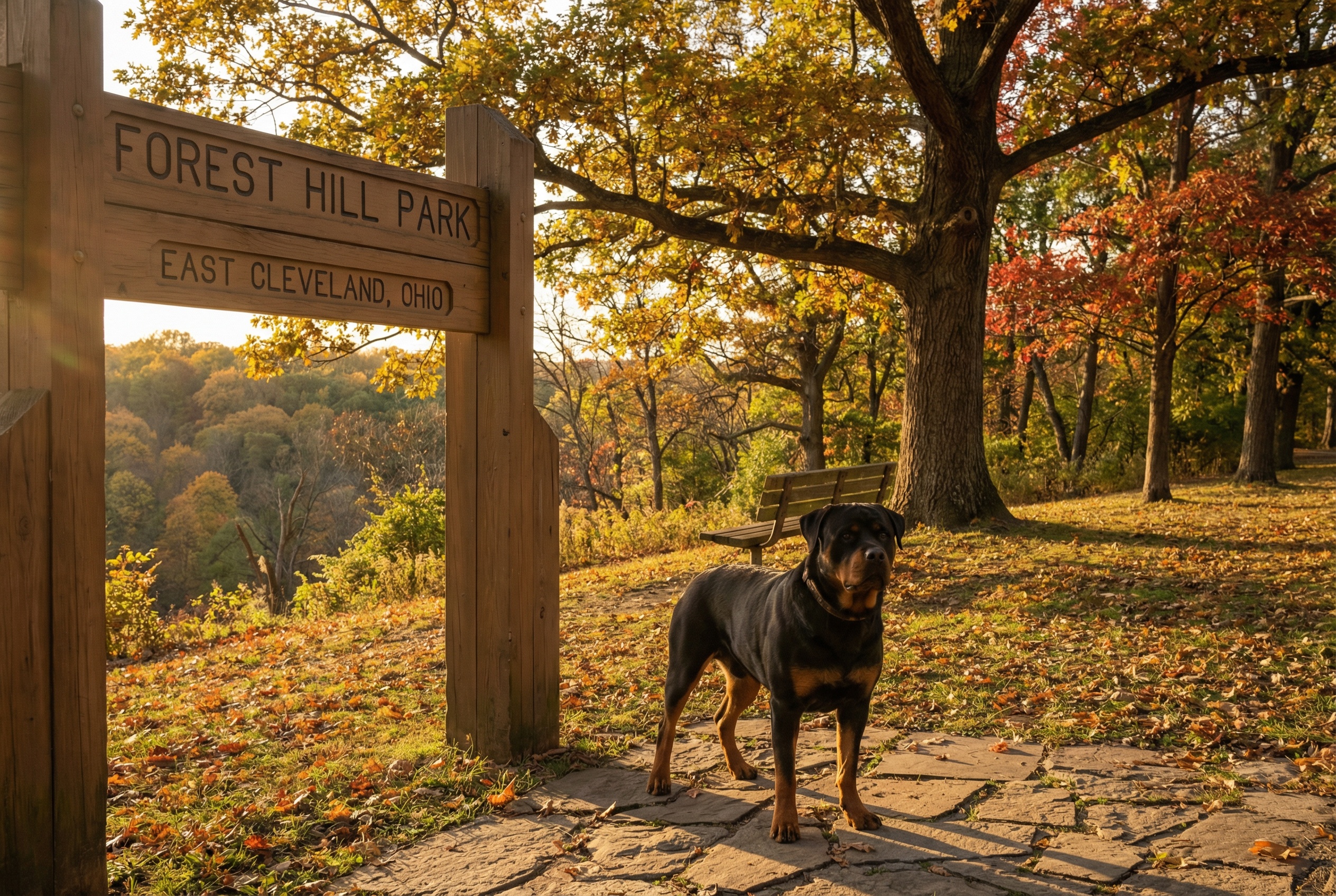
Dog Bite in East Cleveland Ohio: What Victims Should Know
If you or a loved one were attacked by a dog in East Cleveland, Ohio, understanding your rights under state law is the first step toward recovery.
Read article →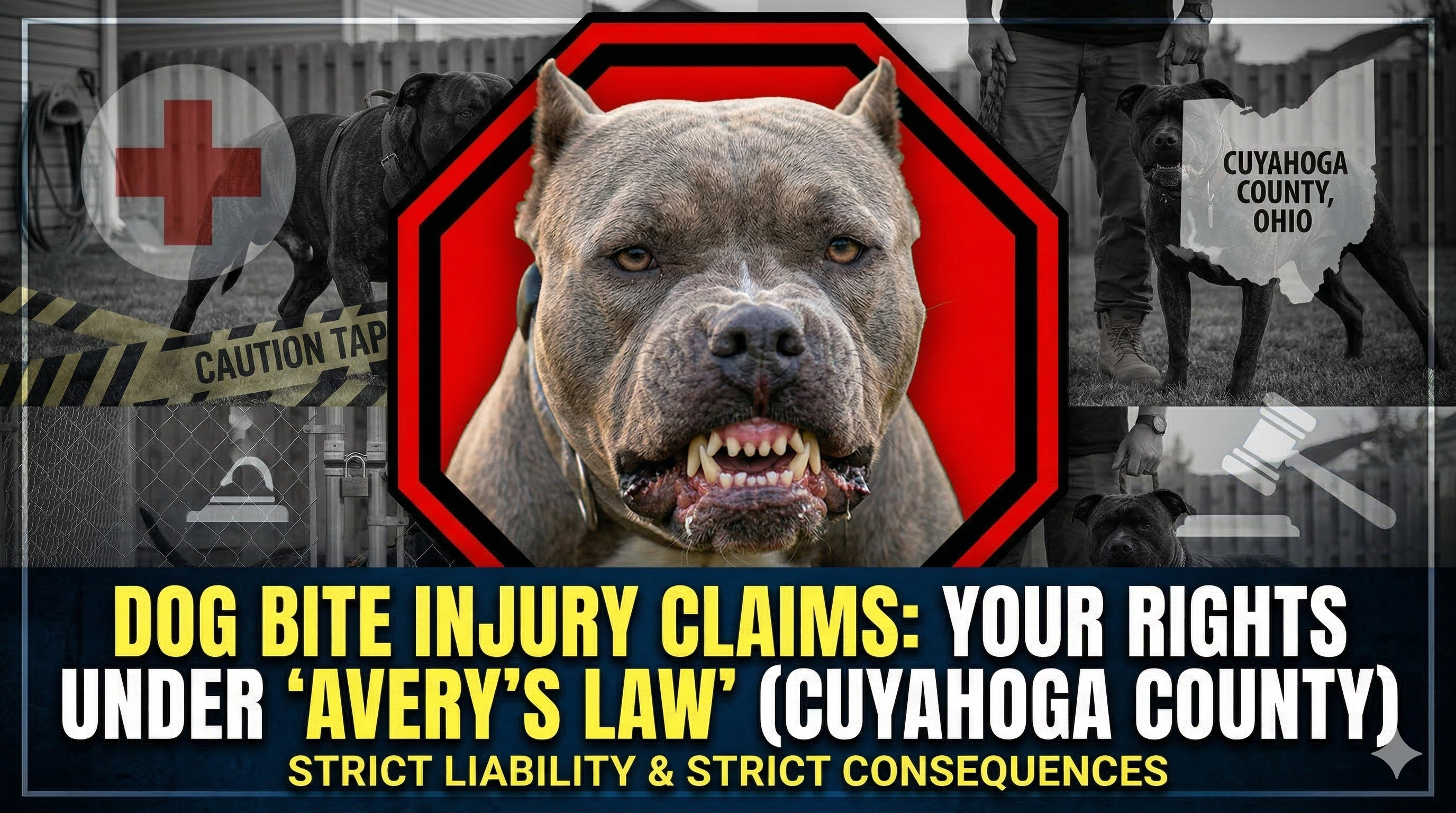
Avery's Law Is Now in Effect: What Ohio's New Dog Attack Law Means for Cuyahoga County Victims
Ohio's most significant overhaul of dangerous dog law in decades takes effect March 18, 2026. Here is what Avery's Law changes, what it does not change, and what it means if you or someone you love is attacked by a dog in Cuyahoga County.
Read article →About This Resource
This site provides educational analysis of Ohio dog bite law under R.C. § 955.28 for residents of East Cleveland and Cuyahoga County. It is not a law firm and does not provide legal advice.
For legal representation, this resource is operated in association with Ryan Injury Attorneys, a personal injury law firm licensed in Ohio.