Child Dog Bite Injuries in Ohio: Facial Scarring, Medical Care, and Legal Options

A dog bite involving a child is frightening for the entire family. In the first hours, parents may be focused on bleeding, wound care, and whether the dog was vaccinated. In the weeks that follow, other questions often emerge: Will the injury leave a scar? Will the scar change as my child grows? Who pays for medical care? What should we document now?
This guide addresses those questions with care. It is written for parents and guardians in Cleveland, Cuyahoga County, and across Ohio who are trying to protect a child after a dog attack. It is not a substitute for medical care or individualized legal advice.
If a child has uncontrolled bleeding, trouble breathing, loss of consciousness, a bite near the eye or neck, a deep wound, or any other emergency symptom, call 911 or seek emergency care immediately. Do not delay medical care to gather photographs, contact an insurer, or investigate the dog's history.
Why Facial Dog Bites to Children Require Particular Care
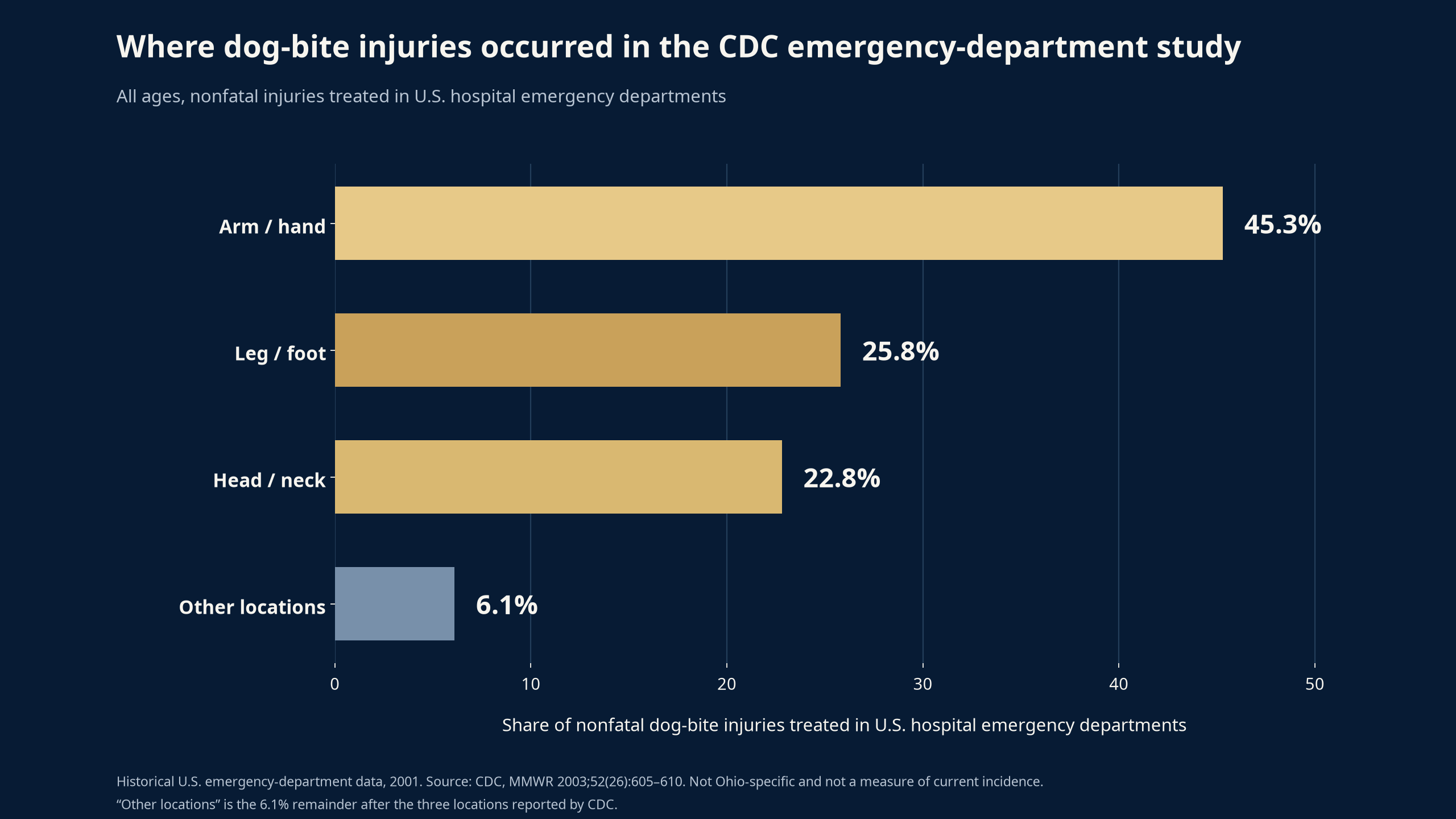
Children are often injured in the head and neck region when bitten by dogs. Clinical guidance notes that most dog-bite victims are children and that bites involving children commonly affect the head and neck. [1]
A facial bite can involve much more than a visible cut. Depending on the injury, a medical team may need to evaluate the skin, lips, eyelids, nose, ears, teeth, facial muscles, nerves, and tissues beneath the surface. Dog-bite wounds also raise infection, tetanus, and rabies-assessment questions. [1]
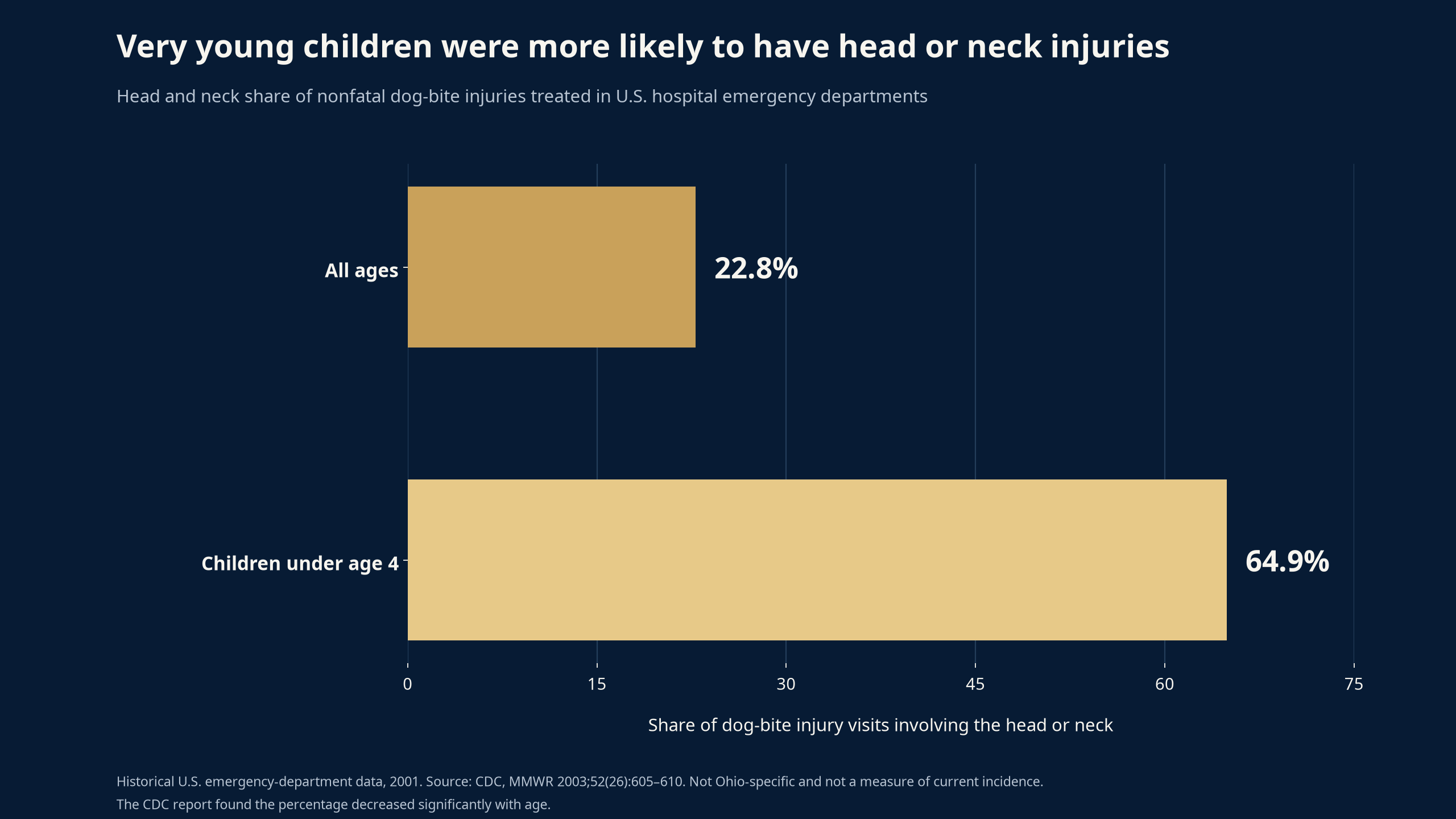
A scar does not define a child, but it can have real consequences. It may affect appearance, sensitivity, movement, confidence, and future medical care. The eventual outcome can depend on the depth and location of the wound, whether a structure was injured, the quality and timing of treatment, infection, the child's healing process, and the child's growth. No one can reliably predict a child's long-term scarring from an early photograph or a quick inspection.
The First Priorities After a Child Is Bitten
The first objective is medical safety. A clinician can assess whether the wound needs cleaning, repair, imaging, specialist consultation, tetanus attention, infection monitoring, or rabies guidance. Clinical guidance for bite wounds discusses thorough cleaning and irrigation, evaluation for injury to deeper structures or foreign material, and individualized decisions about closure and antibiotics. Facial wounds may be considered for closure when cosmetically appropriate, but that is a medical decision based on the particular wound. [1]
The second objective is obtaining reliable information about the dog and the incident. Ohio law establishes a quarantine framework after a dog bites a person. A dog that has bitten someone generally may not be removed from the county or transferred before the required quarantine is completed, and the usual quarantine period is ten days unless the local board of health determines another period is necessary for rabies observation. [2]
The third objective is preserving a clear record. This is not about turning a child's injury into a legal project while they are in pain. It is about keeping the information that the medical team, animal-control officials, and, if needed, an attorney may later need.
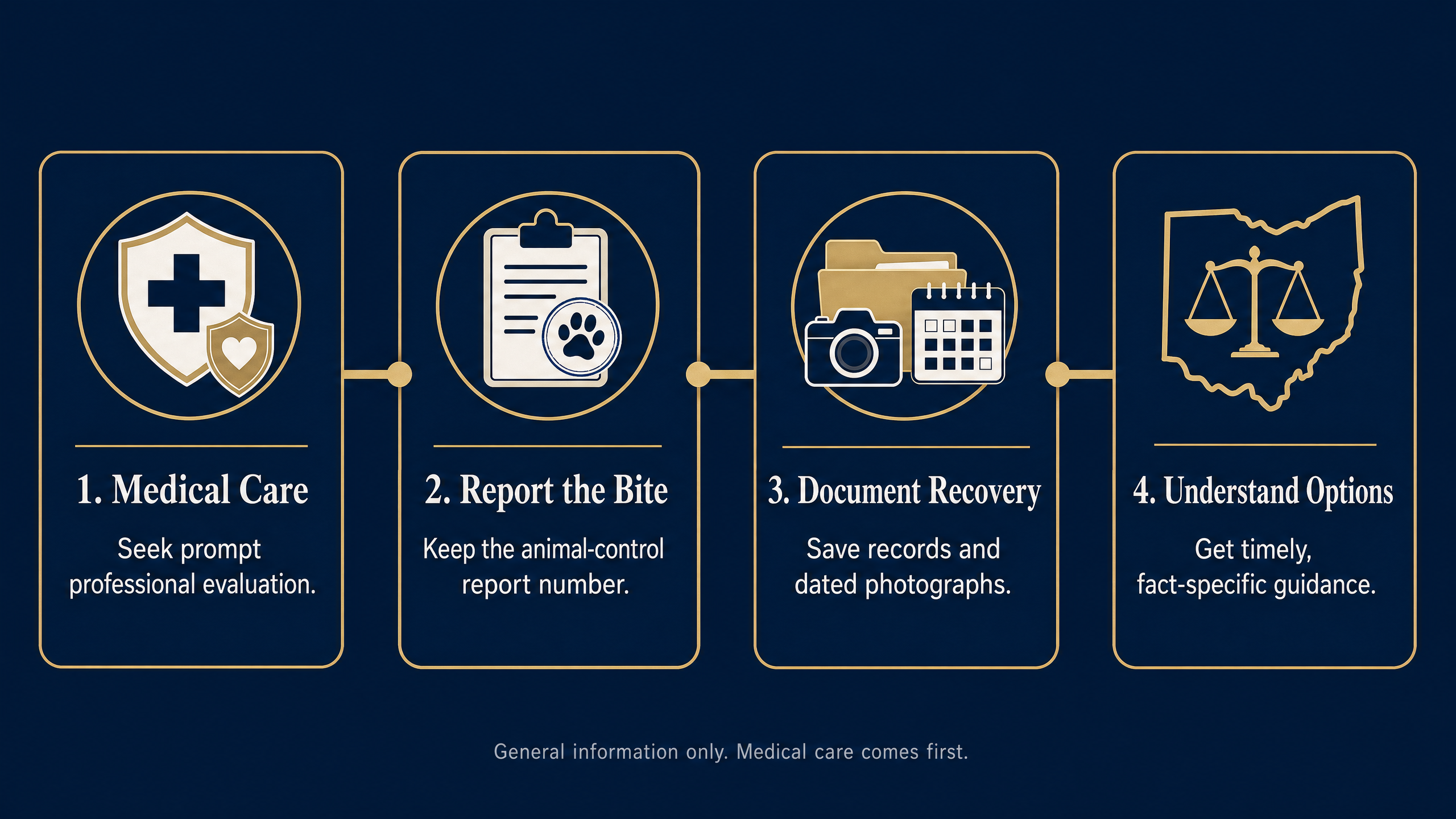
| Priority | What a parent or guardian can do | Why it matters |
|---|---|---|
| Medical evaluation | Follow the treating clinician's instructions and attend recommended follow-up appointments. | A child may need care that is not obvious at the scene, particularly with facial, eye-area, scalp, neck, hand, or deep injuries. |
| Incident report | Contact the appropriate local animal-control agency or health authority and ask for an incident or report number. | The report can help identify the dog, its owner, and the rabies-observation process. |
| Documentation | Save discharge instructions, bills, medication records, photographs taken for medical follow-up, and witness contact information. | Contemporaneous records can help show what happened and how the child recovered. |
| Scar progression | Keep a dated, private photo record only as medically appropriate and consistent with the child's dignity. | Healing and scar appearance can change over time. |
| Legal review | Seek advice early, even if the family is still waiting to understand the full medical outcome. | Different claims and defendants can have different deadlines. |
Facial Scarring: What Parents Should Know

Facial scarring after a dog bite can be emotionally difficult because the injury is visible and the child is still growing. It is appropriate for parents to ask the medical team about healing, sun protection, follow-up, and whether referral to a specialist is appropriate. The treating clinician should direct any scar-care plan.
Parents should avoid relying on informal online advice or attempting treatments that have not been approved by the child's medical team. A wound may need time to heal before scar management is considered. Some children need only routine follow-up. Others may be referred to specialists depending on the location, complexity, function, or appearance of the injury. The need for future care is a medical question that should be assessed over time rather than guessed at during the first week.
The child's emotional recovery deserves the same respect as the physical recovery. A child may become anxious around dogs, embarrassed about a visible injury, reluctant to return to a familiar location, or distressed by medical procedures. Parents can discuss these changes with the child's pediatrician or a qualified mental-health professional. Supportive, age-appropriate care can be an important part of recovery.
How Ohio Dog-Bite Law May Protect an Injured Child
Ohio Revised Code Section 955.28(B) states that a dog's owner, keeper, or harborer is liable in damages for injury, death, or loss caused by the dog, subject to statutory defenses. The statute includes defenses involving certain criminal conduct, criminal trespass, or teasing, tormenting, or abusing the dog on the responsible person's property. [3]
This is commonly described as Ohio's statutory dog-bite liability rule. It differs from the older common-law theory that required proof that an owner knew about a dog's dangerous tendencies. The Ohio Supreme Court has recognized that R.C. 955.28 created a statutory liability by removing that knowledge requirement. [4]
The statute does not guarantee compensation in every case. Liability can depend on the identity of the person responsible for the dog, the location of the incident, available insurance, the statutory defenses, and other facts. A careful review may be especially important if the injury occurred at an apartment complex, a relative's home, a daycare setting, a park, or a business.
What Can Be Included in a Child's Dog-Bite Claim?
The value and scope of a claim are fact-specific. A child who is injured by a dog may have losses that extend beyond the emergency-room bill. Depending on the evidence and the applicable law, damages may involve medical treatment, follow-up care, counseling, pain and suffering, visible scarring or disfigurement, and other injury-related losses.
In a child facial-scar case, it is often important not to rush a settlement before the medical outlook is better understood. That does not mean a family should delay investigating the case. It means medical records, photographs, specialist opinions, and the child's progress should be evaluated carefully so that any decision is informed rather than speculative.
A responsible legal review should also consider insurance. The dog owner's homeowners, renters, or other liability coverage may be relevant, but coverage depends on the actual policy, exclusions, the dog's ownership, the residence, and the circumstances of the incident. No attorney should promise that coverage will exist or that a particular outcome will follow.
Does a Child Have More Time to Bring a Claim?
Ohio law has a tolling provision for a person who was a minor or of unsound mind when a cause of action accrued. In qualifying circumstances, R.C. 2305.16 permits the person to bring an action within the applicable limitations period after the disability is removed. [5]
That provision can be important, but it should not be treated as a reason to wait. A child's own claim may not be the only claim arising from the incident. Related claims, insurance issues, and claims involving parents or other parties can have different deadlines. Evidence can also disappear quickly. The correct deadline depends on the legal theory and the defendant, so a family should obtain a prompt, individualized deadline analysis rather than relying on a general rule about a child's age.
A Practical Documentation Plan for Parents
Good documentation is organized, humane, and privacy-conscious. It should not require a child to repeatedly relive the attack. Begin with the medical record. Keep emergency-room and urgent-care records, follow-up notes, prescriptions, therapy recommendations, referral records, invoices, and any correspondence related to care. Ask providers how to obtain complete records when appropriate.
Create a simple dated timeline. Record the date and location of the bite, the dog's known owner or handler, the name of any responding police, animal-control, or health official, and the report number. Save the contact information of witnesses. Keep copies of communications with the dog owner, property manager, and insurance representatives.
Photographs can be useful when taken respectfully and only as consistent with the child's care. A short series of dated photos may document healing, rather than relying on a single image from the day of the attack. Do not post injury photographs on social media. Protect the child's privacy and let medical and legal professionals advise on what documentation is appropriate.
Common Questions From Parents
My child knows the dog. Does that change anything?
Not necessarily. Many dog bites involve dogs known to the child or family. The legal analysis still depends on the facts, the relationship to the dog, the responsible parties, and any available statutory defenses. [1] [3]
The dog had never bitten anyone before. Can we still have a claim?
A prior bite is not generally required for a statutory claim under R.C. 955.28(B). The statute's framework focuses on whether the defendant was an owner, keeper, or harborer and on the listed defenses. [3] [4]
Will my child's facial scar be permanent?
No responsible person can answer that from a photograph or a few early days of healing. Scarring and treatment needs depend on the individual injury and the child's medical course. Ask the treating clinician about the expected healing process and follow-up plan.
Should we wait for animal control before getting medical care?
No. Medical care comes first. Animal-control and public-health reporting can proceed promptly, but they should not delay emergency or urgent care. Ohio's quarantine rules exist to support public-health observation after a bite. [2]
What if the bite happened at an apartment complex or another person's home?
The dog's owner may be the primary person to evaluate, but the facts can affect whether other parties or insurance policies are relevant. A landlord or property manager is not automatically responsible for a tenant's dog. The circumstances, control, and legal theory matter.
Speak With an Ohio Child Dog-Bite Attorney Promptly
A child deserves a recovery process centered on health, stability, and dignity. The legal side should support that goal by helping preserve evidence, identify responsible parties, understand available insurance, and avoid preventable deadline problems.
If your child suffered a dog bite in Cleveland, Cuyahoga County, or the surrounding area, contact Ryan Injury Attorneys for a confidential case evaluation. We can listen, review the circumstances, and explain the options that may be available under Ohio law. A consultation does not guarantee any result.
Operated by Ryan LLP.
Important medical and legal notice: This article provides general information as of August 19, 2026. It is not medical advice, legal advice, or a substitute for emergency care. Treatment, scarring, liability, and deadlines are fact-specific. Seek prompt medical attention for a child after a dog bite and obtain individualized legal advice about any potential claim.
Related Ohio Dog-Bite Resources
- Ohio Dog Bite Law: R.C. 955.28 Overview
- What to Do After a Dog Bite in Ohio: A Step-by-Step Guide
- What Avery's Law Changed About the “One Bite Rule” in Ohio
- Ohio Supreme Court Rules Landlords Are Not Automatically “Harborers” in Dog Bite Cases
References
Injured in a Dog Bite in the Cleveland Area?
Ohio's strict liability law means you don't have to prove the dog was dangerous before. Ryan Injury Attorneys handles dog bite cases throughout Cuyahoga County. No fee unless we recover for you.