What Avery's Law Changed About the "One Bite Rule" in Ohio
What Avery's Law Changed About the "One Bite Rule" in Ohio
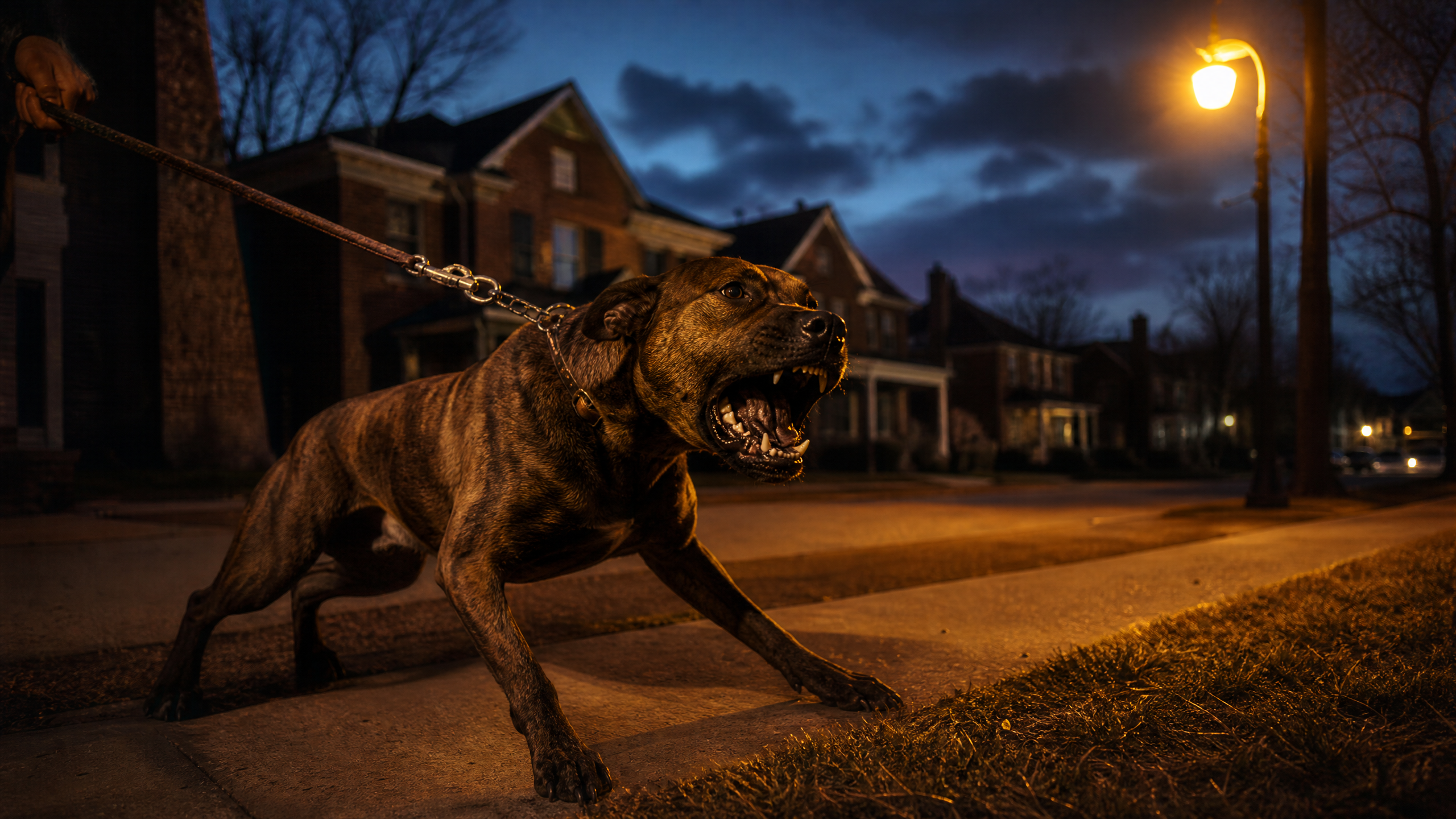
If you are bitten by a dog in Ohio, one of the first things the dog's owner will likely say is, "He's never done this before!" This defense is rooted in a widespread legal myth known as the "one bite rule"—the idea that a dog gets one "free" bite before the owner can be held responsible.
In Ohio, the one bite rule is a myth. Ohio is a strict liability state, meaning owners are financially responsible from the very first bite. However, with the passage of Avery's Law (House Bill 247) in March 2026, the legal landscape surrounding a dog's "first bite" has fundamentally shifted.
While strict civil liability remains the law of the land, Avery's Law introduced severe criminal penalties and mandatory insurance requirements that apply to negligent owners, even if their dog had never bitten anyone before. Here is exactly what changed, and what it means for dog bite victims in Cuyahoga County.
The Baseline: Ohio's Strict Liability Statute
Before understanding what Avery's Law changed, you must understand what it left untouched: your right to compensation.
Under Ohio Revised Code Section 955.28(B), the "owner, keeper, or harborer" of a dog is strictly liable for any injury the dog causes. To win a civil lawsuit for medical bills, lost wages, and pain and suffering, you do not need to prove:
- That the dog had bitten someone before.
- That the owner knew the dog was aggressive.
- That the owner was negligent (e.g., left a gate open or dropped a leash).
If you were lawfully present and did not provoke the dog, the owner is liable. Period. This strict liability standard has been Ohio law for decades and remains fully in effect today.
How Avery's Law Changed the "First Bite" Consequence
If victims could already sue after a first bite, why did Ohio need Avery's Law? The answer lies in criminal accountability and public safety.
Avery's Law was drafted in response to the tragic June 2024 attack on 11-year-old Avery Russell in Reynoldsburg, Ohio. The dog that nearly killed Avery had not been previously designated as vicious by a dog warden. Because of this, the dog's owner faced minimal criminal consequences—just four days in jail and a $450 fine—despite the catastrophic injuries inflicted on a child.
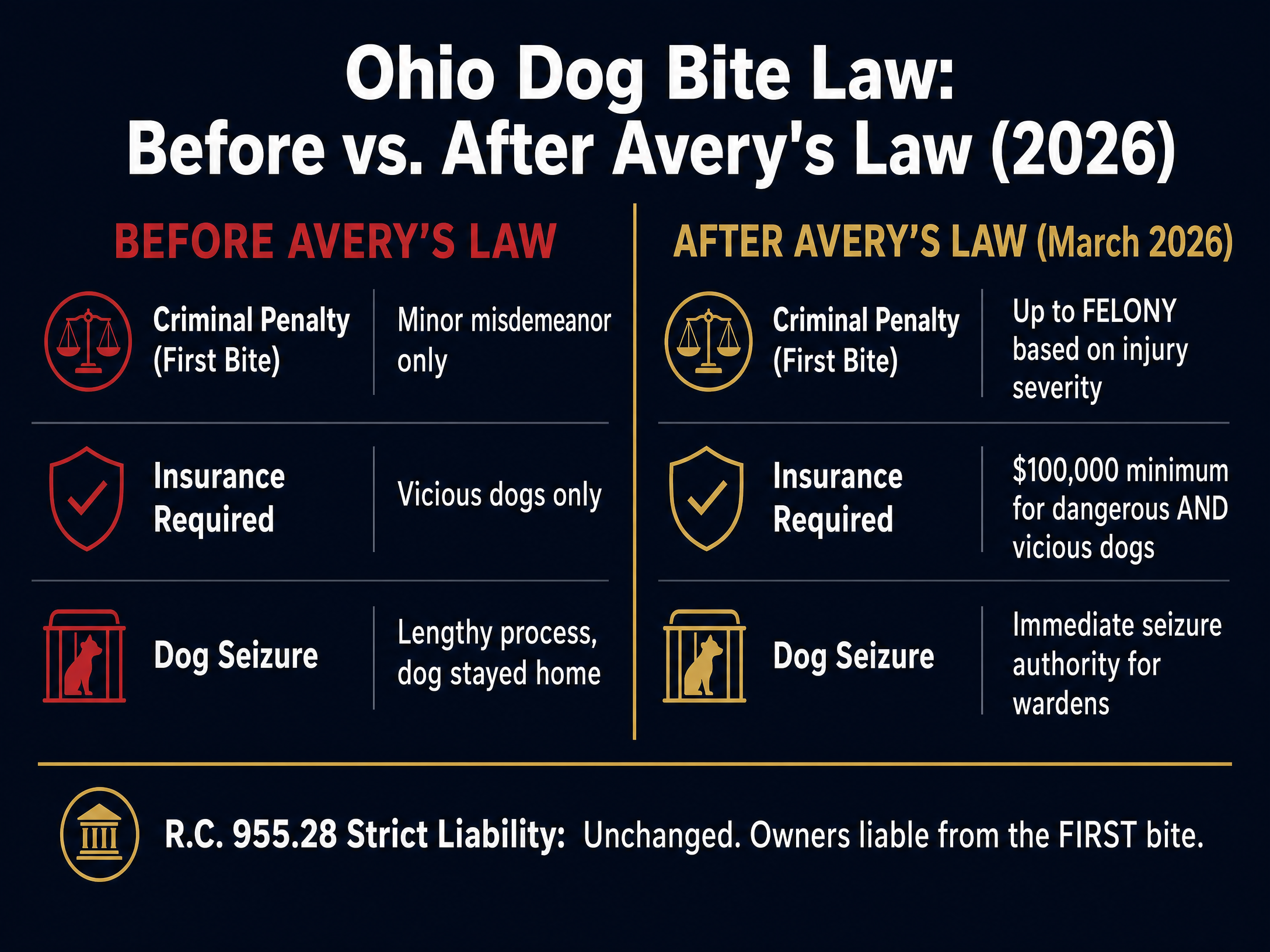
Before Avery's Law, Ohio criminal law effectively had a "one bite rule." Serious criminal penalties (like felonies) were generally reserved for owners whose dogs attacked after they had already been formally designated as dangerous or vicious. A horrific first attack often resulted in little more than a misdemeanor.
Avery's Law (H.B. 247) closed this loophole. Here is how it changed the rules for a dog's first attack:
1. Criminal Charges for Negligent Owners on the First Bite
Under the new law, an owner can face severe criminal charges if they negligently fail to prevent an unprovoked attack, regardless of the dog's prior history. The criminal penalty now scales with the severity of the victim's injuries, not just the dog's prior paperwork:
- Nuisance Dog Act: Minor misdemeanor (e.g., chasing or attempting to bite).
- Dangerous Dog Act: First-degree misdemeanor (causing injury).
- Vicious Dog Act: Felony (causing death or serious injury, such as permanent disfigurement or substantial incapacity).
2. Mandatory $100,000 Liability Insurance
If a dog bites someone for the first time and causes injury, it will likely be designated as a "Dangerous Dog" by the county dog warden. Under prior law, dangerous dogs did not require insurance. Avery's Law now mandates that owners of both dangerous and vicious dogs carry a minimum of $100,000 in liability insurance.
For victims of a second attack, this is crucial. It guarantees that there is a documented, collectible insurance policy available to pay for their injuries, rather than relying on the owner's personal assets.
3. Immediate Seizure and Mandatory Euthanasia
Before 2026, a dog that committed a severe first attack could often remain in the home during a lengthy investigation. Furthermore, judges had discretion over whether to order the dog euthanized, leading to wildly inconsistent outcomes across Ohio counties.
Avery's Law grants dog wardens the authority to immediately seize a dog following a qualifying attack. Furthermore, if a dog kills or seriously injures a person in an unprovoked attack, the court is now required to order humane euthanasia after due process is completed. The "one free bite" leniency for severe attacks is gone.
How the 2026 Harborer Ruling Interacts with Avery's Law
While Avery's Law strengthened owner accountability, another major 2026 legal development shifted how victims pursue compensation. In June 2026, the Ohio Supreme Court ruled in L.H. v. Sun Secured Financing LLC that landlords are not automatically considered "harborers" of their tenants' dogs.
This means if you are bitten by a dog in an apartment complex, you generally cannot hold the landlord strictly liable under R.C. 955.28(B). Your primary claim is against the dog's owner. This makes the insurance mandate in Avery's Law even more vital—if the landlord is no longer liable, the dog owner's mandatory $100,000 policy may be your only path to recovery.
What Victims Need to Know
If you or a loved one are bitten by a dog in Ohio, do not let the owner or their insurance company convince you that they are protected by a "one bite rule."
- You have the right to sue immediately. Strict civil liability applies to the very first bite.
- The owner may face criminal charges. Avery's Law ensures that severe unprovoked attacks carry severe criminal consequences, even for first-time offenders.
- The dog must be reported. Reporting the bite to the local dog warden is critical. It triggers the designation process under Avery's Law, forcing the owner to obtain insurance and secure the dog, protecting the rest of the community.
Contact Ryan Injury Attorneys
The intersection of Ohio's strict liability statute, Avery's Law, and recent Supreme Court rulings makes dog bite litigation highly complex. You need an attorney who understands the nuances of the 2026 legal landscape.
If you have been injured by a dog in Cuyahoga County or the surrounding areas, contact Thomas P. Ryan today for a free, confidential case evaluation. We will fight to secure the compensation you deserve.
Injured in a Dog Bite in the Cleveland Area?
Ohio's strict liability law means you don't have to prove the dog was dangerous before. Ryan Injury Attorneys handles dog bite cases throughout Cuyahoga County. No fee unless we recover for you.