Ohio Supreme Court Rules Landlords Are Not Automatically "Harborers" in Dog Bite Cases

Ohio Supreme Court Rules Landlords Are Not Automatically "Harborers" in Dog Bite Cases
In a significant shift for Ohio dog bite litigation, the Supreme Court of Ohio issued a ruling on June 17, 2026, clarifying the definition of a "harborer" under the state's strict liability dog bite statute. In the case of L.H. v. Sun Secured Financing LLC (Slip Opinion No. 2026-Ohio-2219), the Court held in a 5-2 decision that a landlord or property owner is not strictly liable for injuries caused by a tenant's dog simply because the landlord allows dogs in common areas.
This ruling narrows the scope of who can be held financially responsible under Ohio Revised Code Section 955.28(B) and upends decades of appellate court interpretations regarding landlord liability.
The Facts of L.H. v. Sun Secured Financing LLC
The case originated in Montgomery County at the Oakwood Village manufactured-home community. A young boy, identified as L.H., lived in the community with his mother. Another resident, Beth Ann Lake, allowed her son to take their family dog to the community playground. The dog was tied to a swing set with a leash.
When L.H. approached the dog, it bit him on the face, causing severe injuries that required more than 50 stitches. The victim's family filed a lawsuit against both the dog's owner and Sun Secured Financing, the owner of Oakwood Village. The lawsuit argued that the property owner was a "harborer" of the dog and therefore strictly liable under Ohio law.
Ohio's Strict Liability Law: Owner, Keeper, or Harborer
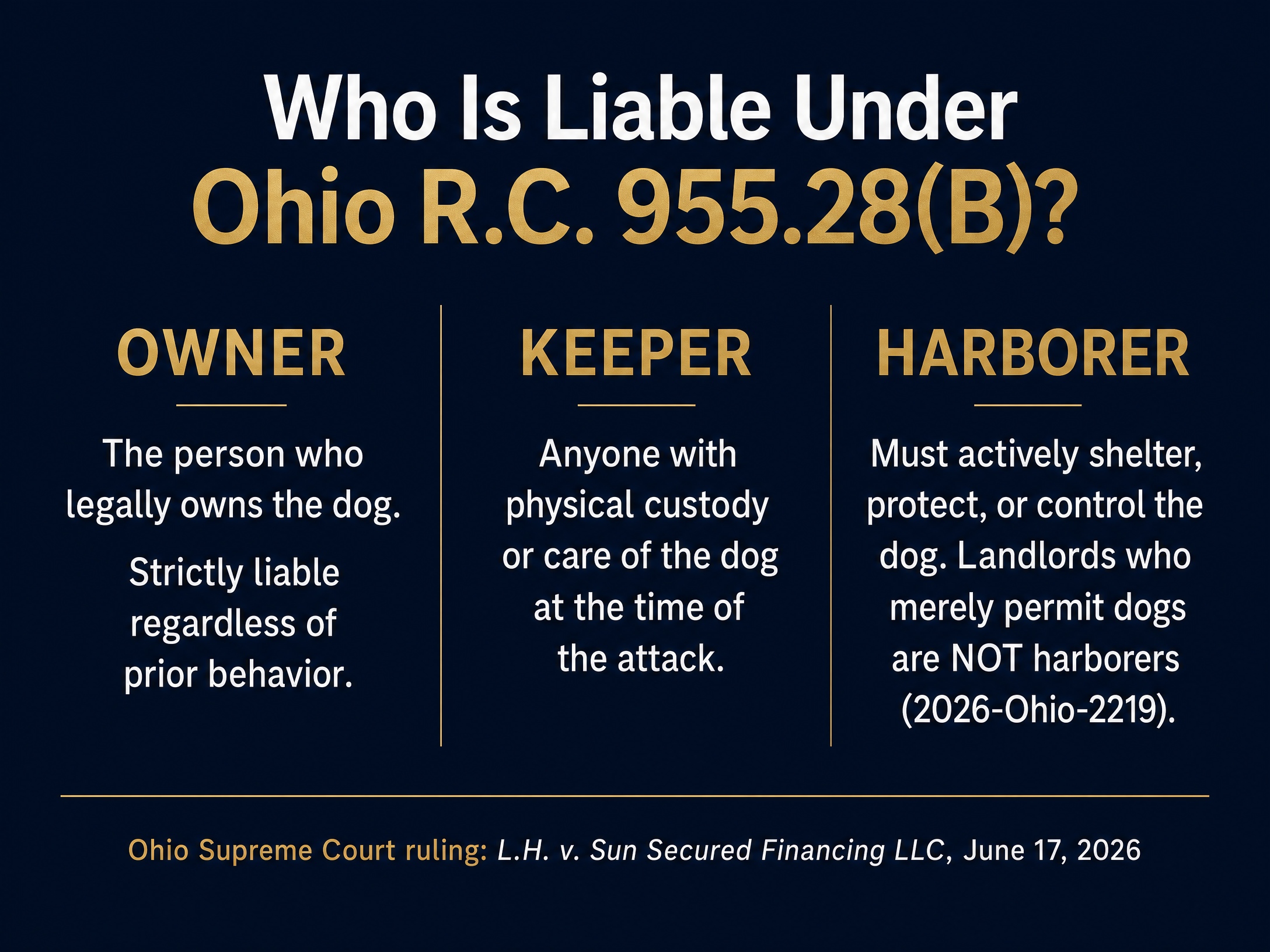
Ohio Revised Code § 955.28(B) provides one of the strongest victim protections in the country. It states that the "owner, keeper, or harborer" of a dog is strictly liable for any injury the dog causes, meaning the victim does not need to prove the dog had a history of aggression (the "one free bite" rule does not apply in Ohio).
While "owner" and "keeper" are relatively straightforward concepts involving ownership and physical custody, the term "harborer" is not explicitly defined in the statute. For decades, Ohio appellate courts generally defined a harborer as someone who possesses or controls the premises where a dog lives and silently consents to the dog's presence. This often meant landlords could be held liable for attacks that occurred in common areas under their control.
The Supreme Court's New Definition of "Harborer"
Writing for the majority, Chief Justice Sharon L. Kennedy rejected the historical appellate court definition. Because the statute does not define "harborer," the Court applied the plain and ordinary dictionary meaning of the word.
The Court ruled: "To harbor a dog under R.C. 955.28(B), one must shelter, protect, or exercise control over it."
The majority concluded that simply allowing residents to own dogs and permitting those dogs in common areas on a leash does not constitute sheltering, protecting, or controlling the animal. The property owner did not provide dog food or dog houses in the common areas. Therefore, as a matter of law, Sun Secured Financing was not a harborer and could not be held strictly liable for the boy's injuries.
The Dissent: Upending Decades of Caselaw
Justice Patrick F. Fischer, joined by Justice Jennifer Brunner, authored a strong dissenting opinion. Justice Fischer pointed out that the definition of a harborer as someone who controls the premises and acquiesces to a dog's presence has been applied by Ohio courts since 1945, including 11 of the 12 district courts of appeals.
The dissent argued that when lawmakers added the word "harborer" back into the statute in 1987, they intended for landlords to face liability under certain circumstances. Justice Fischer stated that if Ohio wishes to institute such a drastic change to limit landlord liability, the change should come from the General Assembly, not the Court.
What This Means for Ohio Dog Bite Victims
This ruling has immediate and profound implications for dog bite victims across Ohio, including here in Cuyahoga County:
- Landlord Liability is Restricted: It is now significantly more difficult to hold an apartment complex, mobile home park, or residential landlord strictly liable under R.C. 955.28(B) when a tenant's dog attacks someone in a common area.
- Focus Shifts to the Owner: Victims must primarily pursue compensation from the dog's actual owner or the person who had physical custody (the keeper) at the time of the attack.
- Negligence Claims Remain: While strict liability under the statute is restricted, landlords may still potentially face liability under common law negligence theories if they knew a specific dog was dangerous and failed to take action to protect tenants. However, negligence requires a higher burden of proof than strict liability.
Seeking Legal Representation
Because the legal landscape surrounding dog bites in Ohio is actively shifting, it is more important than ever to consult with an attorney who closely tracks these Supreme Court decisions. If you or a loved one has been injured by a dog, a thorough investigation is required to identify all liable parties and available insurance coverage.
Consult Thomas P. Ryan at Ryan LLP for a free case evaluation to understand how this new ruling may impact your specific situation.
Injured in a Dog Bite in the Cleveland Area?
Ohio's strict liability law means you don't have to prove the dog was dangerous before. Ryan Injury Attorneys handles dog bite cases throughout Cuyahoga County. No fee unless we recover for you.