Strongsville, Ohio — Dog Bite Law
Strongsville is a large outer-ring suburb of approximately 46,491 residents (2020 Census) located in the southwestern corner of Cuyahoga County at the intersection of Interstate 71 and the Ohio Turnpike. The city's Chapter 618 animal ordinance contains a comprehensive leash law, a nuisance declaration that expressly covers biting dogs, mandatory post-bite rabies quarantine procedures, a detailed dangerous dog classification and confinement framework, and a unique prohibition on dog ownership by convicted felons. Strongsville employs its own dedicated Animal Control Officer and does not share animal control services with neighboring municipalities, which means bite reports, quarantine records, and incident documentation tend to be thorough and accessible.
If you have been bitten by a dog in Strongsville, Ohio law under R.C. § 955.28 entitles you to compensation from the dog's owner, keeper, or harborer regardless of whether the animal has ever bitten anyone before. Strongsville's homeownership rate of approximately 81.5% means the overwhelming majority of dog bite defendants are homeowners whose liability is covered by homeowner's insurance — creating a reliable and financially secure recovery pathway for injured victims.
Strongsville at a Glance
No fee unless we recover — call (216) 363-6040
Strongsville at a Glance
Strongsville Animal Control & Local Ordinances
Strongsville regulates animals under Chapter 618 of its Codified Ordinances, found in Part Six (General Offenses Code). The chapter contains 24 sections addressing leash requirements, nuisance conditions, bite quarantine, dangerous and vicious dog classification, confinement standards, liability insurance obligations, and a post-conviction felon restriction on dog ownership. Strongsville has no breed-specific legislation; Ohio eliminated state-level BSL in 2012 and Strongsville has enacted no local counterpart.
Section 618.01 — Dogs and Other Animals Running at Large
Section 618.01(b) prohibits any owner or keeper of a dog from permitting the dog to go beyond the owner's or keeper's premises at any time, except when held securely on a leash or under the control of some responsible person. Section 618.01(c) provides that the running at large of any animal on a public way or unenclosed land constitutes prima facie evidence that the animal is running at large in violation of the section — a powerful evidentiary provision for victims who can establish the dog was off-leash at the time of the attack.
Penalties: A first-offense violation of subsection (b) carries a fine of not less than $25 nor more than $100. Each subsequent offense carries a fine of $75 to $250 and up to 30 days imprisonment. This section was last amended by Ord. 2021-103 (passed July 19, 2021).
Plaintiff's significance: A violation of Section 618.01(b) establishes negligence per se — the dog was off its owner's premises without a leash, in direct violation of a municipal safety ordinance. The prima facie evidence provision of subsection (c) shifts the initial burden: witness testimony or video footage showing the dog running free is, on its face, sufficient to establish the violation without further proof at the pleading stage.
Section 618.13 — Nuisance Conditions Prohibited
Section 618.13(b) is directly relevant to dog bite victims. It declares that any animal that "by barking, biting, howling or in any other way or manner, injures or disturbs the quiet of any person, or destroys or damages any lawn, tree, shrub, plant, building or other property" beyond the owner's own property is a nuisance. The section further provides that no person who is the owner or in charge of any such animal shall permit the animal to be or create such a nuisance, and that no such person shall continue to keep or harbor such an animal within Strongsville unless it is confined or otherwise controlled so as to prevent the nuisance from recurring.
Plaintiff's significance: This section creates an independent ordinance-based duty running to anyone injured by a biting dog. If the dog bit the victim once before — even without a formal dangerous dog designation — the owner was on notice that the animal had created a nuisance under 618.13(b) and was obligated to confine or control it. A second incident following that prior bite becomes evidence of both a 618.13 violation and notice of dangerous propensity relevant to punitive damages analysis.
Section 618.11 — Rabies Quarantine
Section 618.11(a) requires that whenever an animal bites any person, the owner or person having custody of the animal must immediately cause the animal to be examined by a licensed veterinarian and, upon order of the Director of Public Safety, the Animal Warden, and/or a police officer, quarantine the animal for ten days. All costs of quarantine and examination are borne by the owner. Section 618.11(b) provides that if the owner fails to comply within six hours of an issued quarantine order, any police officer or the Animal Warden may take the animal into custody at the owner's expense.
Plaintiff's significance: The mandatory quarantine and veterinary examination requirements generate a formal paper record documenting the bite incident, the animal's identity and ownership, and the owner's compliance or non-compliance. Victims should promptly request copies of all quarantine orders and Animal Control Officer incident reports, as these become critical exhibits in civil litigation and insurance negotiations.
Section 618.17 — Dangerous Dog Classification; Court Hearing; Appeal
Section 618.17 establishes Strongsville's local dangerous dog classification procedure, including the definitions of "nuisance dog," "dangerous dog," and "vicious dog" that govern the requirements in Sections 618.18 and 618.19. The classification process involves a court hearing at Berea Municipal Court, and the owner, keeper, or harborer of a designated animal has the right to appeal. Classification as a dangerous dog triggers mandatory confinement, restraint, insurance, and registration requirements.
Section 618.18 — Confinement or Restraint of Dog; Liability Insurance
Section 618.18(b) imposes an at-all-times confinement and control obligation on every owner, keeper, or harborer of any dog: the animal must be (1) physically confined or restrained on the premises by a leash, tether, adequate fence, supervision, or secure enclosure to prevent escape, and (2) kept under the reasonable control of some person. This applies to all dogs, not only those designated as dangerous.
Felon restriction (618.18(n)): Strongsville's ordinance contains a notable provision prohibiting any person convicted of or pleading guilty to a felony offense of violence, or a felony violation of R.C. Chapters 959, 2923, or 2925, from knowingly owning, possessing, having custody of, or residing in a household with an unspayed or unneutered dog older than twelve weeks of age, or any dangerous dog, for three years following release from incarceration. A violation of this prohibition is a misdemeanor of the first degree. This creates an additional layer of liability analysis in cases involving dog owners with prior felony convictions.
Section 618.16 — Animal Owner Liable for Damage to Property
Section 618.16 expressly imposes civil liability on animal owners for damage caused by their animals to public property. While the primary recovery vehicle for bite victims is R.C. § 955.28, this provision reinforces the principle of owner accountability embedded throughout Strongsville's animal control framework.
Ohio Strict Liability — R.C. § 955.28
Ohio's strict liability statute — R.C. § 955.28 — is the primary basis for dog bite claims in Strongsville. The statute imposes liability on any owner, keeper, or harborer of a dog that bites, injures, or kills a person, without requiring proof of prior knowledge of the dog's dangerous propensities. For a complete explanation of the statute's elements, affirmative defenses, and recoverable damages, see our complete guide to Ohio dog bite law.
81.5% Homeownership — A Reliable Insurance Recovery Landscape
Strongsville's homeownership rate of approximately 81.5% is among the highest in Cuyahoga County's outer-ring suburbs, comparable to Brecksville and Broadview Heights. Nearly every dog bite defendant in Strongsville is a homeowner whose liability exposure is covered by a standard homeowner's insurance policy. Standard policies typically provide $100,000 to $300,000 in personal liability coverage, and many Strongsville homeowners carry umbrella policies given the city's higher-than-average household incomes. This makes Strongsville one of the most favorable venues in Cuyahoga County from a recovery standpoint — the insurance infrastructure is deep and financially solid.
Aging Population and Elevated Injury Severity
The 2020 Census recorded a median age of 45.8 years in Strongsville, with 22.9% of residents — more than one in five — aged 65 or older. Dog bites suffered by elderly victims carry disproportionate medical and legal significance: older victims are more vulnerable to serious tissue injury, infection, bone fractures from falls caused by dog attacks, and lengthy rehabilitation. Under R.C. § 955.28, all of these are compensable as bodily injury damages. The combination of high injury severity and a financially secure defendant population (homeowners with insurance) supports strong recovery outcomes for Strongsville victims, particularly those in older age groups.
Dual Ordinance Theories: Leash Law and Nuisance Declaration
Unlike cities whose Chapter 618 ordinances are primarily administrative, Strongsville's Section 618.01(b) leash law and Section 618.13(b) nuisance declaration work in tandem to provide two independent ordinance-based theories of liability alongside R.C. § 955.28. When the attacking dog was off-leash at the time of the bite, Section 618.01(b)'s prima facie evidence provision and Section 618.18(b)'s at-all-times confinement requirement both support negligence per se arguments — the owner violated not one but two ordinance-level duties of care. When the dog had bitten or injured anyone previously, Section 618.13(b)'s nuisance framework independently documents prior notice, which is relevant both to damages analysis and to the "harborer" prong of § 955.28 (supporting claims against landlords or property managers who knew of the animal's presence).
Dedicated Animal Control Documentation
Unlike smaller Cuyahoga County municipalities that share animal control personnel with neighboring cities, Strongsville employs its own dedicated Animal Control Officer. Bite incidents in Strongsville generate Animal Control Office reports, quarantine orders under Section 618.11, and follow-up documentation that are maintained locally and independently of county systems. This typically produces a more complete and accessible evidentiary record than in cities relying on shared or contracted animal control services. Victims should request the ACO's incident report and any quarantine documentation immediately following a bite.
“The owner, keeper, or harborer of a dog is liable in damages for any injury, death, or loss to person or property that is caused by the dog, unless the person was trespassing or committing a criminal offense on the property of the owner, keeper, or harborer, or was teasing, tormenting, or abusing the dog.”— Ohio Revised Code § 955.28(B)
Venue & Court Information
Berea Municipal Court
Dog bite civil cases arising in Strongsville are heard at the Berea Municipal Court, located at 11 Berea Commons, Berea, Ohio 44017. The presiding judge is Judge Sean Kilbane, who took office January 2, 2024. Clerk of Court Joe DeMio manages case filing and scheduling and can be reached at (440) 826-5862.
The Berea Municipal Court has jurisdiction over cases arising in Berea, Brook Park, Middleburg Heights, Olmsted Falls, Olmsted Township, Strongsville, and the MetroParks system. The court hears civil claims up to $15,000 and operates a small claims division for claims up to $6,000. Dog bite claims seeking damages of $15,000 or less — including medical bills, lost wages, and pain and suffering — may be filed in Berea Municipal Court. Claims exceeding $15,000 must be filed in the Cuyahoga County Court of Common Pleas.
Note that Strongsville also maintains its own Mayor's Court (18688 Royalton Road, Strongsville) for traffic and misdemeanor criminal matters, including ordinance violations such as dog running at large under Section 618.01. Magistrate George Lonjak presides; contested matters from Mayor's Court are automatically referred to Berea Municipal Court. The existence of Mayor's Court records documenting a prior ordinance violation by the dog's owner can be valuable supporting evidence in a civil claim.
Statute of Limitations
Strict liability claims under R.C. § 955.28 must be filed within six years of the date of the injury. Negligence claims must be filed within two years. If the victim was a minor at the time of the bite, the statute of limitations does not begin to run until the child turns 18. For complete details on filing deadlines, tolling, and recoverable damages, see our Ohio dog bite law guide.
Local Risk Factors in Strongsville
Population and Density
Strongsville had a population of 46,491 at the 2020 Census, spread across approximately 24.6 square miles, for a density of roughly 1,890 residents per square mile. This makes Strongsville one of the largest municipalities in the Berea Municipal Court's jurisdiction by population, comparable in size to Westlake (approximately 33,500) but substantially denser in its residential core. The moderate-to-suburban density means residents regularly encounter neighbors' dogs on sidewalks, walking paths, and shared green spaces — the environments where the majority of dog bites occur.
Senior Population and Vulnerability
With 22.9% of residents aged 65 or older at the 2020 Census and a median age of 45.8 years, Strongsville has one of the more aged demographic profiles among outer-ring Cuyahoga County suburbs. Elderly residents on walking routes, at parks, or receiving home delivery are statistically more likely to sustain serious injuries from dog attacks, including falls, lacerations requiring surgical repair, and infections. These injury profiles typically result in higher medical costs and longer recovery periods, all of which factor into the damages calculation under R.C. § 955.28.
Residential Neighborhoods and Walking Corridors
Strongsville's established residential subdivisions along Royalton Road (US 42), Pearl Road (SR 42), and State Road contain a high density of single-family homes on larger lots, many of which have fenced or semi-fenced yards. Dog encounters commonly occur at property lines, on sidewalks adjacent to unfenced yards, and along the walking paths that connect Strongsville's subdivisions. The city's extensive trail network, including connections to the Cleveland Metroparks' Royalview Lake area and Big Creek Reservation, creates additional encounter points where dogs and pedestrians share space.
Commercial Corridors and the I-71/Turnpike Area
The SouthPark Mall area and the commercial corridor at the I-71/Ohio Turnpike interchange generate substantial pedestrian foot traffic in adjacent residential neighborhoods. Dog encounters in the transition zones between commercial and residential land uses — delivery routes, parking areas near retail centers, and residential streets in the southern and eastern portions of the city — represent a meaningful category of bite incidents.
Reporting a Dog Bite in Strongsville
Dog bite victims in Strongsville should call the Strongsville Police Department at (440) 238-7373 (non-emergency) or contact Animal Control Officer Chuck McCleary directly at (440) 580-3180 or animal.control@strongsville.org. For urgent animal-related matters, call the police non-emergency line. Victims should also report the bite to the Cuyahoga County Board of Health at 216-201-2001, which maintains its own records of animal bite incidents. Request copies of all Animal Control Officer reports, any quarantine orders issued under Section 618.11, and the veterinary examination records, as these documents are essential evidence in a civil claim.
Frequently Asked Questions — Strongsville
Related Articles & News
Dog Bite FAQ Strongsville Ohio: What Victims Should Know
If you were bitten by a dog in Strongsville, Ohio law provides a clear path to compensation. Here are the answers to the most common questions victims ask.
Read article →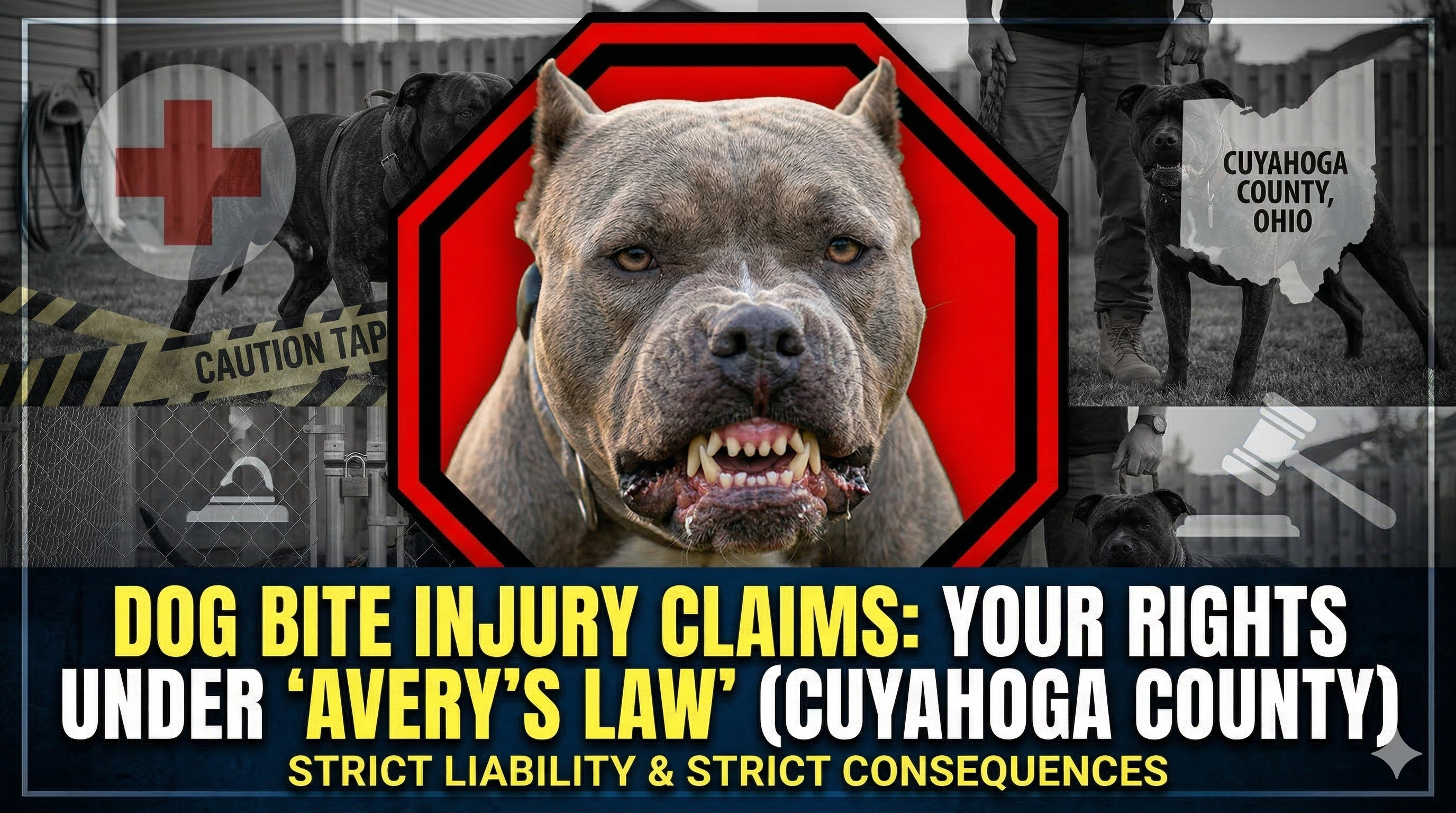
Avery's Law Is Now in Effect: What Ohio's New Dog Attack Law Means for Cuyahoga County Victims
Ohio's most significant overhaul of dangerous dog law in decades takes effect March 18, 2026. Here is what Avery's Law changes, what it does not change, and what it means if you or someone you love is attacked by a dog in Cuyahoga County.
Read article →About This Resource
This site provides educational analysis of Ohio dog bite law under R.C. § 955.28 for residents of Strongsville and Cuyahoga County. It is not a law firm and does not provide legal advice.
For legal representation, this resource is operated in association with Ryan Injury Attorneys, a personal injury law firm licensed in Ohio.