Olmsted Falls, Ohio — Dog Bite Law
Olmsted Falls is a small, historic city in southwestern Cuyahoga County, defined by the Rocky River valley, mature residential neighborhoods, and a walkable downtown centered around Grand Pacific Junction. When a dog bite occurs in Olmsted Falls, Ohio law provides strong protections for victims through the strict liability framework established by R.C. § 955.28.
Under Ohio's strict liability standard, the owner, keeper, or harborer of a dog is responsible for injuries the animal causes — even if the dog has never shown aggression before. Victims do not need to prove negligence. If you were lawfully present and did not provoke the dog, the responsible party owes compensation for your medical expenses, lost wages, pain, and other damages. Olmsted Falls' homeownership rate of approximately 85% strongly indicates that a homeowner's insurance policy will be available to provide financial compensation.
Olmsted Falls at a Glance
No fee unless we recover — call (216) 363-6040
Olmsted Falls at a Glance
Olmsted Falls Animal Control & Local Ordinances
The City of Olmsted Falls regulates animals under Chapter 618 of the Olmsted Falls Codified Ordinances. While the chapter is relatively concise compared to some larger Cuyahoga County municipalities, it addresses the core issues — confinement, dangerous and vicious dog classifications, nuisance conditions, and bite reporting — and defers to state law under R.C. § 955.11 for behavioral classification standards.
Animals Running at Large
Section 618.01 prohibits any owner, keeper, or harborer of an animal — including a dog — from permitting it to run at large upon any public property, unenclosed lands, or the premises of another. The running at large of any animal in these areas is prima facie evidence of a violation. A first offense is a misdemeanor of the fourth degree. When an at-large dog bites a person in Olmsted Falls, the ordinance violation strengthens a negligence per se argument alongside the strict liability claim under state law.
Dangerous and Vicious Dog Requirements
Section 618.01 also incorporates Ohio's statewide behavioral classification system under R.C. § 955.11, which categorizes dogs as "nuisance," "dangerous," or "vicious" based on individual conduct rather than breed. Owners of dangerous dogs in Olmsted Falls must keep the animal securely confined in a locked pen with a top or on a chain-link leash no longer than six feet when off the premises. Owners of vicious dogs must additionally obtain at least $100,000 in liability insurance. Violations involving vicious dogs can result in felony prosecution under R.C. § 955.22(D), and the court may order the dog humanely destroyed. A prior dangerous or vicious dog designation is powerful evidence in a civil bite case — it demonstrates the owner had documented notice of the animal's propensities.
Barking Dogs and Nuisance Conditions
Section 618.15 prohibits keeping any dog that disturbs the peace by barking, biting, howling, or by any other manner. It also declares any dog that damages another person's property to be a nuisance. Upon complaint, the Police Department notifies the owner and orders permanent abatement. A documented history of nuisance complaints under this section can serve as evidence of a pattern of irresponsible ownership in a subsequent bite case.
Wild and Potentially Dangerous Animals
Section 618.015 prohibits keeping or maintaining wild or potentially dangerous animals within the city. This provision supplements the state's behavioral classification system by preventing residents from harboring exotic or inherently dangerous animals that could cause injury.
No Breed-Specific Legislation
Olmsted Falls does not ban or restrict any specific dog breeds. The city's classification system under Chapter 618 is based solely on individual behavior — consistent with the approach Ohio adopted at the state level when it removed breed-specific language from R.C. § 955.11 in 2012. This stands in contrast to several other Cuyahoga County communities. Parma maintains an outright ban on pit bulls. Lakewood imposes breed-specific restrictions requiring certain breeds to be muzzled off-premises and limited to one per household. Brook Park bans pit bulls, American bulldogs, and presa canarios. In those jurisdictions, a violation of a local breed ban provides an additional ordinance violation that can strengthen a negligence per se claim on top of the strict liability protection that applies statewide.
Bite Reporting and Quarantine
When a dog bite occurs in Olmsted Falls, victims should report the incident to the Olmsted Falls Police Department at 440-235-1234. Under state law, R.C. § 955.261 requires a minimum ten-day quarantine period for any dog that has bitten a person to observe for signs of rabies. Victims should also report the bite to the Cuyahoga County Board of Health at 216-201-2001. Report bites promptly — ideally within 24 hours — to ensure quarantine procedures are followed and an official record of the incident is created.
How Local Ordinances Strengthen a Claim
A violation of an Olmsted Falls ordinance at the time of a dog bite can support a negligence per se claim — meaning the ordinance violation itself establishes a breach of the duty of care. This gives victims an additional path to recovery beyond strict liability. In a negligence case, the victim may also seek punitive damages if the owner's conduct was particularly reckless. Combining a strict liability claim under R.C. § 955.28 with a negligence per se argument based on a local ordinance violation creates a stronger overall case.
Ohio Strict Liability — R.C. § 955.28
Ohio Revised Code § 955.28(B) provides that the owner, keeper, or harborer of a dog is liable in damages for any injury, death, or loss to person or property caused by the dog. This is a strict liability standard. The victim does not need to prove negligence, prior knowledge of dangerous tendencies, or any previous incidents. This statute applies with full force to dog bite incidents in Olmsted Falls.
Owner, Keeper, and Harborer
Ohio law identifies three categories of responsible parties to prevent anyone from avoiding liability by claiming the dog belongs to someone else:
Owner — The person who legally possesses or has title to the dog, typically the individual on licensing or veterinary records.
Keeper — A person who had custody or control of the dog at the time of the incident. Dog walkers, pet sitters, and anyone temporarily responsible for the animal can qualify.
Harborer — A person who has possession and control of the premises where the dog lives and acquiesces to the dog's presence. In Olmsted Falls — where approximately 85% of housing is owner-occupied — this definition most frequently applies to homeowners themselves, but can also extend to landlords in rental situations who know a tenant keeps a dog on the property.
Elements of a Claim
To recover under R.C. § 955.28, the victim must establish three elements:
1. The dog caused injury, death, or loss. Any injury caused by a dog qualifies — not just bites. Knockdowns, maulings, and injuries sustained while fleeing an aggressive dog are all covered.
2. The defendant is the owner, keeper, or harborer. The victim must identify the responsible party and establish they fall into one of the three statutory categories.
3. No statutory defense applies. The victim was lawfully present and was not engaged in criminal trespass, criminal activity, or provocation of the dog.
What You Do NOT Need to Prove
Under strict liability, a victim does not need to show that the dog had ever bitten anyone before, that the owner knew the dog was dangerous, that the owner was negligent in training or restraining the dog, or that the dog belongs to a particular breed. Ohio abolished breed-specific liability at the state level in 2012.
Parallel Negligence Claims
Ohio allows a victim to pursue both a strict liability claim and a common law negligence claim in the same case. The Ohio Supreme Court confirmed this in Beckett v. Warren (2010). A negligence claim requires a higher burden of proof — the victim must show the dog had dangerous propensities and the defendant knew about them — but it opens the door to punitive damages for grossly negligent or malicious conduct.
Defenses Under R.C. § 955.28
The statute provides three narrow defenses. The owner is not liable if the victim was committing criminal trespass or another criminal offense (other than a minor misdemeanor) on the owner's property, committing a criminal offense against any person, or teasing, tormenting, or abusing the dog on the owner's property. Courts interpret the provocation defense narrowly — normal interactions like petting, walking near, or running past a dog do not qualify.
Importantly, assumption of the risk is not a valid defense. The Ohio Supreme Court held in Pulley v. Malek (1986) that this defense does not apply to strict liability claims under R.C. § 955.28. The absence of prior bites and the use of reasonable precautions such as leashes or fences also do not relieve the owner of liability.
“The owner, keeper, or harborer of a dog is liable in damages for any injury, death, or loss to person or property that is caused by the dog, unless the person was trespassing or committing a criminal offense on the property of the owner, keeper, or harborer, or was teasing, tormenting, or abusing the dog.”— Ohio Revised Code § 955.28(B)
Venue & Court Information
Berea Municipal Court
Dog bite lawsuits arising in Olmsted Falls are filed at the Berea Municipal Court, located at 11 Berea Commons, Berea, OH 44017. The court handles civil claims of $15,000 or less and serves the municipalities of Berea, Brook Park, Middleburg Heights, Olmsted Falls, Olmsted Township, and Strongsville, as well as the Cleveland Metroparks. For dog bite claims with limited damages, Berea Municipal Court offers a faster path to resolution. The court also handles criminal cases related to animal control ordinance violations and dangerous dog designations.
Cuyahoga County Court of Common Pleas
Dog bite claims seeking damages above $15,000 must be filed in the Cuyahoga County Court of Common Pleas, located at the Justice Center, 1 Lakeside Avenue, Cleveland, OH 44113. Most serious dog bite cases — those involving surgery, permanent scarring, significant lost wages, or ongoing medical treatment — are filed here. The Court of Common Pleas has general jurisdiction with no upper limit on damages.
Statute of Limitations
Strict Liability Claims — Six Years. Claims under R.C. § 955.28 must be filed within six years of the date of the incident. This is significantly longer than most personal injury filing deadlines in Ohio.
Negligence Claims — Two Years. Claims pursued under a common law negligence theory must be filed within two years under R.C. § 2305.10.
Claims Involving Minors. If the victim was under 18 at the time of the attack, the six-year statute of limitations for strict liability claims does not begin to run until the child turns 18.
Importance of Early Action
Even though Ohio provides up to six years for strict liability claims, acting promptly preserves critical evidence, secures witness testimony, and prevents the loss of documentation. Insurance companies frequently contact victims within days of an incident to obtain statements that may undermine a claim. Consulting an attorney before giving any recorded statement is strongly advisable. Victims should also report the bite to the Olmsted Falls Police Department at 440-235-1234 and file a report with the Cuyahoga County Board of Health to create an independent official record of the incident.
Local Risk Factors in Olmsted Falls
Rocky River Valley and Public Parks
Olmsted Falls is geographically shaped by the Rocky River and its associated parklands, including David Fortier River Park and East River Park. These high-traffic public areas draw families, joggers, and dog walkers into close proximity — particularly during warmer months. Encounters between leashed dogs, off-leash dogs, and pedestrians are common along the trails. Bites that occur in public parks carry full strict liability protection for victims who were lawfully present, and an off-leash dog in a park is a direct violation of Section 618.01.
Residential Neighborhoods
Olmsted Falls' residential character — with established neighborhoods of single-family homes along tree-lined streets — creates frequent close-range encounters between residents, visitors, and dogs. Many properties have moderate lot sizes where dogs are kept in yards, on porches, or behind fencing that may not adequately contain an aggressive animal. The city's walkable downtown around Grand Pacific Junction brings pedestrians near residential areas where dogs may not be properly restrained.
Children and Older Adults at Elevated Risk
Approximately one in five Olmsted Falls residents is under 18, and a similar proportion is over 65 — the two age groups most vulnerable to serious dog bite injuries. Children are more likely to approach unfamiliar dogs, less able to recognize warning signs of aggression, and more vulnerable to severe injuries to the face, head, and neck because of their smaller stature. Older adults are at heightened risk for fractures, slow-healing wounds, and dangerous infections from bites. Ohio law permits parents to file a claim on behalf of a minor, and the six-year statute of limitations is tolled until the child's 18th birthday.
Sidewalks and Delivery Interactions
Mail carriers, package delivery drivers, and service workers in Olmsted Falls regularly approach residential properties where dogs may be present. These workers are lawfully on the property and retain full protection under R.C. § 955.28. The growth of home delivery services has increased the number of daily encounters between delivery personnel and dogs in Olmsted Falls' residential areas.
Insurance Considerations
Most dog bite claims in Olmsted Falls are resolved through the dog owner's homeowner's or renter's insurance policy. Olmsted Falls' homeownership rate of approximately 85% strongly indicates that a homeowner's insurance policy will be available to provide financial compensation. Standard homeowner's policies typically include $100,000 to $300,000 in liability coverage for dog bite injuries, though some insurers exclude certain breeds, impose sublimits on animal-related claims, or deny coverage if the dog has a prior bite history. An experienced attorney can investigate all available coverage and identify every potentially liable party early in the process.
Frequently Asked Questions — Olmsted Falls
Related Articles & News
Dog Bite in Olmsted Falls Ohio: Frequently Asked Questions
Have you been bitten by a dog in Olmsted Falls, Ohio? Our FAQ guide covers local ordinances, the critical $100,000 liability insurance requirement for vicious dogs, reporting requirements, and how to seek compensation for your injuries.
Read article →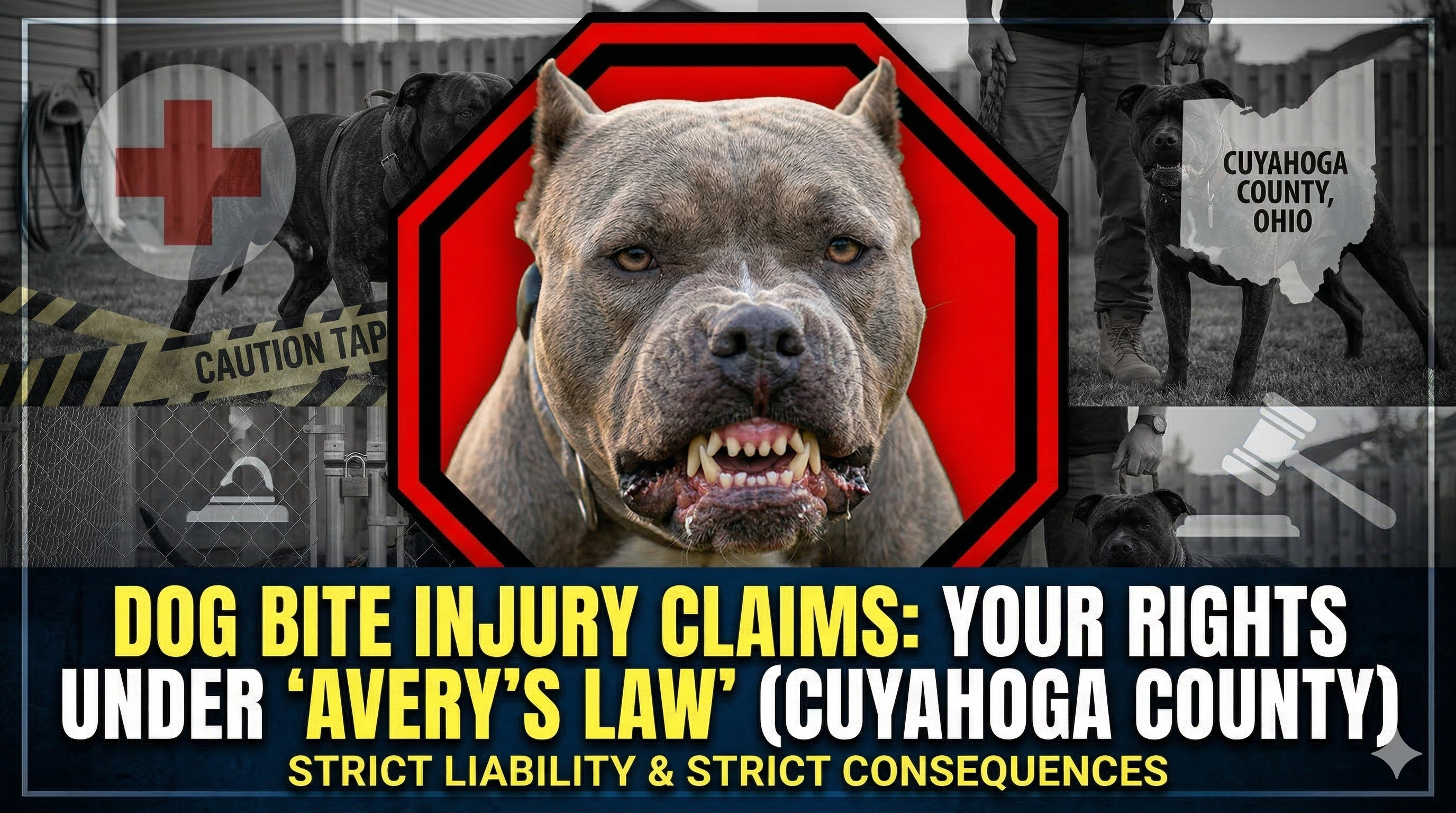
Avery's Law Is Now in Effect: What Ohio's New Dog Attack Law Means for Cuyahoga County Victims
Ohio's most significant overhaul of dangerous dog law in decades takes effect March 18, 2026. Here is what Avery's Law changes, what it does not change, and what it means if you or someone you love is attacked by a dog in Cuyahoga County.
Read article →About This Resource
This site provides educational analysis of Ohio dog bite law under R.C. § 955.28 for residents of Olmsted Falls and Cuyahoga County. It is not a law firm and does not provide legal advice.
For legal representation, this resource is operated in association with Ryan Injury Attorneys, a personal injury law firm licensed in Ohio.