Newburgh Heights, Ohio — Dog Bite Law
Newburgh Heights is a compact, densely settled village of approximately 1,860 residents packed into just 0.58 square miles of southern Cuyahoga County — a density of roughly 3,207 persons per square mile that places it among the more densely populated communities in the county. Bordered by Cleveland, Garfield Heights, and Cuyahoga Heights, this working-class enclave sits along Interstate 77 and Harvard Avenue, and has a strong Polish-American heritage dating to the early twentieth century. The village operates a public Dog Park on Washington Park Boulevard and has enacted one of the more expansive vicious dog ordinances in the county: § 505.20 of the Codified Ordinances defines a "vicious dog" based on observable propensity or tendency to attack — not just a documented prior incident — and routes classification appeals to the Zoning Board of Appeals rather than municipal court, creating an administrative pathway that operates independently of criminal prosecution.
If you or a family member was bitten by a dog in Newburgh Heights, Ohio's strict liability statute — R.C. § 955.28 — entitles you to compensation from the dog's owner, keeper, or harborer regardless of whether the dog has ever bitten anyone before. With approximately half of Newburgh Heights households renting, harborer and landlord liability theories are available in cases where a tenant's dog injures a visitor or neighbor — and the landlord knew or had reason to know a dangerous animal was kept on the premises.
Newburgh Heights at a Glance
No fee unless we recover — call (216) 363-6040
Newburgh Heights at a Glance
Newburgh Heights Animal Control & Local Ordinances
Newburgh Heights regulates animals under Chapter 505 of its Codified Ordinances, one of the most detailed animal control frameworks among the smaller villages in the Garfield Heights Municipal Court jurisdiction. The chapter spans 23 numbered sections covering at-large violations, bites, quarantine, vicious dog classification, dog park regulation, cat registration, and more. Several provisions are structurally unusual and materially affect the rights of bite victims.
Section 505.01 — Dogs, Cats and Other Animals Running at Large
Unlike most Chapter 505 communities, Newburgh Heights' § 505.01 expressly covers cats in the title and operative language alongside dogs — reflecting a legislative choice to apply the same at-large framework to both species. The section defines four terms: Animal Control Officer (any person employed or appointed by the Village authorized to investigate civil infractions and issue citations); Collar (a device bearing registration tags with owner name, address, and phone); Control (exercising dominance that clearly and unequivocally demonstrates unwavering command over the animal); and Restraint (a leash, cord, chain, or other physical means). A dog or cat is "at large" when it is off the owner's or keeper's premises and not under Control by means of a Restraint. Both a Village Animal Control Officer and any Law Enforcement Officer may issue citations upon probable cause. If the owner cannot be located, the ACO may impound the animal at any Cuyahoga County impound facility at the owner's expense.
Section 505.10 — Animal Bites; Reports and Quarantine
Any person bitten by a dog or other animal must report the bite to the Health Commissioner within 24 hours. Upon receiving such a report, the Health Commissioner orders quarantine of the biting animal for a minimum of 10 days from the date of the bite. Quarantine may be at the owner's or harborer's premises, or in a pound or kennel — but in all cases it proceeds under Health Commissioner supervision and at the owner's or harborer's expense. If the Health Commissioner orders a veterinary examination for rabies symptoms, that examination also runs at the owner's or harborer's expense. The animal may not be released from quarantine until it has been properly vaccinated against rabies. Violation of the quarantine order or failure to timely report is a minor misdemeanor. From a victim's perspective, the official quarantine record — including the bite report, the Health Commissioner's order, and any veterinary findings — is a public record that directly documents the incident and establishes the owner's identity as a matter of official record.
Section 505.15 — Maximum Number of Dogs or Cats Permitted
Newburgh Heights limits the number of dogs or cats that may be kept per dwelling unit — a provision relevant in cases involving multi-dog households where a pack dynamic contributed to the severity of an attack. Where the attacking dog was one of several animals kept in violation of the numerical limit, the owner's violation of § 505.15 is independently relevant to a negligence per se analysis.
Section 505.16 — Registration of Cats
Newburgh Heights requires annual registration of cats — an unusual provision that few Cuyahoga County communities have enacted. Cat registration creates an ownership record that is relevant in cases involving cat bites or scratches, establishing identity of the responsible party when the animal cannot otherwise be traced.
Section 505.20 — Vicious Dogs
Section 505.20 is the most legally significant provision in Chapter 505 for dog bite victims. Its text is available at codelibrary.amlegal.com. Three features distinguish it from the standard Ohio Chapter 505 framework:
Broader vicious dog definition. State law under R.C. § 955.11 defines a "dangerous dog" based on actual past conduct (prior bite, killing another dog, or third R.C. § 955.22(C) violation) and a "vicious dog" based on prior serious injury to a person. Newburgh Heights § 505.20(a)(1) goes further: a dog is "vicious" under the local ordinance if it has any propensity, tendency, or disposition to attack unprovoked, to cause injury, or to endanger the safety of humans or domestic animals — even before any incident has occurred. This means a dog that has shown threatening behavior, lunged at people, or displayed aggressive tendencies can be designated vicious under § 505.20 without having actually bitten anyone. A victim who was bitten by a dog that neighbors had previously observed acting threateningly may be able to argue that the dog met the § 505.20(a)(1)(A) definition before the attack — supporting a claim that the owner had notice of the animal's dangerous propensity.
Appeal to Zoning Board of Appeals, not municipal court. When the Chief of Police or the Cuyahoga County Board of Health's Animal Control Officer issues a vicious dog designation, the owner has 5 working days to file a written appeal with the Newburgh Heights Zoning Board of Appeals. The ZBA must hear the appeal within 20 working days and its decision is the Village's final determination. Critically, the filing of an appeal stays the § 505.20 compliance requirements — but does not preclude impoundment and does not relieve the owner, keeper, or harborer of civil or criminal liability for any injury caused during the pendency of the appeal. A victim who pursues a § 505.20 designation proceeding thus creates an official administrative record while the owner's civil liability remains fully intact throughout the process.
Mandatory $1,000 non-suspendable fine for subsequent violations. A first § 505.20 violation (other than subsection (h)) is a first-degree misdemeanor. Any subsequent violation carries a mandatory $1,000 fine that the court may not suspend or remit, in addition to the M1 penalty. The court may also order a vicious dog destroyed if it attacks a human or domestic animal and represents a continuing threat. The offender must pay all shelter, food, and veterinary expenses for identification or certification of the breed or boarding.
Confinement requirements. An unconfined vicious dog is one that is not in a locked, fully enclosed pen (sides, top, and floor/bottom embedded at least 2 feet in the ground) when outside, or is in a room with an open window or screen door when inside. A vicious dog may not be kept on a porch or patio or in any part of a structure from which it could exit on its own.
Section 505.21 — Dog Park
Newburgh Heights established a public Dog Park on Washington Park Boulevard pursuant to Ordinance 2012-80. The park is fenced and gated, open 8:00 a.m. to 8:00 p.m., and accessible to the public subject to posted rules. Violations of park rules are a minor misdemeanor on a first offense and a fourth-degree misdemeanor for each subsequent offense. The Dog Park creates a defined geographic location where dogs from different households interact off-leash — a setting associated with elevated bite incident rates compared to leashed encounters on public streets. Ohio's strict liability statute applies equally to bites occurring inside the Dog Park as to bites anywhere else in the village.
Breed-Specific Legislation
Chapter 505 contains no breed-specific legislation. Ohio eliminated state-level BSL in 2012, and Newburgh Heights has not enacted breed restrictions. Vicious dog status under § 505.20 is determined by behavior, propensity, and administrative/judicial determination — not breed.
Ohio Strict Liability — R.C. § 955.28
Ohio's strict liability statute — R.C. § 955.28 — imposes liability on any owner, keeper, or harborer whose dog bites, injures, or kills a person who was not trespassing, did not tease or torment the dog, and was not committing a criminal offense. No prior bite history is required. For a complete analysis of the statute, available defenses, and recoverable damages, see our Ohio dog bite law guide.
Harborer Liability in a ~49% Renter Community
Approximately half of Newburgh Heights' housing units are renter-occupied — a ratio that makes harborer and landlord liability theories especially important in local dog bite cases. Under R.C. § 955.28, a "harborer" is anyone who permits a dog to remain on their property or who exercises any degree of care or control over the animal. A landlord who knowingly allows a tenant to keep a dangerous dog on rental property, and who has the ability under the lease or applicable housing code to prohibit or remove the animal, may be a harborer for purposes of the statute. Where the tenant is uninsured or judgment-proof, a harborer claim against the property owner provides an alternative recovery pathway — particularly important in a community where median home values of approximately $95,500 limit the judgment-collectability of a case against the owner alone.
The § 505.20 Propensity Definition as Civil Evidence
Because Newburgh Heights § 505.20(a)(1) classifies a dog as vicious based on a propensity or tendency to attack — without requiring a prior incident — an owner who knew or should have known that their dog displayed aggressive tendencies may have had constructive notice of the animal's dangerous character even before any bite occurred. Evidence that a dog had previously lunged at pedestrians, threatened delivery workers, or acted aggressively toward neighbors is relevant to establishing that the owner had actual or constructive notice, which in turn supports both the state strict liability claim and any negligence claim based on failure to confine or control. A § 505.20 designation proceeding, even if not completed before suit is filed, creates an official record of the dog's behavioral history that is discoverable and admissible in civil proceedings.
Dog Park Incidents and the Strict Liability Standard
The Newburgh Heights Dog Park on Washington Park Boulevard creates a location where strict liability analysis intersects with voluntary assumption of risk arguments. Ohio courts have recognized that a person who enters a designated off-leash area assumes some risk of dog-to-dog interaction — but the assumption of risk defense applies to the normal risks of the activity, not to an unprovoked attack by a dog already known to be dangerous or vicious. A victim who was in the Dog Park for lawful recreational purposes and was bitten without provocation retains a full R.C. § 955.28 claim; the dog park setting does not extinguish strict liability. Evidence that the attacking dog previously displayed the propensity or tendency described in § 505.20(a)(1) — even within the Dog Park context — supports full recovery.
Statute of Limitations
Strict liability claims under R.C. § 955.28 must be filed within six years of the date of the bite. Negligence claims — including claims based on violation of § 505.01 (at large or not under control) or § 505.20 (vicious dog confinement requirements) — must be filed within two years. If the victim was a minor at the time of the attack, the statute of limitations does not begin running until the child turns 18. For complete details see our Ohio dog bite law guide.
“The owner, keeper, or harborer of a dog is liable in damages for any injury, death, or loss to person or property that is caused by the dog, unless the person was trespassing or committing a criminal offense on the property of the owner, keeper, or harborer, or was teasing, tormenting, or abusing the dog.”— Ohio Revised Code § 955.28(B)
Venue & Court Information
Garfield Heights Municipal Court
Dog bite cases arising in Newburgh Heights are heard at the Garfield Heights Municipal Court, 5555 Turney Road, Garfield Heights OH 44125, phone (216) 475-1900. The presiding judges are the Honorable Deborah J. Nicastro and the Honorable Sergio I. DiGeronimo. The Clerk of Courts is Alexander F. Grgat. The court's territorial jurisdiction covers Newburgh Heights, Garfield Heights, Independence, Maple Heights, Brecksville, Valley View, Walton Hills, and Cleveland Metroparks.
Garfield Heights Municipal Court exercises civil jurisdiction over claims up to $15,000 and operates a small claims division for claims up to $6,000. Dog bite cases in Newburgh Heights where damages exceed $15,000 — which is common in attacks requiring medical treatment, stitches, or producing permanent scarring — must be filed in the Cuyahoga County Court of Common Pleas. Given Newburgh Heights' modest median home values of approximately $95,500 to $103,000 and its mixed owner-renter demographic, insurance coverage and the existence of a homeowners or renters liability policy should be investigated early in every case.
Statute of Limitations
Strict liability claims under R.C. § 955.28 must be filed within six years of the date of the bite. Negligence and negligence per se claims must be filed within two years. Minor victims have until age 24 to file under the strict liability theory. For complete filing deadline information, see our Ohio dog bite law guide.
Local Risk Factors in Newburgh Heights
Population and Density
Newburgh Heights has a population of approximately 1,860 within just 0.58 square miles, yielding a density of roughly 3,207 persons per square mile. This is one of the highest densities among incorporated villages in Cuyahoga County — comparable to dense urban neighborhoods — and means that dogs and people regularly encounter each other in close proximity on sidewalks, front yards, alleys, and shared open spaces. At that density, an off-leash or poorly restrained dog can reach a pedestrian, child, or neighbor within seconds of exiting a yard or alley.
The Dog Park on Washington Park Boulevard
The Newburgh Heights Dog Park, established pursuant to Ordinance 2012-80 at Washington Park Boulevard, is a fenced, gated off-leash area open from 8:00 a.m. to 8:00 p.m. Off-leash dog parks concentrate dog-to-dog and dog-to-human interactions at levels far exceeding leashed encounters on public streets. Bites at off-leash parks are often serious — dogs running at speed in an enclosed space create conditions where attacks escalate rapidly. Ohio's strict liability statute fully applies to all bites occurring within the Dog Park, regardless of off-leash expectations, and Newburgh Heights' § 505.21 imposes specific rules and violation penalties that create an independently enforceable legal framework for incidents within the park.
Harborer Liability and the Renter-Owner Split
With approximately 49% of Newburgh Heights' households renter-occupied, harborer liability is a critical recovery theory in local dog bite cases. Many renters carry no significant assets or liability insurance, making a judgment against a tenant alone potentially uncollectible. Where the property owner or landlord was aware that a dangerous dog was being kept on the premises, had the contractual authority to prohibit or remove the animal, and failed to act, a harborer claim against the property owner can provide meaningful compensation to a victim whose attacker would otherwise be effectively judgment-proof. Older housing stock — the median construction year in Newburgh Heights is 1938 — also means that properties often lack adequate fencing, contributing to at-large incidents.
Dense Urban Streets and Pedestrian Exposure
Newburgh Heights' compact layout means that pedestrian routes — sidewalks, alleys, and cut-throughs along Harvard Avenue and adjacent streets — bring residents into regular contact with dogs on neighboring properties. Front yards in dense urban villages are often shallow, and fencing is frequently absent or inadequate. The industrial and commercial character of parts of the village means that delivery drivers, mail carriers, and utility workers also regularly traverse properties where dogs may be kept with minimal restraint. These occupational bite victims are entitled to pursue both R.C. § 955.28 strict liability claims and workers' compensation coverage.
Reporting a Dog Bite in Newburgh Heights
Victims should call the Newburgh Heights Police Department at (216) 641-5545 to report any dog bite or attack and request an incident report. Under § 505.10, the bite must also be reported to the Health Commissioner within 24 hours — a requirement the police department can assist with. The Health Commissioner will order quarantine of the biting animal, creating an official record of the incident. If the dog has displayed prior aggressive behavior — consistent with the propensity/tendency standard in § 505.20(a)(1) — a formal vicious dog designation complaint can be filed with the Chief of Police. Impound is handled through Pepperidge Kennels, 7368 Oakhill Rd, Oakwood OH 44122, contact via PD at (216) 641-5545. Victims should also report the bite to the Cuyahoga County Board of Health at (216) 201-2001. Photograph injuries, the attack location, and the dog as soon as possible, and preserve all medical records.
Frequently Asked Questions — Newburgh Heights
Related Articles & News
Dog Bite in Newburgh Heights Ohio: Frequently Asked Questions
Learn about Newburgh Heights dog bite laws, Chapter 505 ordinances, and how to recover compensation after a dog attack in Ohio. [CATEGORY:faq]
Read article →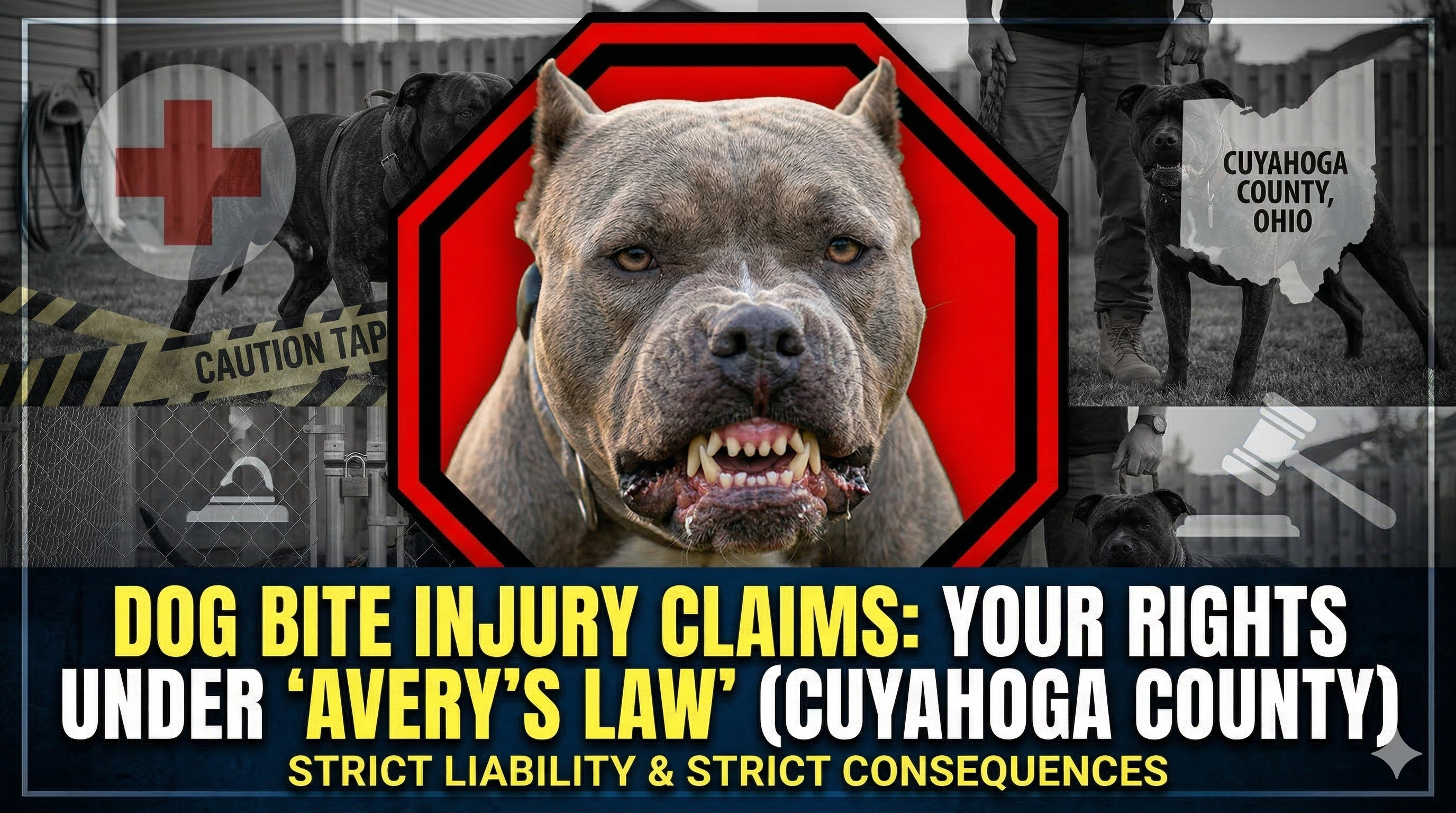
Avery's Law Is Now in Effect: What Ohio's New Dog Attack Law Means for Cuyahoga County Victims
Ohio's most significant overhaul of dangerous dog law in decades takes effect March 18, 2026. Here is what Avery's Law changes, what it does not change, and what it means if you or someone you love is attacked by a dog in Cuyahoga County.
Read article →About This Resource
This site provides educational analysis of Ohio dog bite law under R.C. § 955.28 for residents of Newburgh Heights and Cuyahoga County. It is not a law firm and does not provide legal advice.
For legal representation, this resource is operated in association with Ryan Injury Attorneys, a personal injury law firm licensed in Ohio.