Moreland Hills, Ohio — Dog Bite Law
Moreland Hills is one of the wealthiest and most consistently safe communities in Cuyahoga County — a low-density residential village of approximately 3,466 residents spread across 7.2 square miles of eastern Cuyahoga County, bordered by Chagrin Falls, Hunting Valley, Pepper Pike, Orange, and Solon. The village has been rated the #1 safest suburb in the Cleveland area by Cleveland Magazine for four consecutive years, a distinction that reflects its affluent demographics, active police department, and quiet residential character. Moreland Hills regulates animals under Chapter 505 of its Codified Ordinances, which includes a standalone classification and hearing section (§ 505.011) for nuisance, dangerous, and vicious dog designations — a structural feature that creates a more formalized administrative record than communities that embed classification procedures within a single omnibus section.
If you have been bitten by a dog in Moreland Hills, Ohio law under R.C. § 955.28 entitles you to compensation from the dog's owner, keeper, or harborer regardless of whether the animal has ever bitten anyone before. Moreland Hills' homeownership rate of approximately 95% — among the highest in all of Cuyahoga County — means that nearly every dog owner in the village is a homeowner whose property carries substantial liability insurance. With a median household income of approximately $207,000 and a median home value near $635,000, the village's insurance landscape is among the most favorable for bite victims anywhere in the county.
Moreland Hills at a Glance
No fee unless we recover — call (216) 363-6040
Moreland Hills at a Glance
Moreland Hills Animal Control & Local Ordinances
Moreland Hills regulates animals under Chapter 505 of its Codified Ordinances. The chapter has nine confirmed sections covering at-large violations, dangerous and vicious dogs, a dedicated classification hearing procedure, impound, registration, abandonment, cruelty, and poisoning. An additional animal restriction — the prohibition of exotic animals — appears in the Zoning Code at § 1151.13(e). Individual section texts on American Legal Publishing's platform return access errors; the chapter index URL has been confirmed.
Section 505.01 — Dogs and Other Animals Running at Large; Dangerous and Vicious Dogs
The full text of this section is available at codelibrary.amlegal.com. Section 505.01 is the omnibus animal control provision, addressing both the prohibition on animals running at large and the criminal penalty framework for dangerous and vicious dog offenses. In most Cuyahoga County Chapter 505 communities, a single omnibus section of this type handles at-large, classification, penalties, and confinement requirements. Moreland Hills has separated the classification and hearing procedure into a standalone section (§ 505.011), which means § 505.01 focuses on prohibited conduct and penalties while § 505.011 governs the formal administrative process. A citation under § 505.01 in connection with a bite creates a criminal record of the at-large or dangerous-dog violation that is directly usable in any subsequent civil claim.
Section 505.011 — Designation of Dog as a Nuisance, Dangerous and Vicious Dog: Classification and Hearing
Section 505.011 codifies the nuisance, dangerous, and vicious dog designation procedure as a standalone section — a structural choice that makes Moreland Hills' administrative process more transparent and discoverable than communities that embed classification rules within a longer omnibus provision. This section governs the notice requirements, hearing procedures, burden of proof, and interim confinement obligations that apply once a complaint is filed seeking designation of a dog as nuisance, dangerous, or vicious. From a plaintiff's perspective, this section is highly relevant: a victim who files a classification complaint under § 505.011 creates an official administrative record and initiates a process that, if the designation is granted, establishes the dog's status and triggers Ohio's mandatory insurance requirement under R.C. § 955.22(D). Obtaining a classification order before filing suit can substantially strengthen a civil case by eliminating the need to prove the owner's prior knowledge of the dog's dangerous propensities.
Section 505.02 — Impounding and Disposition; Records
Section 505.02 governs impoundment authority and recordkeeping requirements. Dogs taken into custody in Moreland Hills are transported to the Cuyahoga County Animal Shelter, 9500 Sweet Valley Drive, Valley View, OH 44125. Impound records — including any prior impoundments for the same dog — are discoverable in civil litigation and may establish that the owner had actual notice of the dog's dangerous behavior before the incident that produced the injury.
Section 505.03 — Registration of Dogs and Dog Kennels Required
Section 505.03 requires annual registration of dogs and any dog kennels operated within the village. Licensing and registration records are public records that establish ownership, provide contact information for the responsible party, and document how long the owner has been registered as the dog's keeper — all relevant to establishing the owner-keeper relationship required for liability under R.C. § 955.28.
Sections 505.04 Through 505.07 — Abandonment, Killing or Injuring Animals, Poisoning, and Cruelty
These sections address companion animal welfare and police dog protection. Section 505.05 expressly covers taunting of police dogs in addition to general killing or injuring provisions. While not directly applicable to dog bite victim claims, § 505.07 (cruelty generally) is relevant in cases where a dog's history of mistreatment contributed to its dangerous temperament — evidence that may support a harborer liability theory or establish that the owner had actual knowledge of the dog's propensities.
Section 1151.13(e) — Exotic Animal Prohibition (Zoning Code)
Moreland Hills' Zoning Code expressly prohibits any person from owning, possessing, keeping, harboring, or bringing an Exotic Animal within the village. While most dog bite cases involve domestic dogs, § 1151.13(e) is relevant to the rare case involving an exotic or non-domesticated animal and confirms the village's commitment to controlling non-standard animals through its land use framework. The full text of this provision is available at codelibrary.amlegal.com.
Breed-Specific Legislation
Chapter 505 contains no breed-specific legislation. Ohio eliminated state-level BSL in 2012, and Moreland Hills has not enacted any local breed restrictions. Liability is determined by the individual animal's conduct, classification history, and the owner's knowledge — not breed.
Ohio Strict Liability — R.C. § 955.28
Ohio's strict liability statute — R.C. § 955.28 — is the primary basis for dog bite claims in Moreland Hills. The statute imposes liability on any owner, keeper, or harborer whose dog bites, injures, or kills a person who was not trespassing, did not tease or torment the dog, and was not committing or attempting to commit a criminal offense. No prior bite history is required. For a full explanation of the statute, defenses, and damages, see our complete guide to Ohio dog bite law.
A 95% Homeownership Rate and the Most Favorable Insurance Landscape in Eastern Cuyahoga County
With approximately 95% of housing units owner-occupied, Moreland Hills ties with Bentleyville and Hunting Valley for one of the highest homeownership rates in all of Cuyahoga County. In practical terms, this means that in virtually every dog bite case arising in the village, the responsible party is a homeowner with an active homeowners insurance policy. At a median household income of approximately $207,000 and a median home value near $635,000, Moreland Hills homeowners typically carry standard liability limits well above the state's $100,000 mandatory minimum for vicious dog owners — and many maintain umbrella policies in the $1 million to $2 million range given their overall asset profile. This makes Moreland Hills dog bite cases among the most collectible in Cuyahoga County. Unlike communities where low homeownership rates or modest incomes increase the risk of an uncollectible judgment, the vast majority of Moreland Hills defendants have substantial insurance and real property assets.
The § 505.011 Classification Record as a Civil Litigation Tool
Moreland Hills' standalone § 505.011 classification and hearing procedure creates an administrative pathway that can benefit bite victims before a lawsuit is ever filed. When a bite victim or witness files a formal designation complaint with the police department, the classification process generates a documented record: the complaint, investigation findings, any hearing transcript, and the court's determination. If the dog is designated dangerous or vicious, that record is directly admissible in any subsequent civil action and eliminates the need to prove prior knowledge of the dog's dangerous propensities. A victim who pursues the § 505.011 classification process — even if ultimately declining to sue — creates evidence that will remain in the court record and may affect any future victim's case as well. Attorneys handling Moreland Hills bites should consider filing a § 505.011 complaint as a parallel step alongside the civil claim.
Senior Population and Medical Damages
Approximately 24% of Moreland Hills' residents are 65 or older — nearly one in four — and the village's median age of 54 reflects a predominantly middle-aged-to-elderly demographic. Older victims of dog attacks are statistically more likely to suffer fractures, hospitalization, and prolonged recovery times than younger adults. A dog that knocks down an elderly resident without biting may still trigger R.C. § 955.28 liability if it causes injury, since the statute covers any injury caused by the dog, not only bites. In a community where a quarter of the population is over 65, fall-related injuries from dog encounters generate higher medical damages than comparable incidents in younger communities, and courts routinely award substantial compensation for the extended rehabilitation periods that older victims require.
Large Lot Residential Character and Off-Leash Risk on Private Property
Moreland Hills is characterized by large-lot single-family homes — the village spans 7.2 square miles for only 3,466 residents, yielding a density of roughly 479 per square mile. This low-density residential landscape means that dogs are commonly kept on larger properties with fencing, but also that property boundaries are less well-defined than in denser suburbs. A dog that escapes a large unfenced yard or a property with a malfunctioning fence and crosses onto a neighboring lot to attack creates a straightforward at-large claim under § 505.01. The substantial property values in the village also mean that landscaping workers, delivery personnel, and other invitees regularly access residential properties — occupational dog bite victims can pursue both R.C. § 955.28 strict liability claims and workers' compensation coverage depending on their employment status.
“The owner, keeper, or harborer of a dog is liable in damages for any injury, death, or loss to person or property that is caused by the dog, unless the person was trespassing or committing a criminal offense on the property of the owner, keeper, or harborer, or was teasing, tormenting, or abusing the dog.”— Ohio Revised Code § 955.28(B)
Venue & Court Information
Bedford Municipal Court
Dog bite cases arising in Moreland Hills are heard at the Bedford Municipal Court, located at 165 Center Road, Bedford, OH 44146, phone (440) 232-3420. The court's judges are the Honorable Brian J. Melling and the Honorable Michelle L. Paris. The clerk of courts is Thomas E. Day Jr.
Bedford Municipal Court serves a broad territorial jurisdiction that includes Moreland Hills, Bedford, Bedford Heights, Bentleyville, Chagrin Falls, Chagrin Falls Township, Glenwillow, Highland Hills, North Randall, Oakwood, Orange, Solon, Warrensville Heights, and Woodmere. The court hears civil claims up to $15,000 and operates a small claims division for claims up to $6,000. Dog bite cases in Moreland Hills where damages exceed $15,000 — which is common in attacks requiring surgery, hospitalization, or producing permanent scarring — must be filed in the Cuyahoga County Court of Common Pleas. Given the village's high median income and corresponding high medical cost levels, Common Pleas is the appropriate venue for most serious bite injuries arising in Moreland Hills.
Moreland Hills' municipal website confirms that non-waiverable matters are heard at Bedford Municipal Court, and that waiverable traffic citations may be paid at the police department within one week of issuance to avoid a court appearance.
Statute of Limitations
Strict liability claims under R.C. § 955.28 must be filed within six years of the date of the bite. Negligence claims — including claims based on violation of § 505.01 (at large) — must be filed within two years. If the victim was a minor at the time of the bite, the statute of limitations does not begin to run until the child turns 18. For complete details on filing deadlines and recoverable damages, see our Ohio dog bite law guide.
Local Risk Factors in Moreland Hills
Population and Density
Moreland Hills has a population of approximately 3,466 within 7.2 square miles, yielding a density of roughly 479 residents per square mile — one of the lowest densities of any incorporated community in Cuyahoga County. For comparison, neighboring Chagrin Falls has a density of approximately 2,012 per square mile and Hunting Valley only 97 per square mile. The very low density reflects the village's large-lot residential character, with homes typically set back from the road on wooded parcels. This landscape means that dogs are commonly kept on expansive properties and that off-leash encounters may happen far from public roads, on trails, or across unfenced boundaries between adjacent properties.
Chagrin River Corridor and Cleveland Metroparks Access
The Chagrin River runs along Moreland Hills' eastern boundary, and the village borders portions of the South Chagrin Reservation of Cleveland Metroparks. These natural areas attract walkers, trail runners, equestrians, and cyclists from throughout the eastern suburbs. Dogs are commonly present on and near park trails, and the mix of off-leash dogs, leashed dogs, and non-dog-owning trail users in low-visibility wooded areas creates conditions where bite incidents occur at higher rates than on open suburban streets. Ohio's strict liability statute applies equally to attacks that occur on public trails and in park-adjacent areas as to attacks on private property.
Seasonal Risk: Large Residential Properties and Guest Traffic
Moreland Hills' affluent demographics mean that many households host private social gatherings — outdoor parties, barbecues, and informal events — where dogs are present alongside guests. Under Ohio law, a social guest who is bitten by a homeowner's dog is entitled to recover under R.C. § 955.28 as long as the guest was not trespassing. Because these events typically involve the homeowner's own property and the homeowner's own insurance coverage, guest-bites in Moreland Hills usually present a clean coverage picture with a clearly identified defendant and homeowners policy.
Senior Population and Elder Injury Risk
Approximately 24% of Moreland Hills residents are 65 or older — nearly one in four village residents — and the village's median age of 54 is one of the oldest in the county. Dog attacks on older adults, even those that do not result in bites, can cause severe injuries: hip fractures, wrist fractures, and head injuries from falls are common when a dog jumps on or runs into an older person. R.C. § 955.28 covers all injuries caused by a dog, not only bite wounds. In cases involving elderly victims in Moreland Hills, the combination of high medical damages from age-related injury severity and the village's uniformly strong insurance coverage creates a strong environment for full compensation recovery.
Reporting a Dog Bite in Moreland Hills
Dog bite victims in Moreland Hills should call the Moreland Hills Police Department at (440) 248-7585 (non-emergency, business hours Monday–Friday 8am–4pm) or the dispatch non-emergency line at (440) 247-7321 (after hours). An incident report should be requested immediately following any dog attack. Animal control calls are handled through the police department; no dedicated animal control officer is maintained. The village's impound facility is the Cuyahoga County Animal Shelter, 9500 Sweet Valley Drive, Valley View, OH 44125, reachable through police dispatch. Victims should also report the bite to the Cuyahoga County Board of Health at (216) 201-2001. Photographs of injuries, the location of the attack, and the dog should be taken as soon as possible, and all medical treatment records should be preserved. If the attacking dog has prior incidents on record, request copies of any prior impound records and any § 505.011 classification proceedings from the police department.
Frequently Asked Questions — Moreland Hills
Related Articles & News
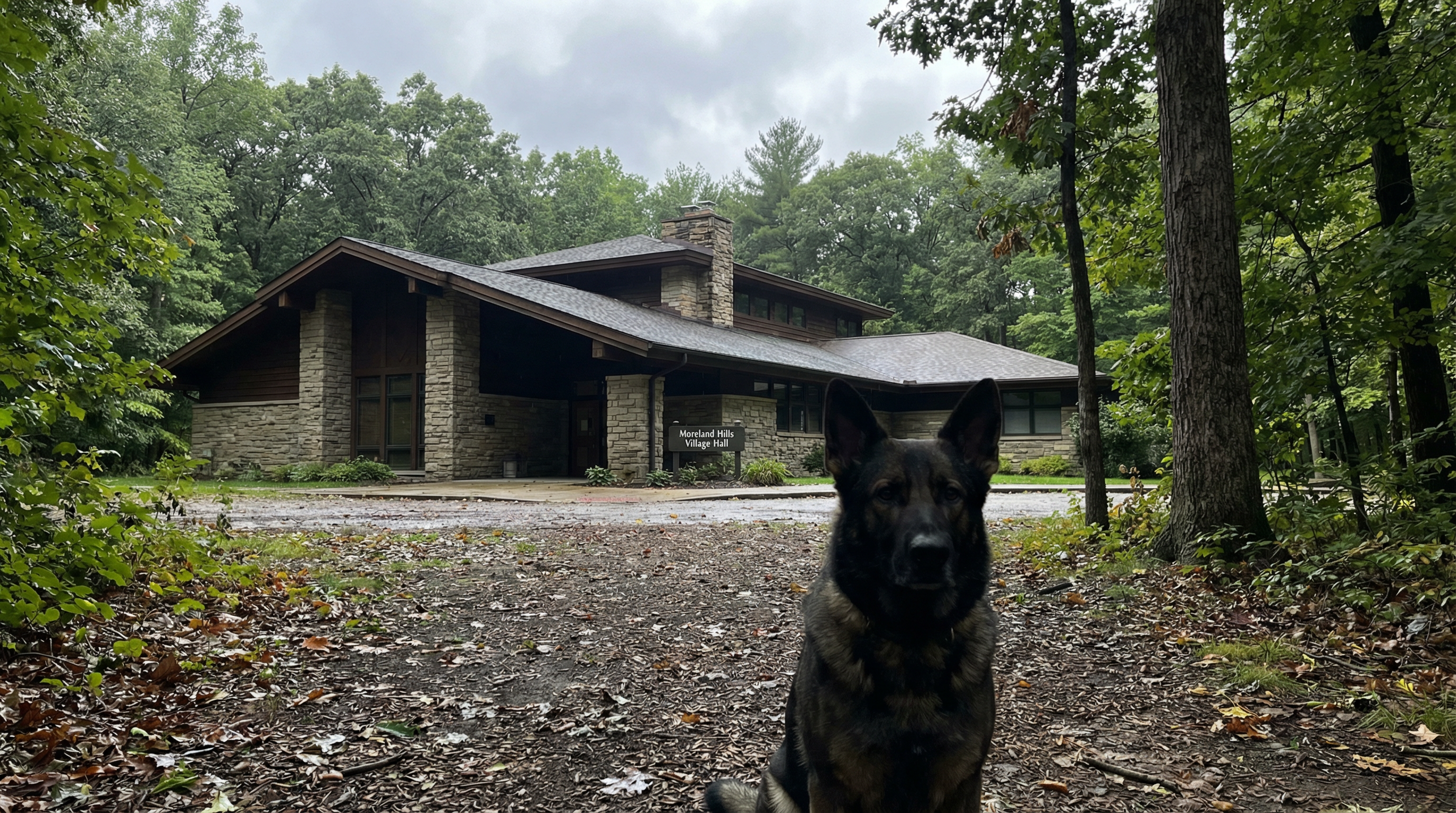
Dog Bite in Moreland Hills Ohio: Incident Report and Legal Guide
If you or a loved one has been bitten by a dog in Moreland Hills, Ohio, understanding your legal rights is the first step toward recovery. Learn about local ordinances and Ohio strict liability laws.
Read article →
Avery's Law Is Now in Effect: What Ohio's New Dog Attack Law Means for Cuyahoga County Victims
Ohio's most significant overhaul of dangerous dog law in decades takes effect March 18, 2026. Here is what Avery's Law changes, what it does not change, and what it means if you or someone you love is attacked by a dog in Cuyahoga County.
Read article →About This Resource
This site provides educational analysis of Ohio dog bite law under R.C. § 955.28 for residents of Moreland Hills and Cuyahoga County. It is not a law firm and does not provide legal advice.
For legal representation, this resource is operated in association with Ryan Injury Attorneys, a personal injury law firm licensed in Ohio.