Highland Hills, Ohio — Dog Bite Law
Highland Hills is a small village of approximately 662 residents incorporated in 1990 from what was formerly Warrensville Township, situated in southeastern Cuyahoga County along Northfield Road near Interstate 271 and Interstate 480. Despite its modest residential footprint of under two square miles, the village hosts several major employers and institutional facilities, making it a community where workers, visitors, and delivery personnel significantly outnumber residents on any given weekday. Dog owners and their dogs are regulated under Chapter 505 of the Codified Ordinances of Highland Hills (current through December 10, 2025). The village also maintains a dedicated Animal Warden under Chapter 146, a distinct feature from many comparable villages in Cuyahoga County that contract animal control services.
If you have been bitten by a dog in Highland Hills, Ohio's strict liability statute — R.C. § 955.28 — entitles you to compensation from the dog's owner, keeper, or harborer regardless of the animal's prior history. Highland Hills has one of the lowest homeownership rates in Cuyahoga County at approximately 33%, meaning the majority of dog owners are renters rather than homeowners. This creates a distinct insurance recovery landscape compared to most other suburbs, and makes landlord and harborer liability theories particularly important in this community. Cases are heard at the Bedford Municipal Court, which serves 14 southeastern Cuyahoga communities.
Highland Hills at a Glance
No fee unless we recover — call (216) 363-6040
Highland Hills at a Glance
Highland Hills Animal Control & Local Ordinances
Highland Hills regulates animals under Chapter 505 of its Codified Ordinances and maintains a dedicated Animal Warden under Chapter 146. The full Chapter 505 section inventory was not directly accessible through the amlegal portal during preparation of this page. Two provisions were independently confirmed and are analyzed below. Attorneys and victims requiring the complete chapter text can access the Highland Hills Codified Ordinances directly, or contact Village Hall at (216) 283-3000.
Section 505.09 — Barking or Howling Dogs
The full text of this section is available at codelibrary.amlegal.com. Section 505.09 prohibits keeping or harboring any dog that creates "unreasonably loud and disturbing noises of such a character, intensity and duration as to disturb the peace, quiet and good order of the Municipality" through frequent and habitual barking, howling, or yelping. A violation is a minor misdemeanor under subdivision (b).
Harborer definition: Subdivision (a) contains an express harborer definition with direct relevance to dog bite liability: "Any person who shall allow any dog habitually to remain, be lodged or fed within any dwelling, building, yard or enclosure, which he occupies or owns, shall be considered as harboring such dog." This definition broadly captures anyone who permits a dog to be kept on their property, regardless of formal ownership — including landlords, building managers, and household members who feed or shelter a dog they do not own. Ohio's R.C. § 955.28 imposes strict liability on owners, keepers, and harborers; the § 505.09(a) harborer definition provides additional anchoring for that theory in the village's own code.
Chapter 146 — Animal Warden
Chapter 146 of the Highland Hills Codified Ordinances establishes and governs the Animal Warden position. Section 146.03, available at codelibrary.amlegal.com, authorizes the Animal Warden to issue citations to persons in violation of any Village ordinance regulating dogs and other animals. Citations for ordinance violations direct the offender to appear at Mayor's Court of the Village of Highland Hills at the next available meeting, while state law violations require appearance at Bedford Municipal Court within seven days.
Plaintiff's significance: Highland Hills is one of a smaller group of Cuyahoga County villages that maintains a dedicated Animal Warden rather than relying on contracted animal control or general patrol. A dedicated warden is more likely to generate formal written citations, maintain citation records for specific animals and owners, and conduct follow-up on reported incidents. These records — obtainable as public records under Ohio law — can establish a pattern of violations by a specific dog or owner, corroborate a victim's account, and support a negligence per se theory alongside the R.C. § 955.28 strict liability claim.
Breed-Specific Legislation
No breed-specific legislation was identified in the Highland Hills Codified Ordinances. The village's animal control framework does not appear to impose enhanced restrictions on specific breeds. Ohio's elimination of state-level breed-specific legislation in 2012 is consistent with the absence of any BSL provision in Highland Hills. Dog bite claims proceed under the R.C. § 955.28 strict liability framework regardless of the animal's breed.
Remaining Chapter 505 Provisions
The confirmed sections above are the provisions that could be independently verified for Highland Hills. The chapter almost certainly contains additional provisions — including running at large, dog registration, impounding, abandonment, cruelty, bite reporting and quarantine, and dangerous/vicious dog classification — based on the standard Chapter 505 structure used throughout Ohio. These sections were not accessible from the amlegal portal during the preparation of this page and are not analyzed here. The complete chapter text is available at the Highland Hills amlegal portal.
Ohio Strict Liability — R.C. § 955.28
Ohio's strict liability statute — R.C. § 955.28 — is the primary basis for dog bite claims in Highland Hills. Under that statute, the owner, keeper, or harborer of a dog is liable for any injury, death, or loss caused by the dog without any requirement to prove prior knowledge of viciousness, a history of biting, or negligent supervision. The only recognized defenses are trespass, commission of a criminal offense on the owner's property, or teasing, tormenting, or abusing the dog. For a full explanation of the statute, available defenses, and the categories of recoverable damages, see our complete guide to Ohio dog bite law.
Low Homeownership and the Landlord/Harborer Theory
At approximately 33%, Highland Hills has one of the lowest homeownership rates among Cuyahoga County villages — dramatically below the county average of roughly 55% and far below the rates seen in comparable eastern suburban villages such as Gates Mills (94%), Bentleyville (96%), or even Bratenahl (82%). With approximately two-thirds of occupied housing units occupied by renters, most dog owners in Highland Hills do not have homeowners' insurance. Renters' insurance — if held — provides personal liability coverage, but renters in lower-income communities carry this coverage at significantly lower rates than homeowners. This changes the practical insurance recovery analysis: victims and their attorneys must look beyond the individual dog owner to identify all harborers with potential liability exposure, including landlords, property managers, and building operators who permitted the dog's presence on the premises. Ohio's strict liability statute explicitly reaches "harborers" — persons who house or shelter a dog without owning it — and the § 505.09(a) harborer definition in Highland Hills's own code supports applying that theory to landlords and property managers who allowed the dog to remain on rental property.
Senior Population and Medical Damages
The Highland Hills Police Department's own website describes the village as composed of "roughly 90% senior citizens" — a demographic reality that shapes both the nature of dog bite injuries sustained and the damages recoverable. Elderly victims are at substantially higher risk of serious complications from dog bites: wounds heal more slowly, infection rates are higher, and injuries that would be minor for a younger adult can result in hospitalizations, surgeries, and extended rehabilitation for an older person. Medical damages for senior victims in Highland Hills dog bite cases will frequently be higher than average, and evidence of permanent or long-term functional impairment — which significantly affects pain and suffering awards — is more likely to appear in the medical record. Counsel should obtain complete records from the treating facility, which is often University Hospitals Ahuja Medical Center or South Pointe Hospital given their proximity to the village.
High Medicaid Enrollment and Medical Cost Documentation
Approximately 48% of Highland Hills residents are enrolled in Medicaid, and a further 16% are on Medicare. These coverage patterns affect how medical expenses are documented and potentially reimbursed in litigation. Ohio's collateral source rule generally allows victims to recover the full billed value of medical services rather than the discounted rate accepted by government payers, although this area of law has seen continued development. Counsel should document both the billed charges and the actual amounts paid by Medicaid or Medicare, and obtain a lien notice from the Ohio Attorney General's Medicaid Fraud Unit if applicable. The high rate of government-insured patients at nearby hospitals means that healthcare billing in this community often involves government payer documentation that differs from standard private-insurance records.
Animal Warden Citation Records
Unlike many smaller Cuyahoga County villages that rely on contracted animal control or general patrol, Highland Hills maintains a dedicated Animal Warden who is authorized to issue formal citations. Warden citation records are public records. If the dog involved in a bite has a prior citation history for running at large, nuisance barking, or other Chapter 505 violations, those records can be obtained from the Police Department and from Mayor's Court, and can be used to establish the owner's awareness of the dog's behavioral issues prior to the bite — evidence that supports punitive damages and negates any defense of ignorance.
“The owner, keeper, or harborer of a dog is liable in damages for any injury, death, or loss to person or property that is caused by the dog, unless the person was trespassing or committing a criminal offense on the property of the owner, keeper, or harborer, or was teasing, tormenting, or abusing the dog.”— Ohio Revised Code § 955.28(B)
Venue & Court Information
Bedford Municipal Court
Dog bite civil and criminal cases arising in Highland Hills are heard at the Bedford Municipal Court, located at 165 Center Road, Bedford, OH 44146 (phone: 440-232-3420). The court is served by Judge Brian J. Melling and Judge Michelle L. Paris. The Clerk of Courts is Thomas E. Day, Jr. Court hours are Monday through Friday, 8:30 a.m. to 4:30 p.m., excluding holidays.
Bedford Municipal Court serves 14 communities: Bedford, Bedford Heights, Bentleyville, Chagrin Falls, Chagrin Falls Township, Glenwillow, Highland Hills, Moreland Hills, North Randall, Oakwood, Orange, Solon, Warrensville Heights, and Woodmere. The court hears civil claims up to $15,000 and operates a Small Claims Division for claims up to $6,000. Section 146.03 of the Highland Hills Codified Ordinances specifically directs that state law violations — including Ohio R.C. dog bite violations — are heard at Bedford Municipal Court within seven days of citation.
Highland Hills also maintains a Mayor's Court at Village Hall (3700 Northfield Road) that handles initial ordinance citation appearances. Civil dog bite claims based on R.C. § 955.28 proceed directly in Bedford Municipal Court. Claims exceeding $15,000 are filed in the Cuyahoga County Court of Common Pleas, which has no upper limit on civil recovery.
Statute of Limitations
Strict liability claims under R.C. § 955.28 must be filed within six years of the date of the bite. Negligence claims — including negligent failure to comply with Chapter 505 animal control requirements — carry a two-year limitations period. If the victim was a minor at the time of the bite, the statute does not begin to run until the child turns 18. Given Highland Hills's demographic profile, many bite victims will be elderly residents — for those individuals, the six-year window under strict liability provides meaningful recovery time even when initial injuries are downplayed or medical follow-up is delayed. For complete details on filing deadlines and recoverable damages, see our Ohio dog bite law guide.
Local Risk Factors in Highland Hills
Population and Density
Highland Hills's 662 residents (2020 Census) live within 1.96 square miles, producing a population density of approximately 338 persons per square mile — comparable to neighboring Glenwillow (365/sq mi) and well below the density of more urban Cuyahoga County communities. However, the de facto population during business hours is substantially higher due to the commercial and institutional employers located within the village limits. Workers, delivery drivers, and visitors traveling through residential areas adjacent to commercial properties represent a significant share of the people in the village on any given day, and they are among the populations most likely to encounter a dog unexpectedly.
Rental-Dominated Housing and Multi-Unit Building Risk
With a homeownership rate of only 33%, Highland Hills has an unusually high proportion of renter-occupied housing. Multi-unit residential buildings — apartment complexes, senior housing, and assisted-living facilities — are common in the village. These settings create elevated risk for dog bite incidents in shared spaces: hallways, stairwells, parking lots, and building entrances where residents, visitors, delivery personnel, and service workers encounter dogs being walked or transported. Shared common areas in multi-unit buildings are among the most frequent settings for dog bite incidents precisely because both the dog and the victim are away from the owner's private premises but the dog has not been secured or leashed. The § 505.09(a) harborer definition — which includes anyone who allows a dog to be lodged or fed in their building or yard — creates a potential liability path against building operators and landlords who permit dogs on the property without adequate control requirements.
Senior Resident Population
The Highland Hills Police Department describes the community as "roughly 90% senior citizens," and department policy reflects this with intensive hourly foot patrols in residential buildings. For dog bite liability purposes, this demographic creates two distinct concerns: first, senior victims face disproportionately serious medical consequences from bite injuries — healing is slower, infection risk is higher, and physical rehabilitation is more demanding — which translates to larger medical damages in civil claims; second, elderly residents walking or waiting near buildings are at elevated risk of serious injury from dogs that knock them down, regardless of whether the dog bites, because falls can cause fractures, head injuries, and other serious consequences for older adults that would not occur with a younger victim. Ohio's R.C. § 955.28 strict liability covers "injury" broadly, not only bite wounds.
Reporting a Dog Bite in Highland Hills
Dog bite victims in Highland Hills should call the Highland Hills Police Department at 216-283-3007 (non-emergency, available 24/7) or 911 for emergencies. The Animal Warden, who is authorized under Chapter 146 to issue citations, can be reached through the Police Department. Bite victims should also report directly to the Cuyahoga County Board of Health at (216) 201-2001, which administers the Health Commissioner's quarantine authority. Request copies of all police incident reports, Animal Warden citation records, and any Health Department quarantine orders — each document can serve as evidence in a civil claim. If the bite occurred in a multi-unit building, document the building management company's name and address, as they may be a harborer under § 505.09(a) with independent liability exposure.
Frequently Asked Questions — Highland Hills
Related Articles & News
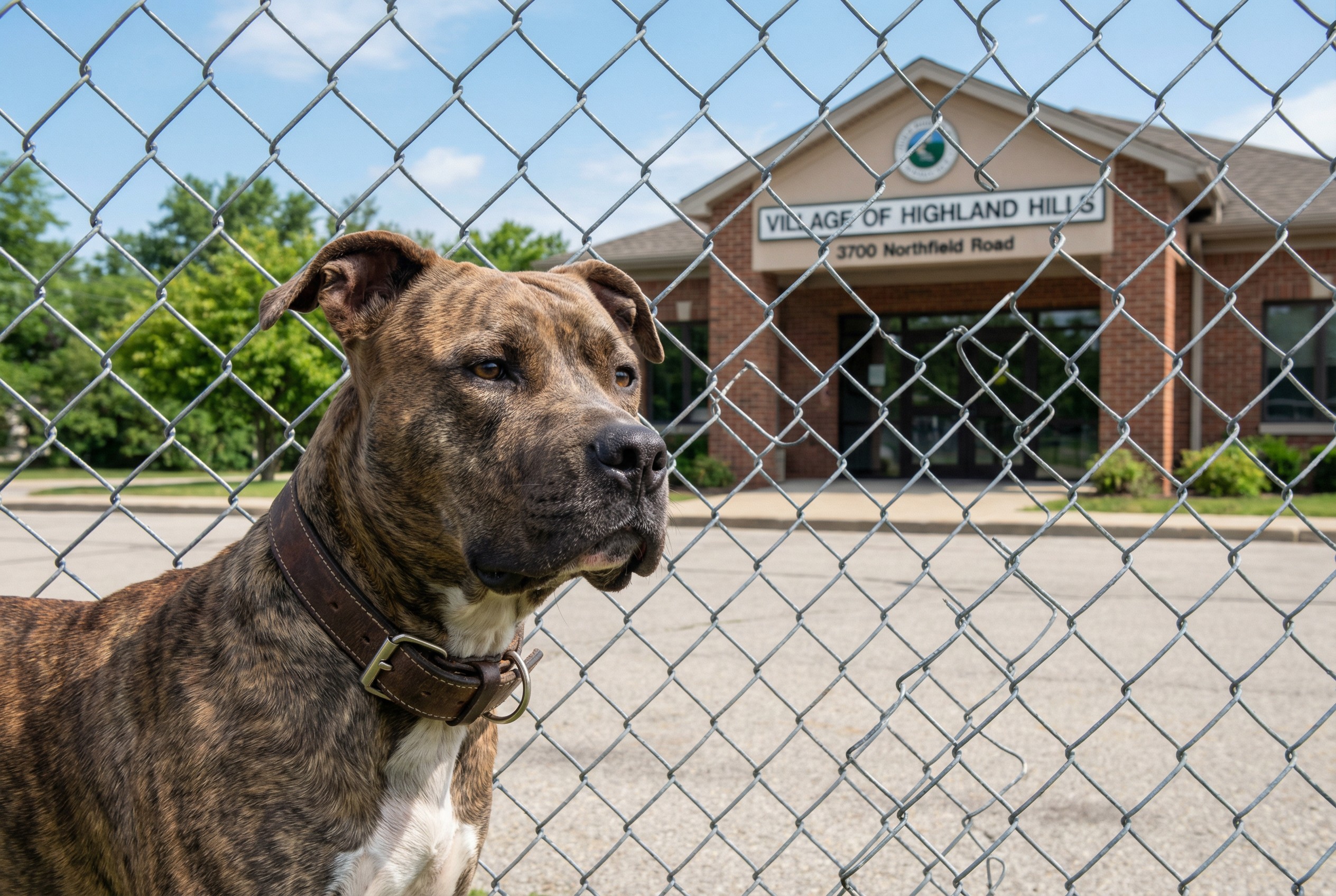
Dog Bite in Highland Hills Ohio: Frequently Asked Questions
If you or a loved one were bitten by a dog in Highland Hills, Ohio, understanding your rights under state law and local ordinances is the first step toward recovery.
Read article →
Avery's Law Is Now in Effect: What Ohio's New Dog Attack Law Means for Cuyahoga County Victims
Ohio's most significant overhaul of dangerous dog law in decades takes effect March 18, 2026. Here is what Avery's Law changes, what it does not change, and what it means if you or someone you love is attacked by a dog in Cuyahoga County.
Read article →About This Resource
This site provides educational analysis of Ohio dog bite law under R.C. § 955.28 for residents of Highland Hills and Cuyahoga County. It is not a law firm and does not provide legal advice.
For legal representation, this resource is operated in association with Ryan Injury Attorneys, a personal injury law firm licensed in Ohio.