Glenwillow, Ohio — Dog Bite Law
Glenwillow is a small, historically distinctive village of approximately 994 residents in southeastern Cuyahoga County. Founded in 1893 as a company town for the Austin Powder Company, Glenwillow has evolved from an explosives-manufacturing hub into a mixed residential and industrial community centered on the Glenwillow Industrial Park. The village covers 2.72 square miles and sits within the Solon school district, bordered by Solon, Oakwood, and Orange. Dog owners and their dogs share the village with an active commercial employment base — a combination that shapes the local dog bite risk profile. Animal regulations fall under Chapter 505 of Glenwillow's Codified Ordinances, which includes specific provisions on mandatory bite reporting and quarantine (§ 505.10) and dangerous and vicious dog classification (§ 505.14).
If you have been bitten by a dog in Glenwillow, Ohio law under R.C. § 955.28 entitles you to compensation from the dog's owner, keeper, or harborer regardless of whether the animal has ever bitten anyone before. Glenwillow's homeownership rate of approximately 84% — among the higher rates in Cuyahoga County's smaller villages — means that the large majority of dog owners carry homeowners' or renters' insurance, the primary source of recovery for dog bite victims. Cases arising in Glenwillow are heard at the Bedford Municipal Court, which serves 14 diverse communities in the southeastern Cuyahoga region.
Glenwillow at a Glance
No fee unless we recover — call (216) 363-6040
Glenwillow at a Glance
Glenwillow Animal Control & Local Ordinances
Glenwillow regulates animals under Chapter 505 of its Codified Ordinances (current through January 1, 2025). The chapter falls within Part Five — General Offenses Code and follows the standard Chapter 505 framework used by many Ohio villages. The full chapter index was not directly accessible through the amlegal portal, but two sections central to dog bite claims — §505.10 and §505.14 — were independently confirmed and are analyzed in detail here.
Section 505.10 — Animal Bites; Reports and Quarantine
The full text of this section is available at codelibrary.amlegal.com. Section 505.10 is the bite-reporting and quarantine provision. Under subdivision (a), whenever any person is bitten by a dog or other animal, that bite must be reported to the Health Commissioner within twenty-four hours. The Health Commissioner then orders quarantine of any dog or cat that has bitten a person. Quarantine may be served by the owner or harborer at home, or in a pound or kennel, always under the Health Commissioner's supervision and at the owner's or harborer's expense. The quarantine runs until the Health Commissioner determines the animal is not rabid, with a minimum duration of ten days from the date of the bite. If a veterinary examination is required, the owner bears that cost as well, and the veterinarian must report findings to the Health Commissioner. No animal may be released from quarantine until it has received a current rabies vaccination. Any person who fails to comply with these requirements — including failure to immediately report symptoms of rabies — commits a minor misdemeanor under subdivision (b).
Plaintiff's significance: The mandatory reporting requirement creates an official record of the bite and triggers a supervised quarantine at the owner's expense. The ten-day quarantine period and required veterinary examination produce documentation — examination reports, quarantine logs, vaccination records — that can corroborate the victim's account of the incident, establish the identity of the biting animal, and confirm the owner's identity and responsibility for the dog's care and confinement.
Section 505.14 — Dangerous and Vicious Dogs
The full text of this section is available at codelibrary.amlegal.com. Section 505.14 governs the classification and control of dangerous and vicious dogs. Subdivision (a) defines "dangerous dog" using behavioral criteria that mirror Ohio R.C. § 955.11 — a dog that, without provocation, has caused specified harm or has been the subject of repeated running-at-large violations. Subdivision (c) imposes confinement and insurance requirements on owners of dangerous dogs, tracking the mandatory $100,000 liability insurance and secure enclosure requirements of R.C. § 955.22.
Penalty structure: Whoever violates the vicious dog provisions of § 505.14 is guilty of a misdemeanor of the first degree on a first offense; the court additionally may order the vicious dog to be humanely destroyed by a licensed veterinarian, the Dog Warden, or the humane society. A misdemeanor of the first degree also applies if the dog causes injury other than killing or serious injury to any person. Violation of subdivision (c) — the confinement and insurance requirements — is independently a first-degree misdemeanor. (Section cites ORC 955.99 as the penalty authority.)
Plaintiff's significance: If a dog involved in a bite incident has previously been classified as dangerous under § 505.14, the owner's failure to maintain the required liability insurance or secure enclosure constitutes a separate criminal violation and strengthens a negligence per se theory running alongside the strict liability claim under R.C. § 955.28. Prior classification records can be requested from the Glenwillow Police Department and the Bedford Municipal Court case docket. The court's authority to order destruction also signals that Glenwillow does not treat dangerous dog designations as minor administrative matters.
Breed-Specific Legislation
Glenwillow's Chapter 505 does not contain breed-specific legislation. The § 505.14 classification framework is behavior-based, consistent with Ohio's elimination of state-level breed-specific legislation in 2012. No breed ban or enhanced restriction on specific breeds was identified in the Codified Ordinances. Dog bite victims are not required to show the animal was a particular breed to pursue a claim — Ohio's strict liability statute applies to all dogs regardless of breed.
Remaining Chapter 505 Provisions
The confirmed sections above are the core provisions for dog bite litigation. The chapter's remaining sections — which based on standard Chapter 505 structure would include provisions governing running at large, dog registration and licensing, abandonment, cruelty, barking dogs, and nuisance conditions — were not independently accessible from the amlegal portal during the preparation of this page. Attorneys and victims seeking the complete chapter inventory can access the Codified Ordinances of Glenwillow, Ohio directly, or contact the Village Clerk at (440) 232-8788.
Ohio Strict Liability — R.C. § 955.28
Ohio's strict liability statute — R.C. § 955.28 — is the primary basis for dog bite claims in Glenwillow. Under that statute, the owner, keeper, or harborer of a dog is liable for any injury, death, or loss caused by the dog, without any requirement that the victim prove prior knowledge of viciousness or a history of biting. The only defenses are that the victim was trespassing, committing a criminal offense on the owner's property, or teasing, tormenting, or abusing the dog. For a full explanation of the statute, available defenses, and categories of recoverable damages, see our complete guide to Ohio dog bite law.
High Homeownership Rate and Insurance Recovery
Approximately 84% of Glenwillow's occupied housing units are owner-occupied — a rate significantly above the Cuyahoga County average of roughly 55%. For dog bite victims, this translates directly into insurance recovery potential: homeowners' insurance policies in Ohio customarily include personal liability coverage that responds to dog bite claims, typically in amounts of $100,000 to $300,000 or more. The higher the homeownership rate, the more likely it is that the dog's owner maintains active liability coverage. Victims should request the owner's homeowners' insurance carrier information as early as possible in the claims process. Renters' insurance — which the remaining 16% of households may carry — also provides personal liability coverage in many cases.
Industrial Park Encounters and Harborer Liability
Glenwillow's Glenwillow Industrial Park brings a significant population of daily workers, delivery personnel, contractors, and visitors into the village who do not reside there. These individuals frequently travel through or park near residential streets adjacent to industrial properties, where dogs may be kept. Ohio's strict liability statute reaches not only owners but also "keepers" and "harborers" — persons who exercise control over a dog or who allow a dog to remain on their premises. When a dog bite occurs at a residential property adjacent to or near commercial parcels, identifying all potential harborers (including businesses or property owners who allow a dog's presence on commercial land) can be an important step in establishing the full range of responsible parties.
Mayor's Court Records as Evidence
Glenwillow maintains a Mayor's Court that hears initial ordinance prosecutions, including animal control violations. If a dog involved in a bite incident has previously been cited for running at large, barking violations, or other Chapter 505 offenses, those Mayor's Court records may establish a pattern of behavior and the owner's awareness of the dog's propensity to create risk — evidence that can support punitive damages or negate a good-faith defense. Mayor's Court records are public records under Ohio law. Cases that were transferred from Mayor's Court to Bedford Municipal Court are available through the court's case management system.
Contracted Animal Control and Documentation Gaps
Glenwillow does not maintain a dedicated, on-staff Animal Control Officer. Animal control services are provided by A&S Animal Control (Steve Suder and Scott Adams) under contract, reachable through the Police Department rather than through a direct ACO line. After-hours requests are routed through Solon non-emergency dispatch. This structure can mean a delay between a bite incident and official animal control response, and can result in less comprehensive incident documentation compared to municipalities with dedicated ACOs. Bite victims in Glenwillow should take independent steps to document the incident: photograph injuries immediately, photograph the dog and the location where the bite occurred, identify the owner and any witnesses on the scene, and submit a written bite report to both the Police Department and the Cuyahoga County Board of Health directly, rather than assuming the contracted warden will generate a formal report.
“The owner, keeper, or harborer of a dog is liable in damages for any injury, death, or loss to person or property that is caused by the dog, unless the person was trespassing or committing a criminal offense on the property of the owner, keeper, or harborer, or was teasing, tormenting, or abusing the dog.”— Ohio Revised Code § 955.28(B)
Venue & Court Information
Bedford Municipal Court
Dog bite civil and criminal cases arising in Glenwillow are heard at the Bedford Municipal Court, located at 165 Center Road, Bedford, OH 44146 (phone: 440-232-3420). The court is served by Judge Brian J. Melling and Judge Michelle L. Paris. The Clerk of Courts is Thomas E. Day, Jr. Court hours are Monday through Friday, 8:30 a.m. to 4:30 p.m., excluding holidays.
Bedford Municipal Court has jurisdiction over 14 communities: Bedford, Bedford Heights, Bentleyville, Chagrin Falls, Chagrin Falls Township, Glenwillow, Highland Hills, Moreland Hills, North Randall, Oakwood, Orange, Solon, Warrensville Heights, and Woodmere. The court hears civil claims up to $15,000 and operates a Small Claims Division for claims up to $6,000.
Glenwillow also maintains a Mayor's Court at Village Hall (29555 Pettibone Road) that handles initial ordinance citations; contested criminal matters may be transferred to Bedford Municipal Court. Civil dog bite claims based on R.C. § 955.28 are filed directly in Bedford Municipal Court. Claims exceeding $15,000 are filed in the Cuyahoga County Court of Common Pleas.
Statute of Limitations
Strict liability claims under R.C. § 955.28 must be filed within six years of the date of the bite. Negligence claims — including negligent failure to comply with Chapter 505 ordinance requirements — must be filed within two years. If the victim was a minor at the time of the bite, the statute of limitations does not begin to run until the child turns 18. Prompt action is important even well within the limitations period: witness memories fade, the dog's owner may relocate, and insurance policy records become harder to obtain. For a complete explanation of filing deadlines and recoverable damages categories, see our Ohio dog bite law guide.
Local Risk Factors in Glenwillow
Population and Density
Glenwillow's 994 residents (2020 Census) occupy 2.72 square miles, yielding a population density of approximately 365 persons per square mile — among the lowest in Cuyahoga County, comparable to nearby Bentleyville (353/sq mi). Low residential density generally means larger lot sizes and more space between properties, but it can also mean dogs spend significant time outdoors unsupervised or on rural-feeling lots without adequate fencing. The village's mix of residential and light industrial zoning means that some properties at the edges of residential neighborhoods may have less conventional setups for dog confinement.
Industrial and Commercial Presence
The Glenwillow Industrial Park adds thousands of daily commuters and commercial vehicles to the village's de facto population each weekday. Workers arriving on foot or by bicycle from adjacent parking areas, delivery drivers accessing loading docks, and contractors visiting industrial tenants may pass through or near residential streets where dogs are kept. These individuals are lawfully present in the village but may be unfamiliar with specific dogs on the route — the classic scenario for a surprise bite by a dog whose owner did not anticipate non-residents in the area. Ohio's R.C. § 955.28 does not require that the victim know the animal or have any prior relationship with the owner; the strict liability standard protects anyone lawfully present.
Diverse Community Demographics
Glenwillow has one of the more racially diverse demographic profiles among small Cuyahoga County villages, with a population that is approximately 44% White, 31% Black or African American, and 20% Asian. The median household income is approximately $91,667 (ACS 2022), and the median age is 45.7 years. An older adult population, particularly ages 55 and above, faces greater medical complication risk from dog bites — deeper lacerations, longer healing times, and heightened infection risk — all of which factor into damages calculations for pain and suffering, medical expenses, and long-term care needs.
Contracted Animal Control Coverage Gaps
Because Glenwillow contracts out animal control rather than maintaining a dedicated officer, response times for non-emergency animal control calls may be longer than in municipalities with in-house ACOs. After-hours calls (outside normal business hours) are handled through Solon non-emergency dispatch at 440-349-1234. Victims should not assume that an animal control response will automatically generate a formal written bite report — separately submitting a written report to the Glenwillow Police Department and to the Cuyahoga County Board of Health ensures official documentation exists for use in a later civil claim.
Reporting a Dog Bite in Glenwillow
Dog bite victims in Glenwillow should call the Glenwillow Police Department at 440-232-8787 (non-emergency administration, weekdays) or 440-349-1234 (Solon non-emergency dispatch, available 24/7 after hours). Section 505.10 of the Codified Ordinances requires that bites be reported to the Health Commissioner within 24 hours. Victims should also report the bite directly to the Cuyahoga County Board of Health at (216) 201-2001, which administers the Health Commissioner's quarantine authority under § 505.10. Request copies of all police incident reports, animal control call logs, and Health Commissioner quarantine orders — these documents are the foundation of a civil dog bite claim.
Frequently Asked Questions — Glenwillow
Related Articles & News
Dog Bite FAQ: Glenwillow, Ohio Laws and Victim Rights
Were you bitten by a dog in Glenwillow, Ohio? Get answers to frequently asked questions about dog bite laws, local ordinances, and what to do next.
Read article →
Dog Bite in Glenwillow Ohio: What Victims Should Know
If you've been bitten by a dog in Glenwillow, Ohio, understanding your rights and the steps to take is crucial. This guide provides essential information for victims, covering immediate actions, legal considerations, and local resources.
Read article →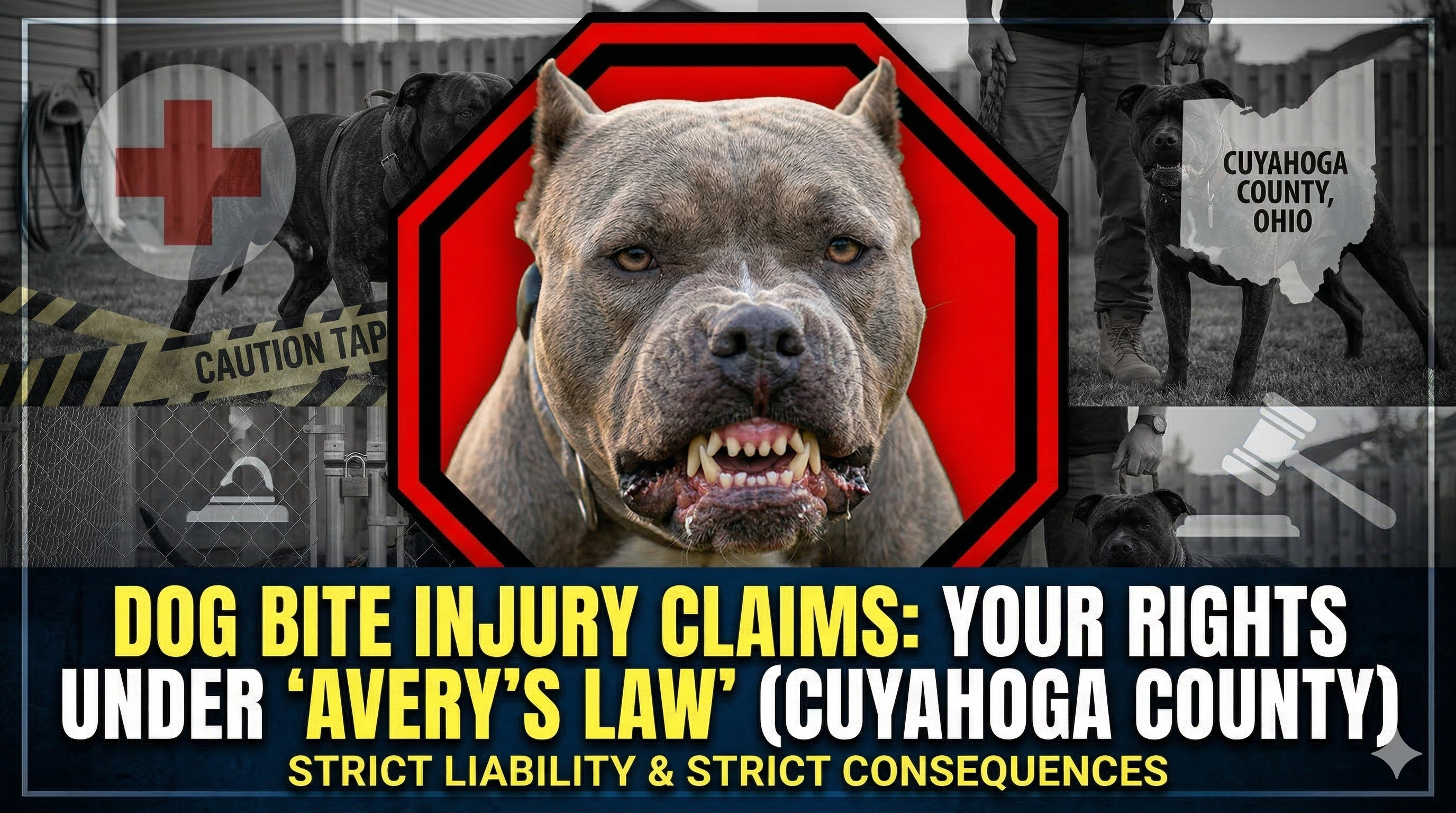
Avery's Law Is Now in Effect: What Ohio's New Dog Attack Law Means for Cuyahoga County Victims
Ohio's most significant overhaul of dangerous dog law in decades takes effect March 18, 2026. Here is what Avery's Law changes, what it does not change, and what it means if you or someone you love is attacked by a dog in Cuyahoga County.
Read article →About This Resource
This site provides educational analysis of Ohio dog bite law under R.C. § 955.28 for residents of Glenwillow and Cuyahoga County. It is not a law firm and does not provide legal advice.
For legal representation, this resource is operated in association with Ryan Injury Attorneys, a personal injury law firm licensed in Ohio.