Dog Bite in University Heights Ohio: Avery's Law Updates for 2026

A serious dog attack can unfold in seconds, but the physical, emotional, and financial consequences can last a lifetime. For residents of University Heights, Ohio, the legal landscape surrounding dog bites is undergoing a massive shift. In December 2025, Governor Mike DeWine signed House Bill 247—commonly known as Avery's Law—which takes effect on March 20, 2026. This sweeping legislation fundamentally changes how dangerous dogs are classified and holds owners, keepers, and harborers to a much higher standard of accountability.
If you or a loved one has been injured by a dog in University Heights, you need to understand how these new state laws interact with existing local ordinances. Ohio has long been a strict liability state under Ohio Revised Code Section 955.28, meaning dog owners are legally responsible for the damages their pets cause, regardless of the dog's prior history. Avery's Law builds upon this foundation by eliminating the "one free bite" myth entirely and imposing severe criminal and financial penalties on owners of dangerous and vicious dogs.
Navigating a dog bite claim requires local legal knowledge. For victims in University Heights, claims valued under $15,000 are filed in the Shaker Heights Municipal Court. However, cases involving severe injuries, reconstructive surgery, or significant lost wages typically exceed this amount and are filed in the Cuyahoga County Court of Common Pleas. Understanding these jurisdictional nuances is critical to securing the compensation you deserve.
What Changes Under Avery's Law?
Avery's Law was named after an 11-year-old girl from Columbus who suffered catastrophic injuries in a 2024 dog attack. The dogs involved had a documented history of aggression, yet the owner faced minimal consequences under the old legal framework. The new legislation was designed to close these loopholes and prevent future tragedies.
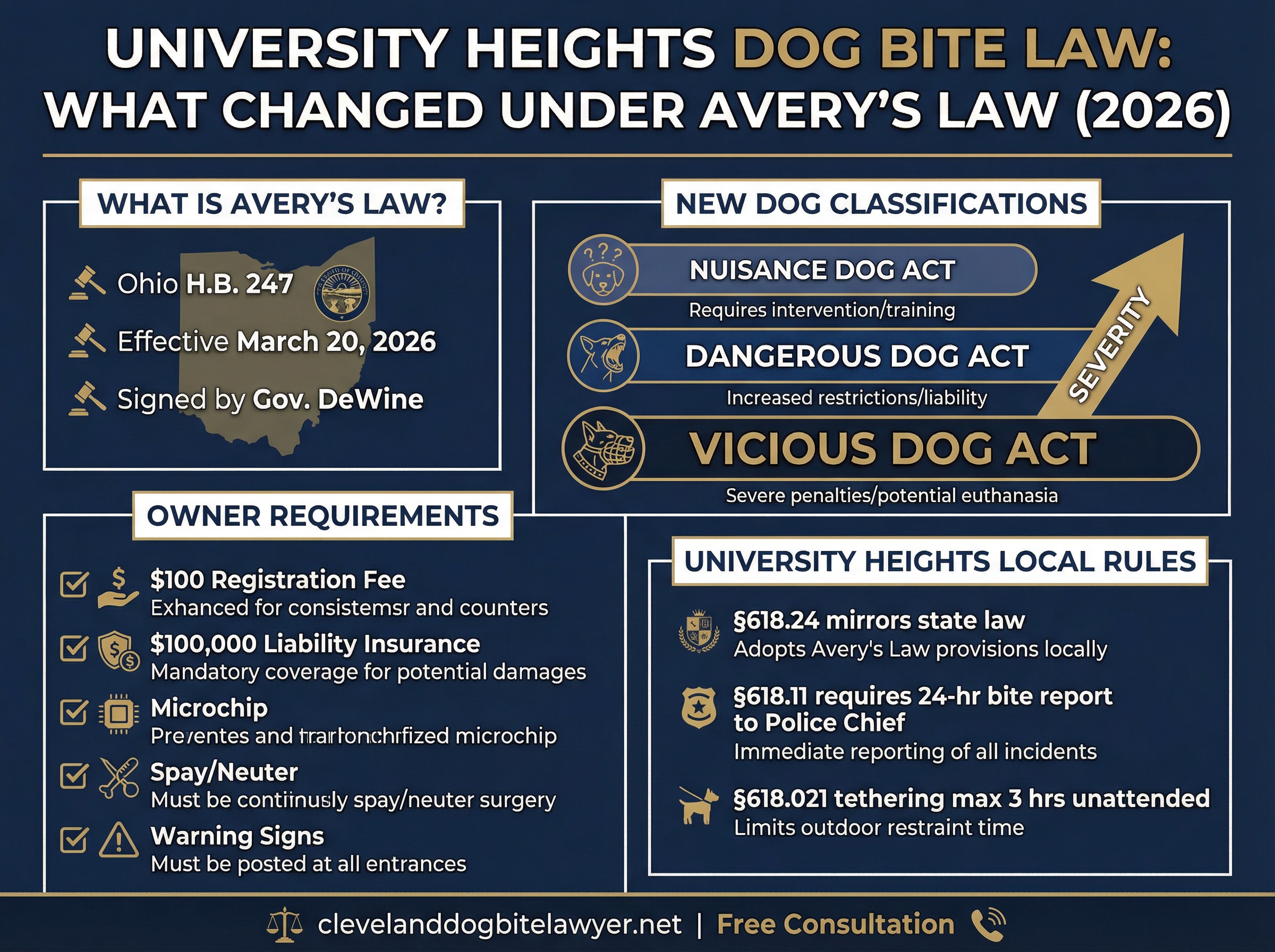
Starting in March 2026, Avery's Law introduces mandatory insurance and registration requirements for dogs classified as dangerous or vicious. Owners must pay a $100 registration fee, microchip their dog, provide proof of spay/neuter surgery, and post visible warning signs on their property. Most importantly for victims, owners of vicious dogs are now legally required to carry at least $100,000 in liability insurance. This ensures that if an attack occurs, there is a guaranteed source of financial recovery for the victim's medical bills and trauma.
New Dog Classifications and Penalties
The new law formally defines three tiers of canine behavior: "nuisance dog acts," "dangerous dog acts," and "vicious dog acts." A dog no longer needs to actually bite someone to trigger legal consequences. For example, a dog that repeatedly chases or menaces people off its property can be classified as a nuisance. A dog that causes injury (even without a bite) or kills another pet can be deemed dangerous.
The "vicious dog" classification is reserved for dogs that kill or cause serious injury to a person without provocation. Penalties for owners of vicious dogs have been drastically increased, escalating to a third-degree felony in the most severe cases, carrying potential prison time and fines up to $10,000. Furthermore, the law grants courts the authority to mandate euthanasia for dogs involved in fatal or catastrophic attacks.
Expanded Liability for Keepers and Harborers
A crucial aspect of Avery's Law is its explicit expansion of liability beyond the legal owner of the dog. The law applies strict requirements to "owners, keepers, and harborers." A keeper is someone who has physical control over the dog at the time of the incident, such as a dog walker or a pet sitter. A harborer is someone who controls the premises where the dog lives, such as a landlord who allows a tenant to keep a known dangerous dog.
This expanded definition is vital for dog bite victims. If the dog's legal owner is uninsured or lacks assets, your attorney can investigate whether a keeper or harborer shares liability. By identifying all responsible parties, you maximize your chances of securing full compensation for your injuries.
University Heights Local Dog Ordinances
In addition to Ohio state law, University Heights has its own municipal ordinances that may strengthen your dog bite claim. In fact, the city recently updated its own codes to mirror the strict requirements of Avery's Law:
- Dangerous and Vicious Dogs (§ 618.24): Passed in October 2024, this ordinance adopts the state's definitions for dangerous and vicious dogs and mandates the $100,000 liability insurance requirement locally.
- Unsafe Dog (§ 618.245): Also passed in late 2024, this unique local rule classifies any dog that kills or seriously injures another dog, cat, or chicken as an "unsafe dog," allowing courts to order obedience training or euthanasia.
- Bite Reporting (§ 618.11): Anyone bitten by an animal must report the incident to the Chief of Police within 24 hours. The animal must be examined by a veterinarian and quarantined for at least 10 days.
- Leash Law (§ 618.01): Dogs must be physically confined on the owner's property or kept on a leash and under reasonable control at all times when off the premises.
- Tethering Restrictions (§ 618.021): Dogs cannot be tethered outside unattended for more than 3 hours, and tethering is strictly prohibited between 11:00 p.m. and 6:00 a.m. or during severe weather warnings.
Violating these local ordinances can establish negligence per se—meaning the dog owner is automatically considered negligent if they broke a local law, which significantly strengthens your claim.
Ohio Revised Code § 955.28
Ohio is a strict liability state for dog bites. This means that the owner, keeper, or harborer of a dog is legally responsible for any injuries the dog causes, regardless of whether the dog had a history of aggression or whether the owner was negligent. The only exceptions are if the victim was trespassing, committing a crime, or actively teasing, tormenting, or abusing the dog.
For the full statute text and legal analysis, see our Ohio dog bite law guide.
Dog Bite Resources in University Heights, Ohio
If you have been bitten by a dog in University Heights, here is the essential local information you need to protect your health and your legal claim:
- Court: Dog bite claims under $15,000 are filed in the Shaker Heights Municipal Court. Claims exceeding $15,000—which includes most serious bite cases involving surgery, scarring, or lost wages—are filed in the Cuyahoga County Court of Common Pleas.
- Filing deadline: Up to 6 years under R.C. § 955.28 for strict liability claims. Negligence claims: 2 years. Minor victims: clock starts at age 18.
- Animal Control / Police: Report the attack immediately to the University Heights Police Department at (216) 932-1800 to ensure an official record is created and quarantine procedures are initiated.
- Cuyahoga County Board of Health: Report all bites within 24 hours at ccbh.net or (216) 201-2001. Request the investigation report—it is key evidence.
- Nearest Emergency Care: Seek immediate medical attention at a facility like Cleveland Clinic - South Pointe Hospital (Warrensville Heights) to clean the wound, assess infection risks, and document your injuries.
Frequently Asked Questions
Does Avery's Law apply to dog bites that happened before March 2026?
No, Avery's Law is not retroactive. If you were bitten before March 20, 2026, your case will be governed by the laws in effect at the time of the attack. However, Ohio's strict liability statute (ORC 955.28) still applies to older cases, meaning you can still pursue compensation without proving the owner knew the dog was dangerous.
What if the dog owner in University Heights doesn't have the required $100,000 insurance?
If an owner of a vicious dog fails to carry the mandatory liability insurance required by both Avery's Law and University Heights Ordinance 618.24, they are committing a crime. Your attorney can pursue compensation through other avenues, such as the owner's personal assets, a landlord's insurance policy (if they harbored the dog), or potentially your own uninsured/underinsured coverage depending on the circumstances.
Do I have to go to court for a dog bite claim?
Not necessarily. Many dog bite claims are resolved through negotiated settlements with the dog owner's homeowners or renters insurance company. However, if the insurance company refuses to offer a fair settlement, it may be necessary to file a lawsuit in the Shaker Heights Municipal Court or the Cuyahoga County Court of Common Pleas to secure the compensation you deserve.
Injured by a Dog in University Heights?
Ohio's strict liability law may entitle you to compensation for medical expenses, lost wages, pain and suffering, and scarring—regardless of the dog's prior history.
Cases filed in University Heights are heard at the Shaker Heights Municipal Court or the Cuyahoga County Court of Common Pleas—our attorneys know these courts and can guide you through every step of the legal process.
Get Your Free Case ReviewThis article is for informational purposes only and does not constitute legal advice. No attorney-client relationship is formed by reading this content. Contact a licensed Ohio attorney for advice about your specific situation.
Related Communities
Injured in a Dog Bite in the Cleveland Area?
Ohio's strict liability law means you don't have to prove the dog was dangerous before. Ryan Injury Attorneys handles dog bite cases throughout Cuyahoga County. No fee unless we recover for you.